
Bhutan in Depth: The Real Bhutan Through the Eyes of Dickson Tung
Bhutan is more than just the label of a 'happy kingdom.' Follow Dickson Tung as he steps into the local scene—from cultural shocks to natural landscapes—to discover a Bhutan that is more real and more deserving of understanding.
After collaborating with DeWonder Travel on 'Journey to the East' and visiting Bhutan in person, Dickson Tung saw a real Bhutan that goes beyond the 'happy kingdom' label. This journey was full of profound cultural shocks and reflections:
- The Contrast of Faith: 'Phallus totems' can be seen all over the streets—these are sacred symbols for warding off evil and praying for children. Moreover, there is gender equality, with farmers' wives holding full control over the family finances.
- Environmentalism at Its Peak: To protect the black-necked cranes, the Phobjikha Valley chose to sacrifice convenience by 'not stringing overhead power cables.'
- A Blend with the Modern: The capital, Thimphu, has no traffic lights and relies on police officers to direct traffic; travellers can even make their own personalised postage stamps; and there's a healthy disco nightlife where 'the whole family drinks tea and dances together.'
- A Spiritual Pilgrimage: Hiking up to the Tiger's Nest Monastery at over 3,000 metres above sea level is a journey of dialogue with oneself.
The value of an in-depth trip to Bhutan lies not in how much you see, but in how deeply you see it.
In the programme he made in collaboration with DeWonder Travel, Dickson Tung points out that if you simply rush through a few attractions, Bhutan can of course be very beautiful; but many of the things that truly change your perspective are not on the surface, but in the culture and logic of life behind it. What changed his perspective most on this journey was not only the scenery, but the following 4 detail-rich, genuine cultural shocks:
The first thing that most overturns your impressions is often not the temples, but the totems on the streets and on the walls of homes.
- Not a taboo, but a blessing: In Bhutan, the phallus totem is linked to the beliefs of the "Divine Madman" Drukpa Kunley, symbolising the warding off of evil, the averting of misfortune, and prayers for children. Tung Fong Sing even personally picked out a wooden phallus souvenir at the market—something that, for the locals, is a perfectly natural part of their everyday faith.
- Everyday details of gender equality: Beyond the symbols of faith, when Tung Fong Sing sampled a Bhutanese farmhouse meal, he was surprised to discover that it was the man of the house doing the cooking. When he curiously asked the farmer's wife, "Does your husband hand all the money over for you to manage?", she laughed and answered again and again: "Yes, yes really!" This kind of gender equality and financial division of labour—surpassing that of many modern nations—was truly eye-opening.
Want to learn more about Bhutan's unique beliefs and customs? 👉 Further reading:Bhutan vs Tibet: How Does Tibetan Buddhism Shape Daily Life? A Cultural Comparison and Travel Guide 👉 Further reading:Cultural Highlights of Bhutan

The phallus totems so commonly seen on Bhutan's streets are not exotic curiosities, but symbols of faith rooted in the beliefs of the "Divine Madman" Drukpa Kunley, representing the warding off of evil, the seeking of blessings, and protection. They may come as a shock to first-time visitors, but once understood, they reveal the true face of Bhutanese culture all the more clearly.
What leaves a lasting impression about Bhutan is not only its culture, but also the way it prioritises the value of nature.
- The Phobjikha Valley is an important wintering habitat for the rare Black-necked Crane.
- To prevent the birds from injuring themselves by colliding with power cables in flight, the Bhutanese government and local residents reached a consensus to erect no overhead power cables at all in this area, opting instead for underground lines or alternative solutions.
This willingness to sacrifice the convenience of development for the sake of wildlife is a truly striking lesson in conservation for those of us accustomed to highly developed cities. When “more convenient” and “more nature-friendly” cannot both hold true, Bhutan chose the latter. 👉 Further reading:Black-necked Crane Viewing Guide 👉 Further reading:Bhutan Festivals - Black-necked Crane Festival and Tshechu

Around Gangtey and the Phobjikha Valley, you won’t see the usual overhead power cables. This not only keeps the scenery purer, but also reflects the lifestyle choices Bhutan has made to protect the habitat of the Black-necked Crane. Behind this seemingly tranquil wilderness lies a value system that places nature before convenience.
Bhutan's capital, Thimphu, presents a wonderful sight where the modern and the traditional blend in perfect harmony:
- Traffic directed by hand: Thimphu is one of the few capitals in the world without traffic lights. The government actually did install traffic lights once, but the locals felt the cold, impersonal machines lost their human touch, so in the end they restored the tradition of white-gloved police officers standing at intersections directing traffic with graceful gestures.
- Making your own personalised stamps: At Bhutan's General Post Office, Dongfang Sheng experienced a truly special service—simply provide a photo of your face, and it can be printed on the spot into official stamps that can actually be used to send mail within Bhutan and abroad, with tremendous keepsake value.
- A "wholesome" disco nightlife: Bhutan has nightclubs too! Dongfang Sheng went to a local disco in the evening, expecting to see scenes of debauchery, but to his surprise, not only was it perfectly safe inside, there were even whole families in there drinking tea, singing and dancing. Entertainment exists, but it doesn't equate to indulgence.
- The wisdom to put down the phone: The local young people speak excellent English and all carry smartphones to scroll through Instagram and YouTube. But Dongfang Sheng observed that when they faced beautiful mountain scenery, they would naturally and voluntarily "put down their phones" to appreciate nature, choosing not to be completely enslaved by technology.
If there is one most iconic image from the entire journey, it must be Tiger's Nest. This landmark is special because:
- It is built upon a sheer cliff, requiring a hike up to an altitude of over three thousand metres, as challenging as climbing Hong Kong's Lion Rock.
- This is not a "get off the bus, take a photo, leave" kind of attraction. Although you can choose to ride a horse up the mountain for the first half of the journey to save energy, you'll still have to complete the final stretch on foot by yourself.
What makes Tiger's Nest Monastery truly awe-inspiring is the way you arrive there—out of breath, step by step, at your own pace. That sense of calm and accomplishment upon reaching the top made Dongfang Sheng declare it absolutely worth it. Worried you won't have the stamina to make it? 👉 Further reading:Is Bhutan's Tiger's Nest Monastery hard to climb? A complete guide to fitness requirements, hiking difficulty, and things to note

Members of the Bhutan tour run in partnership between Dongfang Sheng and DeWonder Travel completed the Tiger's Nest hike together. For many travellers, the Tiger's Nest is not just a must-visit landmark, but a journey you have to walk into yourself to truly feel the spiritual landscape of Bhutan.
The reason this Bhutan journey revealed so many deeper stories lies not only in "where you go," but even more in "how you are guided to see it." True in-depth travel is not about squeezing offbeat spots into the itinerary, but about giving travellers the chance to move beyond the surface and into the context. Dongfang Sheng chose to work with DeWonder based on three core values of in-depth travel:
- The point is not knowing the information, but understanding the cultural context: Dongfang Sheng admits that it's easy nowadays to search online or ask AI, but such answers often lack warmth.As a cultural researcher, the founder of DeWonder doesn't just tell you "what this attraction is"—he can also answer questions like "how religion and faith shape daily life" and "the order of values behind lifestyle choices."
- Communication in a familiar language, so your in-depth experience never stays on the surface: Most Bhutan tours are guided in English or Mandarin. But as a Hong Kong travel agency, DeWonder can offer the most direct, barrier-free cultural insights and exchanges in Cantonese, allowing travellers to turn what they feel on the spot into a deeper cultural understanding at any time.
- Using the rhythm of the itinerary to open a dialogue between tradition and modernity: Dong Fong Sing shares that DeWonder's itinerary isn't simply about stringing popular spots together—it deliberately begins by entering the more remote, traditional Phobjikha Valley, before finally returning to the more modern Thimphu. First you feel the slowness and stillness, then you come to understand change and its impact. This rhythmic sense of contrast lets a country's character between the modern and the traditional gradually unfold.

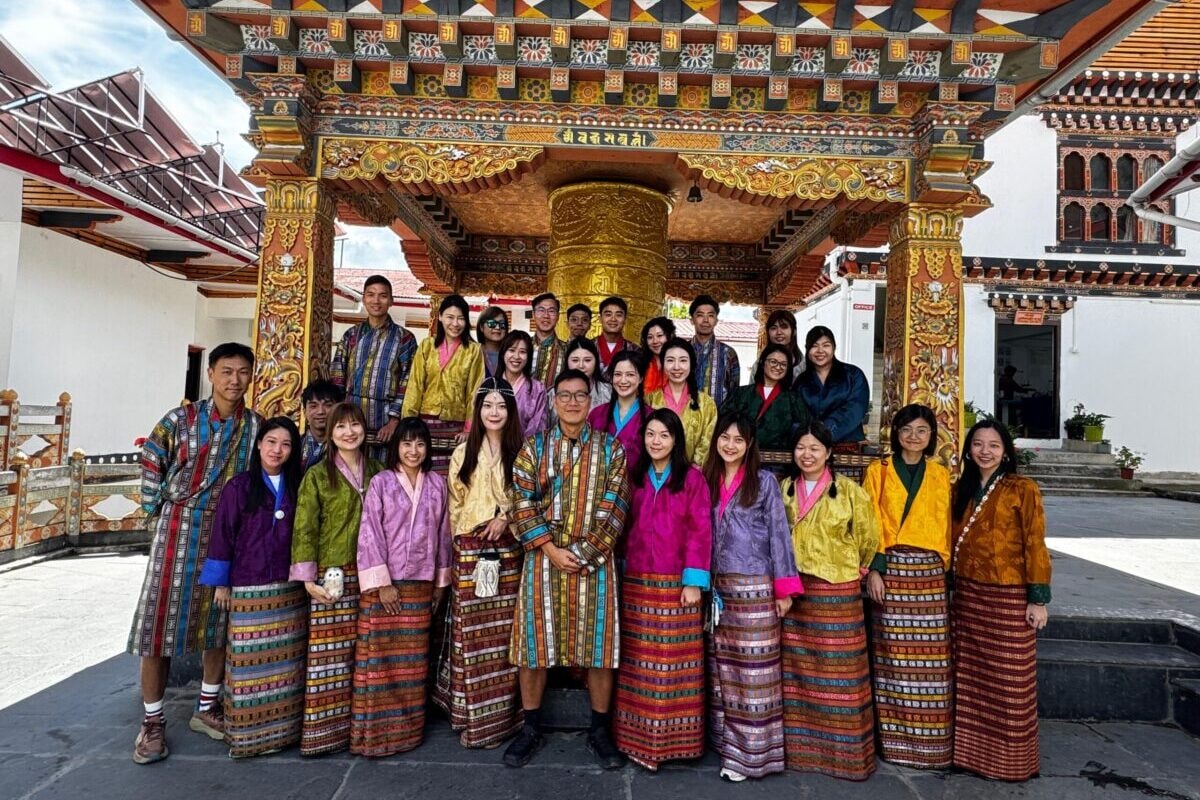
Dong Fong Sing and members of the DeWonder Travel Bhutan tour step into local temple grounds for a close encounter with the local culture. Such an experience is not just about visiting attractions, but about actually walking in and interacting, bringing the journey closer to Bhutan's daily life and faith.

Members change into traditional Bhutanese dress, immersing themselves in the local way of life. For DeWonder Travel, a journey is not just about watching, but about giving travellers the chance to take part in person and understand Bhutan's cultural context through experience.
What truly makes Bhutan unforgettable has never been merely that it is quiet and beautiful. It's that its lifestyle choices, so different from the mainstream world, make you rethink what really matters. If, like Dong Fong Sing, you want to do more than just "have been to Bhutan"—if you hope to truly understand this place's culture and values—we invite you to learn more about how DeWonder Travel plans a Bhutan journey that's truly worth remembering.
Catering to different travel rhythms and holiday lengths, DeWonder now offers:
- 6-Day In-Depth Bhutan Itinerary: Ideal for first-time visitors with limited time
- 8-Day In-Depth Bhutan Itinerary: A more relaxed pace, covering more cultural and lifestyle experiences
👉 Further Reading : Bhutan Itinerary Recommendations : The Best Routes for a 6–8 Day Trip You can also enquire about a Private Tour,and our team will help plan it according to your actual needs. Many travellers choose DeWonder In-Depth Bhutan Tour for reasons that may also match your preferred way of travelling:
- 10 Years of Local Experience in Bhutan: From guides to farmhouse stays, we have worked with local partners for years to make every experience more authentic.
- Hong Kong Direct-Flight Partners: In selected months we arrange charter departures flying direct to Paro, Bhutan, for smoother, more time-saving trips.
- Small-Group Departures, Flexible Private Tours: Averaging 8–14 people, with private tours arranged at your own pace.
- Cultural experiences that go beyond the surface: farmhouse dinners, mandala (sand painting) experiences, festival observances…… all elements that give the journey a warmer, more human touch.
- A track record of international-level collaborations: we once helped Ed Sheeran hold a solo concert in Bhutan — the country's first-ever event featuring an international superstar.
- TVB partner: assisted in planning the itinerary for the Bhutan episode of the TVB programme "Travelling with Ah Jeh"
If you'd also like to step into Bhutan in a more comfortable, more authentic way, feel free to check out our latest tour dates or chat with us about your travel plans. 👉 Viewthe Bhutan year-round tour schedule 👉 Sign up for free for our Bhutan online seminar, where we'll answer more of your questions about travelling in Bhutan: Click here to register 👉 For more about travelling in Bhutan, we recommend reading this piece: The Complete Guide to Travelling in Bhutan