
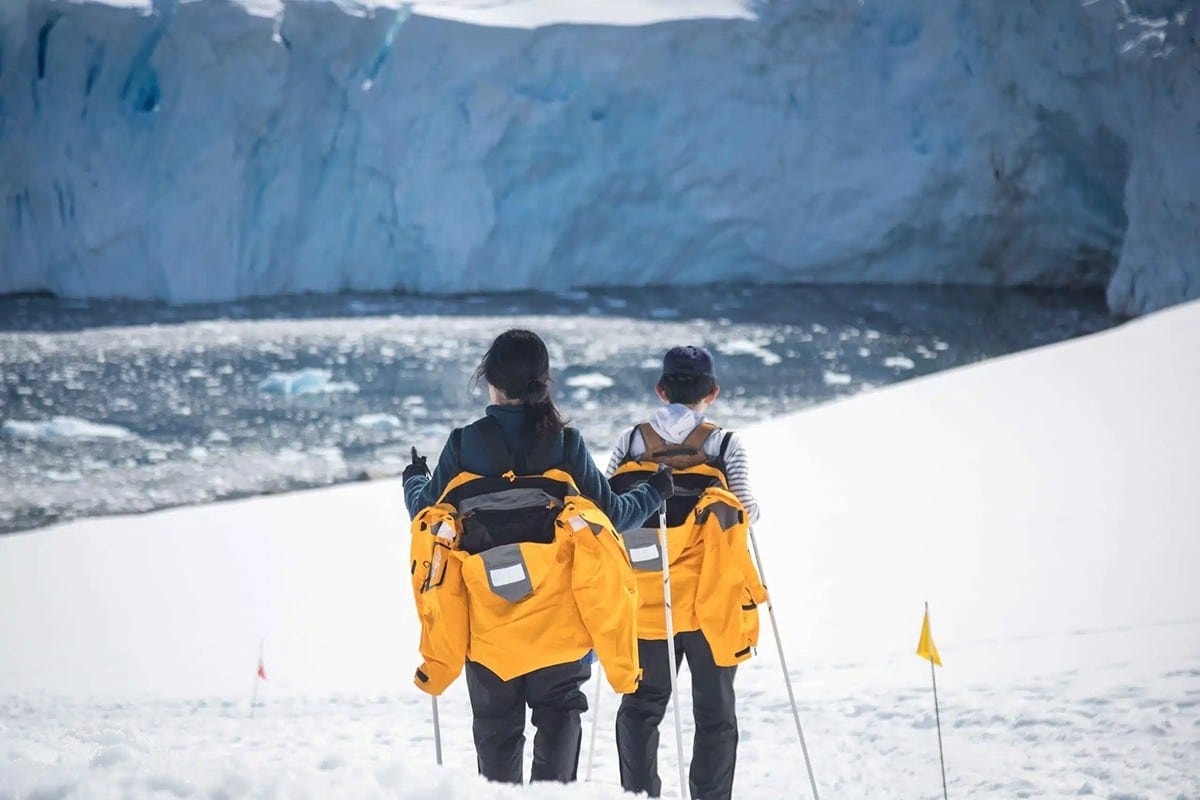
Complete Polar Dressing Guide: The Three-Layer System for Antarctica & the Arctic, with Field-Tested Gear Tips
A full breakdown of what to wear on a trip to Antarctica or the Arctic — from the three-layer dressing principle and waterproof gear to landing excursions and aurora-chasing scenarios — helping you prepare suitable and safe polar clothing.
- The Three-Layer System (Layering System): A moisture-wicking base layer, an insulating mid layer, and a windproof, waterproof outer layer — cotton clothing is strictly forbidden.
- Best base layer choice: 100% merino wool (recommended weight 200g-260g), which wicks moisture and retains warmth even when wet.
- Waterproof outer layer: Must feature Gore-Tex or equivalent technology, with a recommended waterproof rating of 10,000mm or above.
- Essential items: Waterproof trousers are the most important item for Antarctic landings; professional cold-resistant snow boots are essential for chasing the aurora in the Arctic
When planning a polar trip, most travelers worry most about the “sub-zero temperatures.” But in fact, the core principle of polar dressing isn't about piling on thickness — it's about “being windproof, waterproof, and able to adjust flexibly according to activity intensity.”
In the polar regions, wearing too much is just as dangerous as wearing too little. If you sweat heavily from being overdressed during activity, the moisture will cause your body temperature to drop rapidly the moment you stop moving — this is the biggest difference between polar dressing and ordinary winter travel attire. The real key lies in building a flexible “three-layer system.”
Whether you're heading to Antarctica or the Arctic, the layering logic is almost identical — the only difference lies in fine-tuning the number of layers for the specific environment.
The base layer's main job is to keep your skin dry. Once this layer becomes damp and cold, no outer jacket, however thick, can prevent heat loss.
- Recommended Material: Merino wool or synthetic performance underwear.
- ❌ Absolutely Avoid: Heat-tech thermal wear (e.g. Heattech) and cotton clothing. Heat-tech fabrics lack sufficient moisture-wicking ability, so trapped sweat causes rapid heat loss; cotton, once damp, dries slowly — making it one of the most dangerous choices in polar dressing.
The mid layer traps the heat your body generates, and should be adjusted flexibly based on your cold tolerance and activity intensity.
- Common Choices:
- Fleece jacket: Ideal for landing excursions involving more activity
- Lightweight down: Ideal for stationary activities or travellers who feel the cold easily
In polar environments, wind and moisture are more dangerous than the cold itself. The outer layer's purpose isn't warmth, but blocking out the elements.
- Technical Spec: We recommend choosing Gore-Tex grade to ensure protection against sea spray while cruising in the Zodiac.
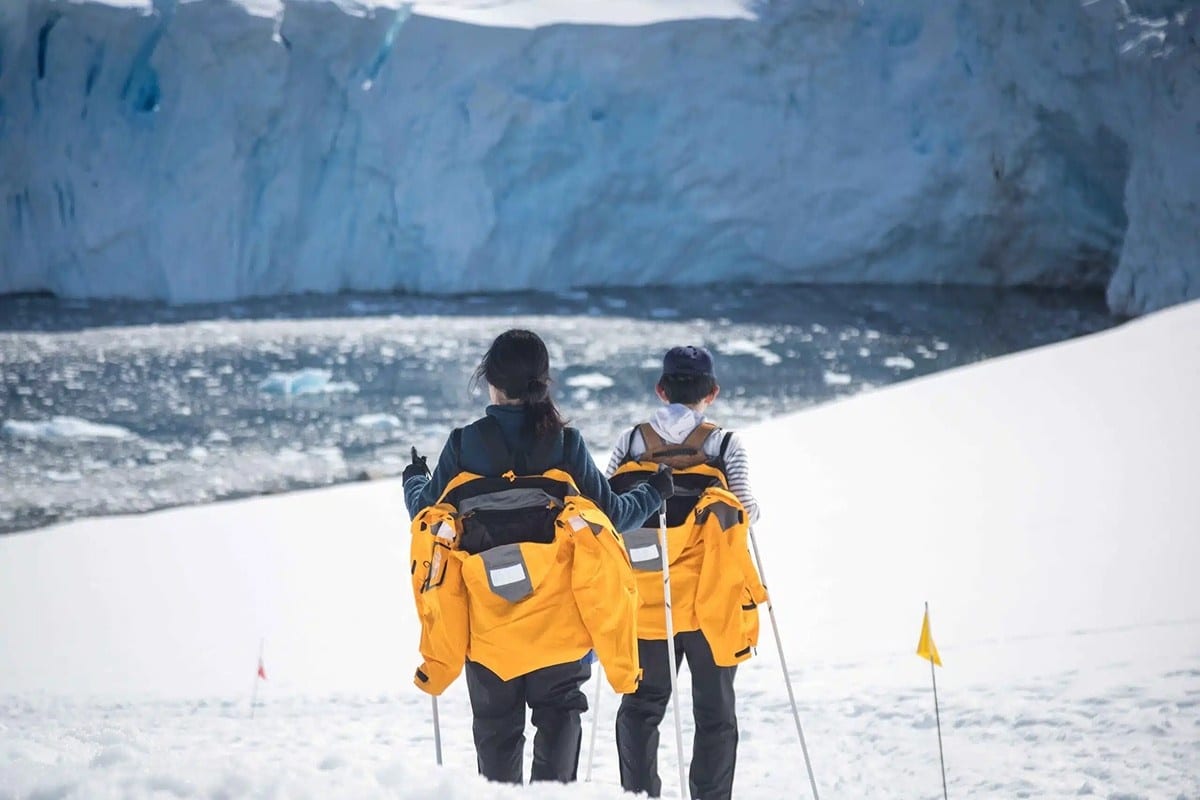
Layered "onion-style" dressing is a key principle for polar attire—master this and you can confidently handle polar climates
The answer is: your outer layers (especially trousers) must be "fully waterproof"—"water-repellent" alone is not sufficient.
- Why does it need to be fully waterproof? Landing in Antarctica requires riding a Zodiac, during which sea spray can easily soak your thighs. If your trousers are only water-repellent, moisture will seep into the fabric, leading to freezing and hypothermia.
- How to check the waterproof rating? We recommend a waterproof rating of 10,000mm or above, and be sure to check that the seams have Seam Sealed tape.
- What do the cruise operators provide? Most expedition ships provide windproof and waterproof jackets (parkas) and landing boots, but usually do not provide waterproof trousers, so travellers are strongly advised to bring their own.
One of the most common questions travellers face when preparing their gear is:Do I really need to buy expensive professional outdoor brands? The answer depends on the type of itinerary and individual physical condition.
- Positioning: High value for money, suitable for indoor spaces on board or brief, low-activity outdoor wear.
- Points to note: Heat-tech thermal wear has limited moisture-wicking speed, so it is not recommended as a base layer for high-activity situations (such as landings); ordinary down jackets generally lack windproof and waterproof functions, making them unsuitable as an outer layer.
- Positioning: An entry-level choice, balancing function and price.
- Buying Tips: Make sure the ski pants have waterproof taped seams; the cuffs should ideally feature a Gaiter design to prevent snowmelt from seeping in.
- Positioning: Offers ultimate warmth and weather resistance, ideal for Arctic land-based aurora hunting or travellers who feel the cold intensely.
- Recommendation: For Antarctic cruise itineraries, this can be assessed based on your budget—it's not absolutely necessary.
In polar environments, "activity intensity" determines how many layers you need. Antarctic landings require frequent movement and water resistance, while Arctic land-based aurora hunting tests your ability to withstand the cold while standing still for long periods.Below is a comparison of key gear considerations for different scenarios:
Comparison Item | Antarctic/Arctic Summer "Landing" (Zodiac Landing) | Arctic Land-Based Aurora Hunting (Finland/Norway/Canada) | Arctic Cruise Aurora Hunting |
Environmental Challenges | High activity level, prone to sweating, prone to getting splashed by waves/snowmelt | Standing still outdoors for extended periods (2–4 hours) | Stronger sea winds, but you can return to the cabin to warm up anytime |
Upper Body Essentials | Moisture-wicking base layer + warm mid layer;The ship usually provides windproof jackets | Heavy-duty snow jacket or a one-piece snowsuit | Prioritise mobility while keeping your head and neck well insulated |
Lower Body Essentials | Fully waterproof, windproof trousers are a must (jeans are strictly forbidden) | Heavyweight thermal trousers + professional snow pants | Ordinary thermal trousers will do |
Footwear Needs | Thick-soled wool socks (the ship usually provides professional landing boots) | Professional cold-resistant snow boots (hand warmers recommended) | Thick wool socks + ordinary warm footwear |
Photography Tips | Bright, high-saturation colours such as red, vivid yellow and royal blue photograph best | Adjust for the ambient light and focus on staying warm to prevent frostbitten fingers | Prioritise ease of putting on and taking off, as you'll be moving in and out of the cabin frequently |

On Arctic and Antarctic cruises, the cruise line usually provides a warm parka for landings, Zodiac rides and time on deck, so travellers don't need to bring their own outermost jacket

Chasing the aurora on land means spending extended periods outdoors, so compared with chasing it from a cruise, you'll need even warmer clothing, shoes and socks to fend off the cold
Beyond the core three-layer system, your choice of accessories directly determines your comfort and safety during polar activities.
- Inner layer: Choose thin touchscreen-compatible gloves for easy operation of cameras or phones, preventing direct skin contact with cold air.
- Outer layer: Thick gloves with complete waterproofing are essential to prevent snowmelt from seeping in.
- Beanie: Must cover the ears, as polar winds can easily cause ear frostbite.
- Buff: Safer and warmer than a long scarf, effectively blocking cold wind from entering the collar.
- Choose thick-soled merino wool socks.
- ❌ Wrong way to wear: Wearing two pairs of overly tight socks. This compresses foot space and impairs blood circulation, which actually makes your toes cold faster.
- Protection Focus: UV reflection off polar snow is extremely intense (up to over 80%), so UV-protective sunglasses are essential to prevent snow blindness.
The indoor temperature of the expedition cruise ship is maintained at a comfortable constant of about 20–22°C, so there's no need for heavy clothing.
- Indoor Attire: Regular long sleeves, shirts, thin sweaters, or casual wear will do.
- Dress Code: Expedition cruises are mostly Smart Casual, so there's no need to bring formal evening wear.
- Footwear Tips: Please change into clean casual shoes, sneakers, or non-slip slippers indoors. Note: To maintain cleanliness onboard, please do not wear landing boots into indoor public areas.
A: Not recommended for landings or outdoor activities. Jeans are extremely difficult to dry once wet, and become stiff and frozen in low temperatures, greatly increasing the risk of hypothermia.
A: A regular down jacket can serve as a "mid-layer" for warmth. However, the outermost layer still needs a jacket with professional windproof and waterproof functionality to handle sea spray and snow.
A: Not entirely the same. Land itineraries require long periods outdoors, so gear needs to be extremely heavy-duty (such as -30°C rated snow boots); cruise itineraries allow you to return to the cabin to warm up anytime, offering greater flexibility in clothing choices.
There is no single standard answer for polar clothing—the key lies in:
- Itinerary type (land or cruise)
- Activity intensity (active or stationary)
- Personal sensitivity to cold
As long as you master the three-layer dressing principle and adjust your gear according to the situation, most travelers can complete their polar journey comfortably and safely. 💡 Worried that your gear preparation isn't complete?You can use the following complete checklist to confirm one by one:
DeWonder has teamed up with Quark Expeditions to create professionalAntarctica In-depth ToursandArctic In-depth Tours. With over 30 years of polar travel experience, our small-group arrangements let you observe wildlife up close through cruise ships and Zodiac excursions, while expert guides help you gain deep insight into polar ecology and admire the region's unique natural landscapes. If you have other questions about polar travel, feel free to read our Arctic and Antarctic travel guides, or sign up for a free online seminar and let our experts answer them for you 🐧Antarctica Travel Extended Information
- More practical information can be found in theAntarctica Travel Guide
- Sign up now for thefree online seminar, andenjoy an exclusive discount on tour fees
- Check out thefull-year Antarctica departure schedule
🐻❄️ Arctic Travel Extended Information
- Learn about different Arctic routes and attractions in theArctic Travel Guide
- Join the free online seminar, and enjoy an exclusivediscount
- Check out thefull-year Arctic departure schedule