
Polar Wildlife Guide: What Animals Can You See at the North and South Poles, and When Is the Best Time to Go?
A breakdown of the animals found in Antarctica and the Arctic, their ecological differences, and the best seasons to observe them—from penguins to polar bears, this guide gives you a quick grasp of what matters most for polar travel.
Antarctica and the Arctic sit at opposite ends of the Earth, yet they have given rise to completely different animal ecosystems.When it comes to polar travel, some of the most common questions people ask include: What animals can you see? Where do penguins and polar bears each appear? And how does their behaviour differ depending on the month you visit? From the perspective of real travel and nature observation, this article sums up the representative animal species and ecological traits of Antarctica and the Arctic, along with the best season to observe each, helping you clearly understand the differences—and set the right expectations—between the two poles before you set off.
Aspect | Antarctic | Arctic |
Geographic Nature | An isolated continent surrounded by ocean | An ocean surrounded by land |
Core Animal Ecology | Predominantly marine ecosystems | Land and sea ecosystems coexist |
Location of Top Predators | In the sea (e.g. orcas) | On land (polar bears) |
Wariness of Humans | Generally lower | Generally higher |
Main Settings for Wildlife Viewing | Coastlines, ice floes, near-shore waters | Land, sea ice, coastal areas |
Most Commonly Seen Animal Groups on Trips | Penguins, seals, whales | Polar bears, walruses, reindeer |
Although Antarctica and the Arctic are both bitterly cold, the wildlife found in each region stems from entirely different geographic structures. This difference determines which animals are able to reach, settle in, and evolve into stable populations over the long term.
- The Arctic is an ocean surrounded by land: Connected to the Eurasian and North American continents, it allows land animals to enter and establish complete ecosystems, so both marine and terrestrial species coexist there.
- Antarctica is an isolated continent surrounded by ocean: Long-term isolation has prevented large land animals from entering, so its animal composition is highly concentrated in the sea.
- The predator structure is completely different: The Arctic has land predators such as polar bears, while Antarctica has no large land predators at all.
- As a result, what travellers actually see differs too: In the Arctic, animal activity spans land, coastlines, and drift ice; in Antarctica, life unfolds almost entirely around sea ice and coastlines.
Antarctica's animal composition has one very clear characteristic: life activity revolves almost entirely around the ocean. Because the Antarctic continent has long been isolated by the sea, no land animals have been able to successfully enter and establish stable populations. The species that can survive here must, for the most part, adapt to both freezing seawater and drift-ice environments. For travellers, this also means 👉 most wildlife observation in Antarctica takes place along coastlines, drift ice, and nearshore waters.
When people think of Antarctica, the most iconic animal is the penguin. Although penguins are birds, they have fully adapted to life at sea, only staying on land or ice for extended periods during breeding, incubation, and moulting. In the Antarctic Peninsula region, the most commonly seen species during tours include:
- Adélie Penguin:Breeds close to sea ice and is highly active
- Gentoo Penguin:Fast swimmer, often seen in ice-free waters
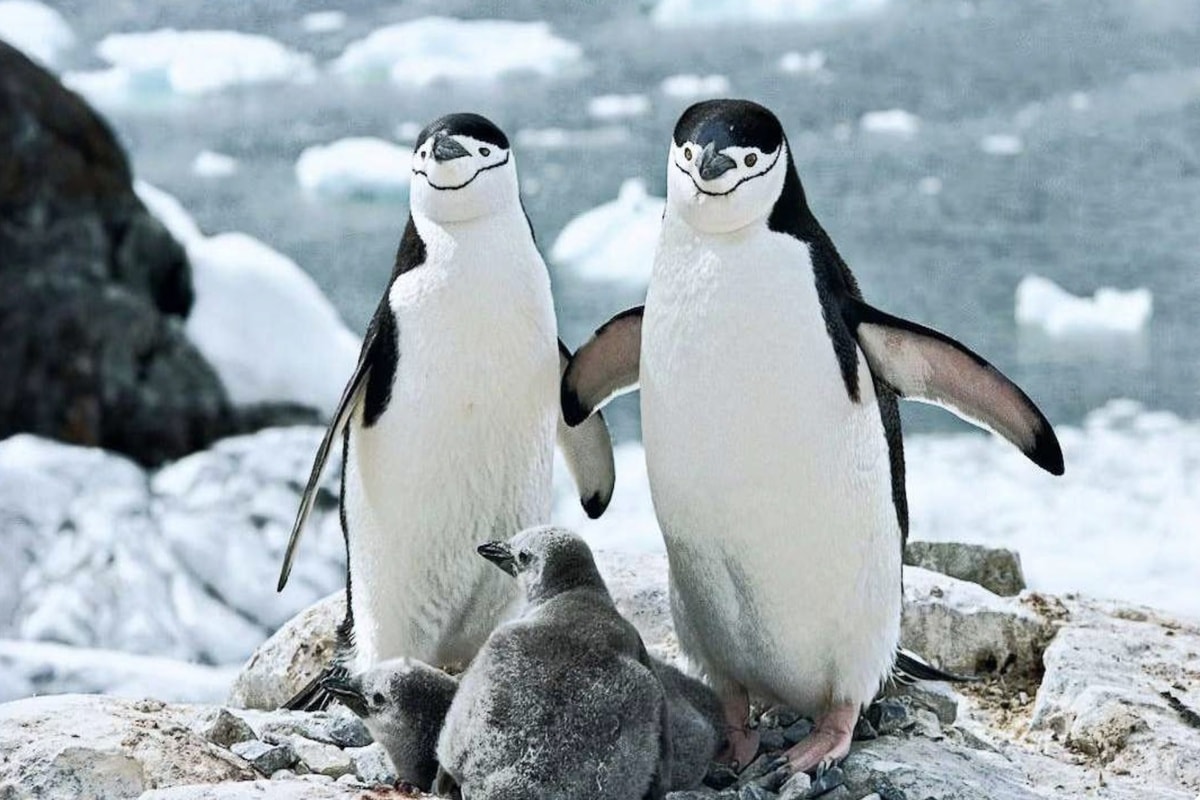
- Chinstrap Penguin:Distinctive black line across the face, gathers in large colonies
The key to penguins' successful breeding in Antarctica lies not in the land, but in a stable and highly nutritious source of marine food. 👉 Further Reading:Types of Antarctic Penguins and the Best Viewing Season
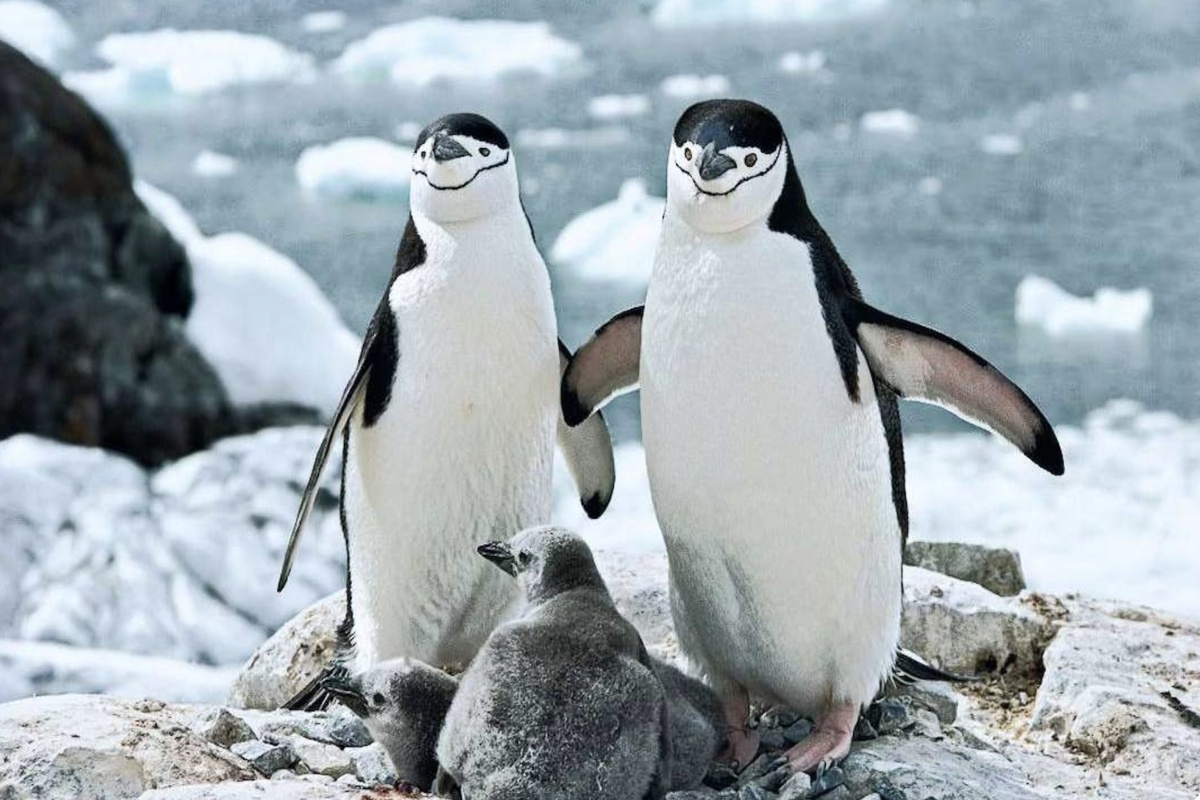
A pair of penguins stand beside their nesting site, with a chick still covered in grey down in the centre, capturing the scene of chick-rearing during the Antarctic summer.
Besides penguins, the animals most easily observed up close in Antarctica are often various species of seals. They forage in the sea but spend long periods resting on the ice, allowing travellers to clearly observe their appearance and behaviour. Common species include:
- Weddell Seal:Often rests on the ice for extended periods
- Leopard Seal:Antarctica's top predator, known for ambushing penguins
Since there are no land predators in Antarctica, seals tend to be relatively unafraid of humans — one reason many travellers find Antarctic wildlife feels "unusually close."
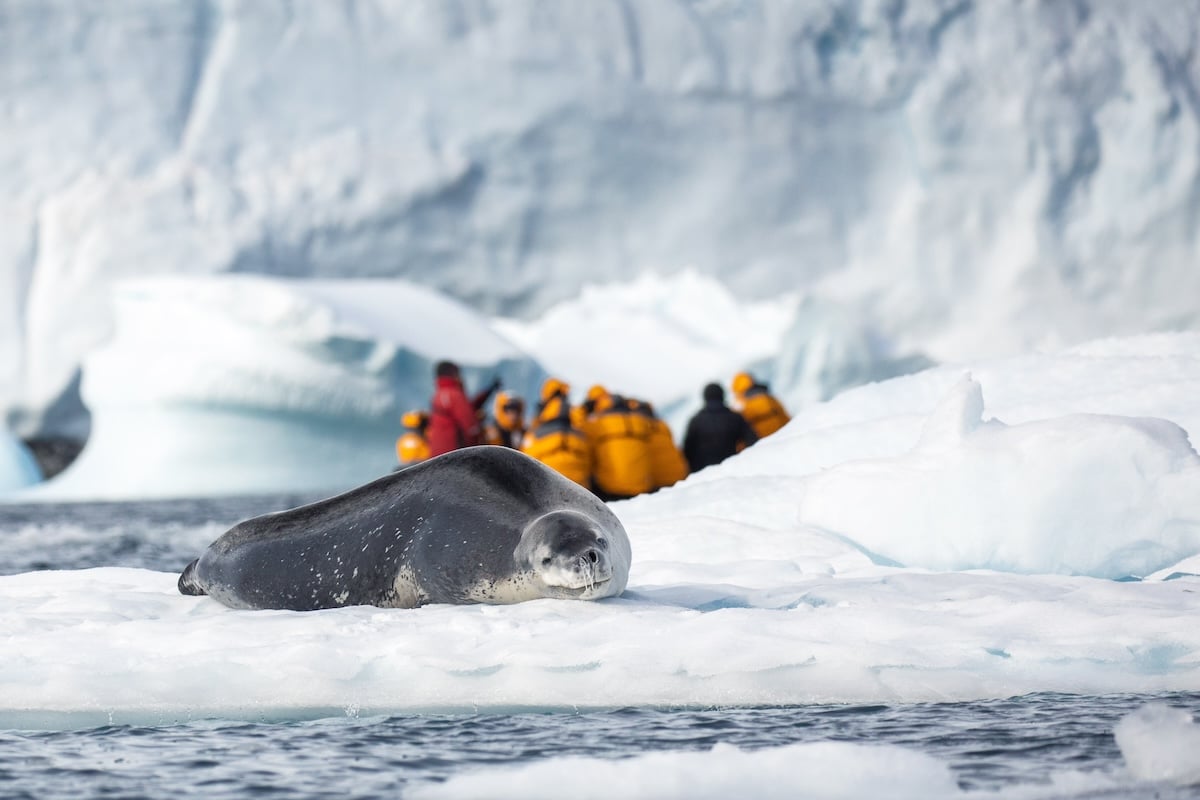
During Antarctic voyages, seals often rest on ice floes, and travellers usually observe them from a distance aboard expedition ships or Zodiac boats.
Antarctica is also one of the world's most important whale feeding grounds. Every Southern Hemisphere summer, vast swarms of krill gather, drawing whales back from lower-latitude waters. The most iconic species include:
- Orca:At the top of the food chain, known for their highly social behaviour
- Blue Whale:The largest animal on Earth
For many travellers, spotting whales during the voyage becomes one of the most unforgettable moments of the entire Antarctic experience.
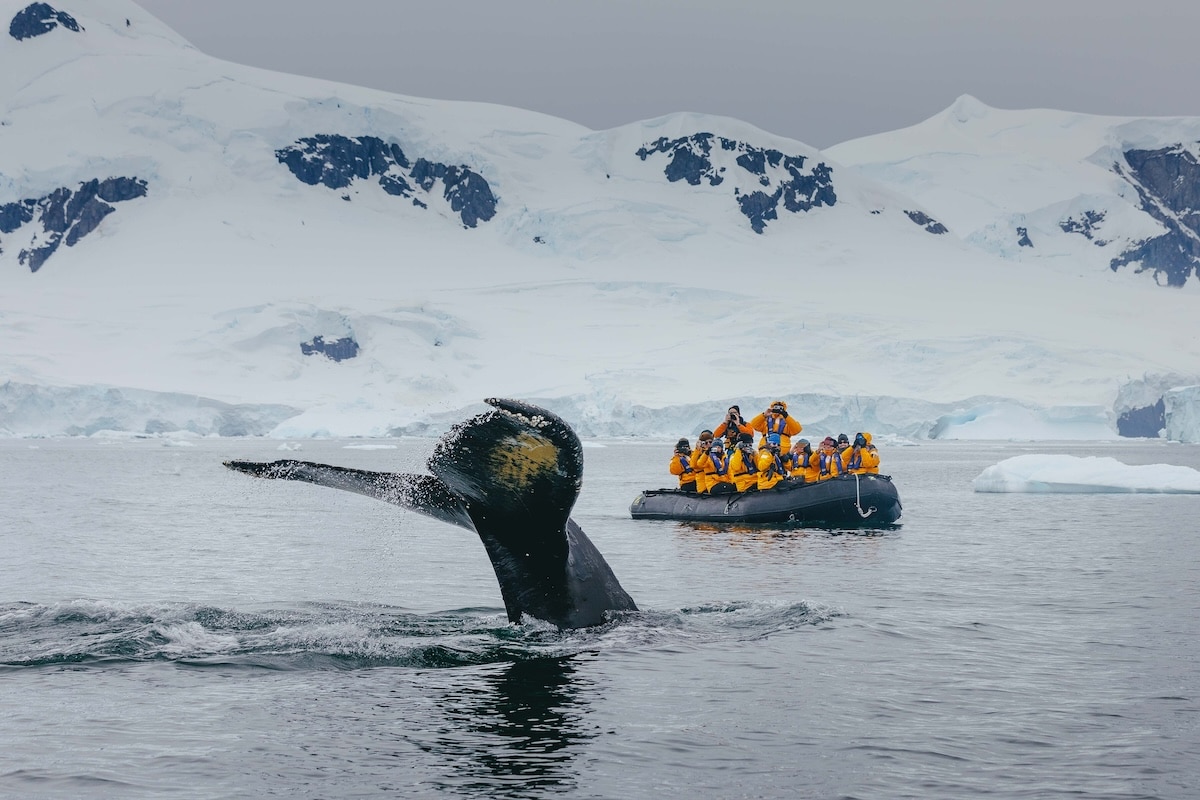
During Antarctic voyages, travellers often observe whale activity up close aboard Zodiac boats — though whether they appear depends entirely on sea conditions and a bit of luck at the time.
Wildlife watching in Antarctica is mostly conducted from expedition cruise ships as a base, taking place during sailing and brief landings.
- Long-distance viewing from the expedition ship: Whales surfacing or seals resting on ice floes can often be seen during the voyage.
- Close-up observation via Zodiac boats:Approaching the coastline and ice floes by Zodiac is the most common way to observe penguins and seals up close.
- Landing to observe penguins:At certain designated sites, you can go ashore on foot to closely observe penguins' nesting and chick-rearing behaviour.
Unlike Antarctica, the Arctic is a region where both land and marine ecosystems exist simultaneously. Because it is connected to the Eurasian and North American continents, many large land animals have been able to migrate in and settle long-term, making the Arctic the polar region with the most diverse animal composition. For travellers, this also means that when visiting the Arctic, the types of animals and scenes observed will be more scattered than in Antarctica.
The polar bear is the Arctic's most iconic animal and the world's largest land predator. They mainly move along the edges of sea ice, relying on hunting seals for survival, so whether or not you can see polar bears is often closely tied to that year's ice conditions and season. Because polar bears are dangerous, they can usually only be observed from a safe distance, without close on-foot approaches. 👉 Further Reading:Polar Bear Viewing Guide | The Best Place to See Polar Bears: Svalbard

A polar bear walking on sea ice, the most iconic apex land predator in the Arctic ecosystem.
Along the Arctic coastline and on ice floes, herds of walruses and various types of seals can often be seen.
- Walrus:Unique to the Arctic, massive in size, often gathering in groups on ice floes or along the coast
- Various seal species:Active along the ice edge and near-shore waters, serving as an important prey source for polar bears
These animals mostly move about on sea ice or along the shore, making them the most commonly observed wildlife during Arctic voyages.

In the Arctic, walruses often gather in large groups along coastlines or gravel beaches, and travellers typically observe them from a distance—either from the ship or designated viewing points.
In certain Arctic regions (such as areas beyond Svalbard), travellers may also have the chance to spot:
- Reindeer
- Arctic Fox
These animals are mostly active on the tundra, making the Arctic one of the few polar regions where both land mammals and marine mammals can be observed together.

Arctic foxes change their coat colour with the seasons, turning greyish-brown in summer to help them blend into the tundra landscape.
Wildlife viewing in the Arctic typically combines expedition cruise voyages with distant, safety-first observation principles.
- Viewing from expedition cruise ships: While sailing through fjords and pack ice, whales, walruses, or seals can often be spotted.
- Close-shore viewing by Zodiac boat: Travellers can approach walrus colonies or animals on ice floes from a safe distance, though itineraries are highly dependent on ice conditions and weather.
- Distant polar bear observation: Polar bears are typically observed only from the ship or fixed safe points using binoculars or telephoto lenses—close approaches on foot are never arranged.
Overall, wildlife viewing experiences in the Arctic place greater emphasis on distance and risk control compared to Antarctica, which is one of the key differences between the two polar travel experiences.
Travel seasons for Antarctica and the Arctic are not open year-round, but instead heavily concentrated within their respective summer months. This is not only because the climate is more stable, but also closely tied to the animals' feeding, breeding, and activity cycles. Simply put 👉 the time when animals are most abundant and active is precisely during the polar regions' brief summer.
Antarctic tourism is concentrated in the Southern Hemisphere's summer, and animal activity changes noticeably from month to month:
Month | Typical Animal Activity | Viewing Highlights |
November | Penguins nest-building and courting | Pristine, unbroken snowscapes |
December | Eggs hatching, chicks born | Early stage of the life cycle |
January | Peak chick growth | Highest concentration of penguin chicks |
February–March | Moulting, whales highly active | Best chance for whale watching |
Visiting in different months means the "same species" can display completely different behaviours—this is one of the most fascinating aspects of travelling to Antarctica. 👉 Further Reading:Best Time to Visit Antarctica

In mid-summer in Antarctica, emperor penguin chicks gather at their breeding colonies, covered in fluffy grey-white down—making this the easiest stage of the year to observe them.
The Arctic travel season is likewise concentrated in summer, but the viewing highlights differ from Antarctica:
- Early Summer (June–July):Sea ice has not fully retreated yet, making this a key period for spotting polar bears and seals.
- Peak Summer (August–September):As sea ice recedes and fjords open up, deeper voyages become easier, offering chances to observe walruses, land animals, and magnificent landscapes.
Whereas Antarctica's experience "revolves around the breeding cycle," the Arctic viewing experience is moreinfluenced by ice conditions and geography.
- Antarctica: Different months = vastly different animal behaviour
- Arctic: Different ice conditions = different accessible areas and viewing opportunities
Therefore, when planning a polar trip, "when to go" is often just as important as "which pole to visit."
Q1: Do penguins only live in Antarctica? Is it true that there are no penguins in the Arctic? A : Yes, wild penguins are only found in the Southern Hemisphere, including Antarctica, the islands surrounding Antarctica, as well as South America, the southern tip of Africa, New Zealand and other areas. There are no wild penguins in the Arctic at all — in their natural state, the two never appear in the same region. Q2: Do polar bears eat penguins? A : No. Polar bears live only within the Arctic Circle, while penguins exist only in the Southern Hemisphere. They are located at opposite ends of the Earth and never meet in their lifetimes. Q3: Are you guaranteed to see penguins on an Antarctic trip? A : The probability is very high, but it still depends on the route, landing sites and season. During the Southern Hemisphere summer (roughly November to March), most Antarctic itineraries include landings at penguin habitats, so the chances of seeing penguins are very high — though the actual numbers and behaviour observed can vary depending on that year's environmental conditions. Q4: Are you guaranteed to see polar bears on an Arctic trip? A : Not necessarily. Polar bears are wildlife highly dependent on ice conditions, and whether they can be observed is closely tied to location, season and that year's sea ice distribution. Arctic trips generally cannot guarantee polar bear sightings, but in the right areas and seasons, the chances are still quite high. Q5: Which is easier for spotting wildlife — Antarctica or the Arctic? A : Overall speaking
- Antarctica: Wildlife activity is concentrated and encounters feel close-up, giving a high success rate for observation
- Arctic: Species are more diverse, but distribution is scattered, so observation relies more on luck and conditions
So, if your goal for a first polar trip is to see plenty of wildlife, Antarctica is usually the more straightforward choice; if you prefer diverse ecosystems and a sense of adventure, the Arctic offers a different kind of appeal. Q6: Is it safe to get close to this wildlife? A : Polar travel is governed by strict regulations.Antarctic itineraries generally follow the IAATO regulations, which restrict distances from animals and set fixed walking routes; in the Arctic, where large land predators exist, safety controls are far stricter, and in most cases wildlife can only be observed from a distance. 👉 Further Reading:Antarctica Pre-Trip Essentials: IAATO Guidelines
There's no such thing as Antarctica being "better" than the Arctic or vice versa — it all comes down to what kind of polar experience you're hoping for. If what you're hoping for is:
- Seeing abundant, densely gathered wildlife
- Being able to observe penguins and seals up close within safety guidelines
👉 Antarcticais usually the more intuitive choice, and the one more likely to leave a lasting impression. But if what you're drawn to instead is:
- A diverse mix of wildlife (land + sea)
- A more distanced approach centred on observation and exploration
- Landscapes where fjords, tundra, and drifting ice intertwine
👉 The Arctic, on the other hand, offers an experience closer to an "expedition-style journey." If you're already intrigued by Antarctica or the Arctic, why not dive deeper into:
- What wildlife you can actually see, depending on the route and season
- How expedition cruise itineraries and observation methods differ
- Which arrangement best matches your travel expectations
As a partner of Quark Expeditions, DeWonder offers the most affordable Antarctica cruise prices on the market, making your dream polar expedition a reality.
- Route: Classic single-island Antarctic Peninsula itinerary
- Duration: 11-day, 10-night cruise itinerary
- Includes: Cruise ticket, shore landings, onboard meals, polar lectures, and expert guidance from the expedition team
- Exclusive services: Professional pre-departure consultation for Hong Kong/Macau/Taiwan departures, visa consultation, flight connection advice, and packing guide
👉 Check outFull-Year Antarctica Departure Schedule
- Departing fromReykjavik, Iceland, crossing the Denmark Strait deep into thefjords of Northeast Greenland
- Daily Zodiac landings to explore glaciers, Arctic villages, and wildlife
- September is the best time to see the Northern Lights, offering the perfect combination of aurora and wildlife exploration
- A once-in-a-decade astronomical spectacle: witness atotal solar eclipse
- The itinerary combines fjord exploration, wildlife observation, and scientific lectures
- Perfect for travellers who love photography and astronomy
- Gathering inHelsinki, Finland, taking a chartered flight toLongyearbyen to board the ship
- The area with the world's highest density ofpolar bears, exploring glaciers and wildlife under the summer midnight sun
- Flexible route design, adjusted in real time based on wildlife sightings and sea conditions
👉 Check out the Full-Year Arctic Departure Schedule 👉 Further Reading: Arctic Travel Guide | Antarctica Travel Guide 👉 Further Reading: Arctic Travel Costs | Antarctica Travel Costs 👉 Further Reading: Antarctic & Arctic Cruise Activities & Itinerary Comparison