
Valley of the Kings: From Tutankhamun to Hatshepsut, Seeking the Pharaohs' Eternal Realm
Step into the Valley of the Kings and the Temple of Queen Hatshepsut, uncovering the golden burial chambers of the pharaohs and the legend of Tutankhamun, and feel the splendour of ancient Egyptian faith and eternity.
On the west bank of the Nile, as the sun slowly sinks into the sand-coloured valley, light sweeps across layer upon layer of rock walls, as if whispering secrets from three thousand years ago. This is the Valley of the Kings, the "Eternal Gate" that the pharaohs of ancient Egypt built for themselves.
In this silent valley, power, faith and death intertwine like poetry. From the golden boy king Tutankhamun to Hatshepsut, the female pharaoh crowned with sunlight, their stories are all hidden within these rock walls guarded by time.
 Aerial view of the Valley of the Kings, showing the entrances to the pharaohs' burial chambers and the terrain of the valley, the famous ancient royal tomb site on the west bank of Luxor, Egypt. By Fotograf/Photographer: Peter J. Bubenik (1995) - Own work, CC BY-SA 2.0
 Inside a pharaoh's tomb in the Valley of the Kings: murals depict the Book of the Dead and the pharaoh's journey to the afterlife. The walls are covered in hieroglyphs and relief carvings of deities, bearing eternal witness to ancient Egyptian art and belief. Photo by Dmitrii Zhodzishskii on Unsplash
💡 Did You Know: The Golden Legend of Howard Carter and Tutankhamun
In 1922, British archaeologist Howard Carter discovered a step leading down into the sand in the Valley of the Kings — it was the entrance to the tomb of Tutankhamun. Sealed for over three thousand years, the burial chamber's grave goods were preserved almost intact — gold masks, jewels, chariots, bows and arrows, and garlands, over five thousand artifacts in all.When his patron, Lord Carnarvon, asked, "Can you see anything?", Carter's reply has echoed through history ever since:“Yes, wonderful things.”This discovery reshaped the world's imagination of ancient Egypt and turned the "Valley of the Kings" into one of the most iconic names in the history of archaeology.
Inside a pharaoh's tomb in the Valley of the Kings: murals depict the Book of the Dead and the pharaoh's journey to the afterlife. The walls are covered in hieroglyphs and relief carvings of deities, bearing eternal witness to ancient Egyptian art and belief. Photo by Dmitrii Zhodzishskii on Unsplash
💡 Did You Know: The Golden Legend of Howard Carter and Tutankhamun
In 1922, British archaeologist Howard Carter discovered a step leading down into the sand in the Valley of the Kings — it was the entrance to the tomb of Tutankhamun. Sealed for over three thousand years, the burial chamber's grave goods were preserved almost intact — gold masks, jewels, chariots, bows and arrows, and garlands, over five thousand artifacts in all.When his patron, Lord Carnarvon, asked, "Can you see anything?", Carter's reply has echoed through history ever since:“Yes, wonderful things.”This discovery reshaped the world's imagination of ancient Egypt and turned the "Valley of the Kings" into one of the most iconic names in the history of archaeology.
 In 1924, British archaeologists discovered Tutankhamun's tomb in the Valley of the Kings, capturing the very moment the golden shrine was first opened. Howard Carter (crouching in front) and his team carefully examined the shrine panels covered in hieroglyphs, unveiling the golden secret of Pharaoh Tutankhamun's 3,000-year slumber. By Harry Burton - The New York Times photo archive, via their online store, Medelhavsmuseet: HB06, Public Domain
Standing at the entrance to the tomb, surrounded by silence, you come to realize that these dust-covered chambers were not built for death, but prepared for "rebirth."
In 1924, British archaeologists discovered Tutankhamun's tomb in the Valley of the Kings, capturing the very moment the golden shrine was first opened. Howard Carter (crouching in front) and his team carefully examined the shrine panels covered in hieroglyphs, unveiling the golden secret of Pharaoh Tutankhamun's 3,000-year slumber. By Harry Burton - The New York Times photo archive, via their online store, Medelhavsmuseet: HB06, Public Domain
Standing at the entrance to the tomb, surrounded by silence, you come to realize that these dust-covered chambers were not built for death, but prepared for "rebirth."
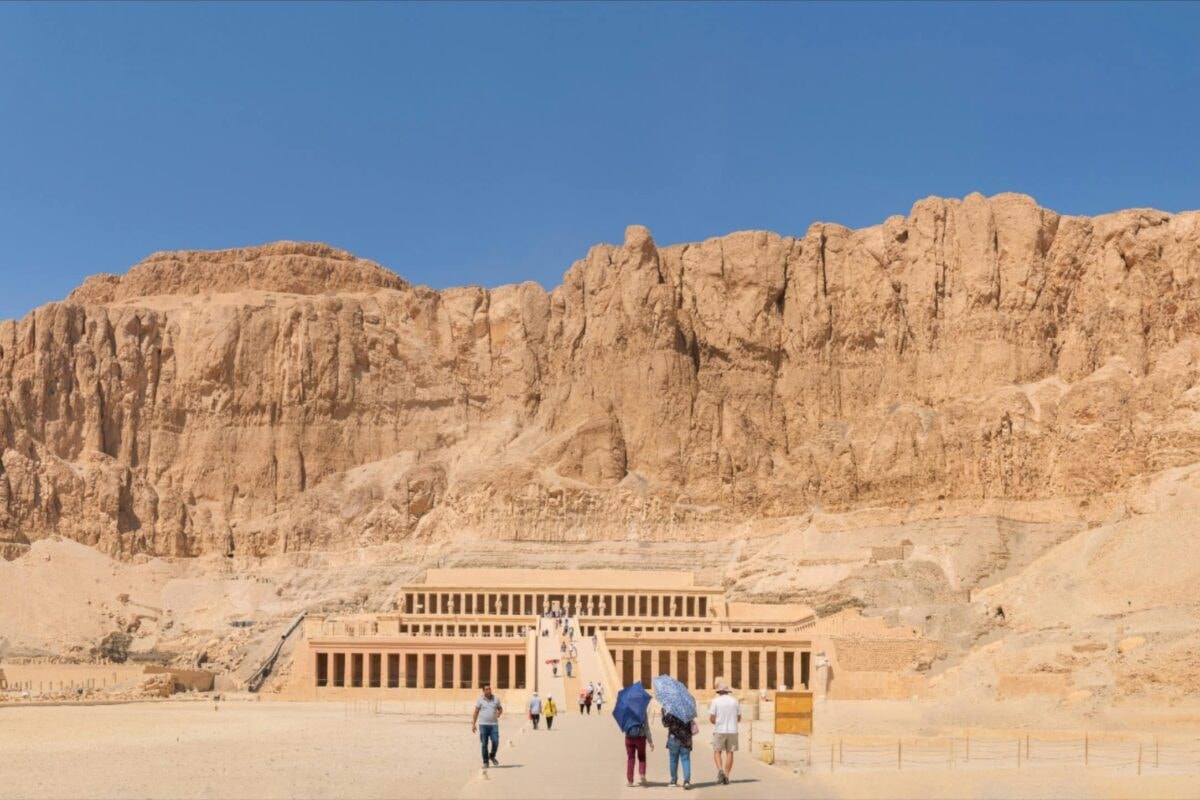
 Looking out from Hatshepsut's Temple towards the Valley of the Kings, the pharaohs' eternal resting places lie hidden among the cliffs and rock strata. Set within the desert on the west bank of the Nile, this limestone mountain range was seen by the ancient Egyptians as a gateway to the world of eternity. Photo by Siddhesh Mangela on Unsplash
💡 Did You Know: The Legend of the Female Pharaoh's Divine Birth and Voyage
The temple's murals record the legend of her "divine birth." The sun god Amun is said to have taken the form of her mortal father, granting her a divinely chosen bloodline to legitimise a woman's ascent to the throne. Another celebrated relief depicts her dispatching a fleet on a voyage to the Land of Punt—one of the earliest recorded overseas trade expeditions in ancient Egyptian history. The incense trees, ivory and metals shown in the carvings reveal her vision as both ruler and diplomat.
As a woman, Hatshepsut held both the pharaoh's sceptre and the light of the sun, transforming "power" from a symbol of conquest into one of creation and continuity. Standing on the temple steps and looking out over the Nile, you come to understand that her glory has never been buried by time.
Looking out from Hatshepsut's Temple towards the Valley of the Kings, the pharaohs' eternal resting places lie hidden among the cliffs and rock strata. Set within the desert on the west bank of the Nile, this limestone mountain range was seen by the ancient Egyptians as a gateway to the world of eternity. Photo by Siddhesh Mangela on Unsplash
💡 Did You Know: The Legend of the Female Pharaoh's Divine Birth and Voyage
The temple's murals record the legend of her "divine birth." The sun god Amun is said to have taken the form of her mortal father, granting her a divinely chosen bloodline to legitimise a woman's ascent to the throne. Another celebrated relief depicts her dispatching a fleet on a voyage to the Land of Punt—one of the earliest recorded overseas trade expeditions in ancient Egyptian history. The incense trees, ivory and metals shown in the carvings reveal her vision as both ruler and diplomat.
As a woman, Hatshepsut held both the pharaoh's sceptre and the light of the sun, transforming "power" from a symbol of conquest into one of creation and continuity. Standing on the temple steps and looking out over the Nile, you come to understand that her glory has never been buried by time.
 Mural of Hatshepsut's Temple: depicting the scene of the Queen dispatching a fleet on a voyage to the Land of Punt. This relief records one of ancient Egypt's earliest overseas trade expeditions, symbolizing the Queen's vision and power as both ruler and diplomat. By Diego Delso, CC BY-SA 4.0
A Tranquil Realm Deep in the Desert – The Origins of the Valley of the Kings
There are no pyramid peaks here, nor magnificent palaces. Instead, there are entrances leading underground scattered throughout the barren valley. This is where the pharaohs chose to rest eternally. Since the New Kingdom period (c. 1550–1070 BCE), the rulers of ancient Egypt moved their tombs from open pyramids to this hidden valley. They believed that the sun setting in the west also symbolised the soul's journey towards the underworld. Thus, the Valley of the Kings, located on the west bank of the Nile, was regarded as the gateway to the "afterlife". 💡 Did You Know: The terrain of the Valley of the Kings resembles a natural "arrow of the sun", pointing directly towards where the sun god Ra sets each day. To the ancient Egyptians, this was not merely a burial ground, but a pathway for the soul towards eternity. Viewed from afar, the layered rock walls silently guard the valley — indeed, the eternal resting place the pharaohs of ancient Egypt prepared for their souls. Aerial view of the Valley of the Kings, showing the entrances to the pharaohs' burial chambers and the terrain of the valley, the famous ancient royal tomb site on the west bank of Luxor, Egypt. By Fotograf/Photographer: Peter J. Bubenik (1995) - Own work, CC BY-SA 2.0
Glory Beneath the Rock Walls – The Underground Palaces of the Pharaohs
Under the scorching sun, the Valley of the Kings appears to be a barren wasteland, but beneath the surface lie more than sixty magnificent tombs. These burial chambers wind deep into the mountainside, like tunnels leading to eternity — "underground palaces" that pharaohs built for themselves.Each ruler personally planned the design of their tomb during their lifetime. They recorded the journey of the soul through murals and symbols, carving the Book of the Dead into the stone walls to guide themselves through the underworld and into rebirth. Under the lights, the interwoven blues, golds, and ochres still shimmer faintly, like the breath left behind by time. You can see the sun god Ra sailing his night boat through the darkness, and see pharaohs standing judgment before the gods. Here, death is not an end, but a passage to another dawn. Inside a pharaoh's tomb in the Valley of the Kings: murals depict the Book of the Dead and the pharaoh's journey to the afterlife. The walls are covered in hieroglyphs and relief carvings of deities, bearing eternal witness to ancient Egyptian art and belief. Photo by Dmitrii Zhodzishskii on Unsplash
💡 Did You Know: The Golden Legend of Howard Carter and Tutankhamun
In 1922, British archaeologist Howard Carter discovered a step leading down into the sand in the Valley of the Kings — it was the entrance to the tomb of Tutankhamun. Sealed for over three thousand years, the burial chamber's grave goods were preserved almost intact — gold masks, jewels, chariots, bows and arrows, and garlands, over five thousand artifacts in all.When his patron, Lord Carnarvon, asked, "Can you see anything?", Carter's reply has echoed through history ever since:“Yes, wonderful things.”This discovery reshaped the world's imagination of ancient Egypt and turned the "Valley of the Kings" into one of the most iconic names in the history of archaeology.
In 1924, British archaeologists discovered Tutankhamun's tomb in the Valley of the Kings, capturing the very moment the golden shrine was first opened. Howard Carter (crouching in front) and his team carefully examined the shrine panels covered in hieroglyphs, unveiling the golden secret of Pharaoh Tutankhamun's 3,000-year slumber. By Harry Burton - The New York Times photo archive, via their online store, Medelhavsmuseet: HB06, Public Domain
Standing at the entrance to the tomb, surrounded by silence, you come to realize that these dust-covered chambers were not built for death, but prepared for "rebirth."
The Queen's Glory — Temple of Hatshepsut
Leaving the shadows of the Valley of the Kings behind, sunlight once again illuminates the cliffs on the west bank of the Nile. Amid those golden rock formations stands another breathtaking structure — the Temple of Hatshepsut. She was one of the rare women in ancient Egyptian history to rule as "Pharaoh," and the only queen to leave such a profound mark across architecture, politics, and faith.The temple was designed by her loyal official and architect, Senenmut, rising in three tiered terraces that blend seamlessly with the mountain behind it. This structure is neither a palace nor a tomb, but a hymn dedicated to the sun god Amun-Ra and the goddess Hathor. As the morning light spills between the stone columns, the entire temple seems to awaken together with the sun—symbolising how the queen's soul "rises with the light," born and radiant alongside the sun itself. Looking out from Hatshepsut's Temple towards the Valley of the Kings, the pharaohs' eternal resting places lie hidden among the cliffs and rock strata. Set within the desert on the west bank of the Nile, this limestone mountain range was seen by the ancient Egyptians as a gateway to the world of eternity. Photo by Siddhesh Mangela on Unsplash
💡 Did You Know: The Legend of the Female Pharaoh's Divine Birth and Voyage
The temple's murals record the legend of her "divine birth." The sun god Amun is said to have taken the form of her mortal father, granting her a divinely chosen bloodline to legitimise a woman's ascent to the throne. Another celebrated relief depicts her dispatching a fleet on a voyage to the Land of Punt—one of the earliest recorded overseas trade expeditions in ancient Egyptian history. The incense trees, ivory and metals shown in the carvings reveal her vision as both ruler and diplomat.
As a woman, Hatshepsut held both the pharaoh's sceptre and the light of the sun, transforming "power" from a symbol of conquest into one of creation and continuity. Standing on the temple steps and looking out over the Nile, you come to understand that her glory has never been buried by time.
Mural of Hatshepsut's Temple: depicting the scene of the Queen dispatching a fleet on a voyage to the Land of Punt. This relief records one of ancient Egypt's earliest overseas trade expeditions, symbolizing the Queen's vision and power as both ruler and diplomat. By Diego Delso, CC BY-SA 4.0
Faith and Eternity — A Dialogue from the Underworld to the Light of Day
In the same vast desert, on one side lies a pharaoh's tomb hidden beneath the earth, and on the other, a queen's temple rising toward the sky. One dark, one bright; one yin, one yang — this is not merely a contrast in space, but the ancient Egyptians' belief in the cycle of life.To them, death was not an end, but the beginning of the soul's next journey. The soul had to pass through darkness and judgment before it could be reborn at dawn, rising once more into the sky alongside the sun god. The Valley of the Kings represents "quietly returning to the earth," while Hatshepsut's Temple symbolizes "embracing light and rebirth." One slumbers within the mountains, the other is awakened by the sun. Together, they seem to converse with each other, telling of humanity's faith in eternity.DeWonder's Curated Nile Cruise Itinerary — Step into the Eternal Kingdom of the Pharaohs
In the soft glow of the Nile, the golden river reflects the distant hills. There lies the Valley of the Kings, where pharaohs rest in eternal sleep; and there too stands Hatshepsut's Temple, facing the rising sun.If you wish to witness this magnificence and serenity with your own eyes, join DeWonder Travel's "Egypt In-Depth Tour" and set off on this journey.We make your journey more than just "seeing ancient civilizations" — it becomes a personal dialogue with history and light. ✨ Tour Highlights:- Expert Guided Explanations: Delve into tombs and temples to understand the pharaohs' beliefs and artistry.
- Comfortable Transport Arrangements: Travel with ease from the cruise ship or Luxor to the Valley of the Kings and the Queen's Temple.
- Cultural Experience Class: Trace hieroglyphs by hand and learn the story of the ancient Egyptian soul's rebirth.
- Small Group Departures (8–14 People): Experience the true rhythm of travel amid tranquil valleys and temples.