
A Beginner's Guide to Egyptian Hieroglyphs: 3 Tips to Understand What Temple Wall Paintings Are Saying
Stepping into an Egyptian temple, you're always drawn to the hieroglyphs covering every wall — but have no idea where to start reading? This guide will use the simplest approach to teach you how to decode the stories in the wall paintings.
The first time you step into Karnak Temple or the Valley of the Kings, you might feel dizzy from all the symbols, patterns, birds, snakes, eyes, and hand gestures covering the walls. "Every symbol looks familiar, but put together, I have no idea what they mean?"
This article will guide you through a "story structure" approach, paired with the <Guide to Egyptian Symbols>to compare key hieroglyphs, one by one decoding what the temple wall paintings are telling us. This decryption manual will let you understand what's happening between the pharaoh and the gods when you stand before a temple.
👉 Further Reading: 10 Must-Know Egyptian Symbols and Icons
👉 Further Reading: A Quick Guide to Egypt's Major Deities
 The oval "cartouche" in Ancient Egyptian murals symbolises protection and kingship, used to frame a Pharaoh's name. Once you spot this symbol, you can instantly tell which Pharaoh left this "signature".
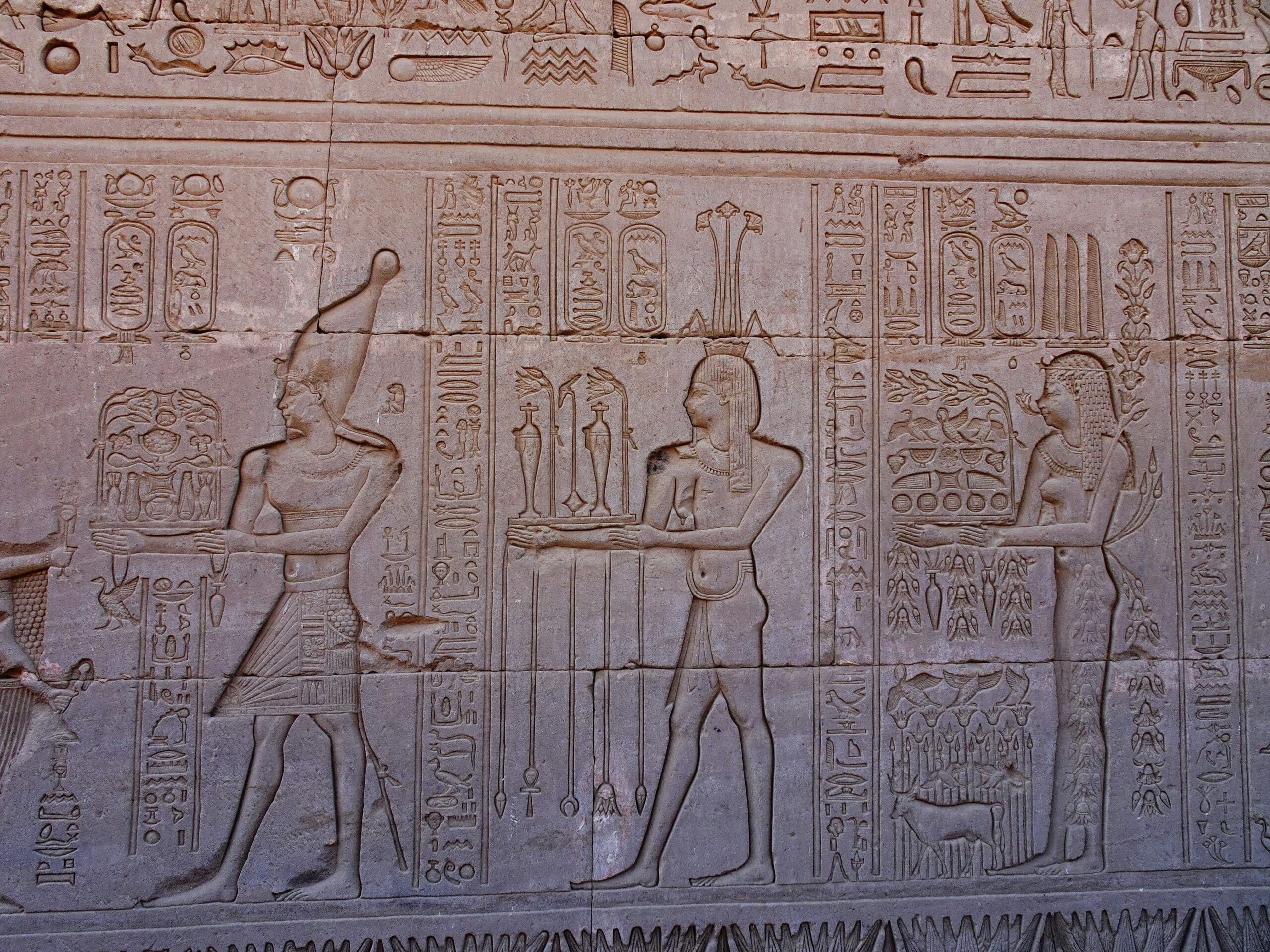
 The mural depicts a typical ancient Egyptian "offering scene": the pharaoh presents food, spices, and ritual items to the deity, symbolising the exchange of dialogue and blessings between them—one of the most authentic representations of everyday ancient Egyptian religion.
 In ancient Egyptian wall paintings, deities are often shown holding the ☥ Ankh to the pharaoh's nose and mouth, symbolizing the bestowal of the “breath of life” upon the ruler, affirming his right to rule and his divine status. In this image, the falcon-headed god Horus is performing this sacred ritual—one of the most iconic compositions found in temple murals.
Tip 1: Find the "Cartouche" First — The First Step to Reading Wall Paintings
Every story needs a protagonist. And in Egyptian temples, the protagonist is always the Pharaoh. Want to know which pharaoh's achievements, rituals, or prayers a wall painting depicts? Simply learn to recognize the "cartouche."What Is a Cartouche?
Why are only Pharaohs' names framed? A cartouche is an oval rope-shaped loop, resembling a tightly bound length of rope, encircling a string of hieroglyphs. It represents:- Protection: symbolising that the Pharaoh's name is protected by the gods
- Symbol of kingship: only Pharaohs were entitled to use it
- Signature: the Pharaoh's mark left on temples reading "I built this" or "I dedicated this"
- Marker of the protagonist: wherever a cartouche appears, that is the story's central figure
The oval "cartouche" in Ancient Egyptian murals symbolises protection and kingship, used to frame a Pharaoh's name. Once you spot this symbol, you can instantly tell which Pharaoh left this "signature".
How to play "treasure hunt" in the temples? Find the cartouche, find the protagonist
Once you know the shape of a cartouche, you'll discover countless "hidden Easter eggs" throughout the temples. All you need to do is one thing:👉 Look for the round rope-shaped loop on walls, pillars and statues.Find it, and you find the pharaoh's name. This is especially true at Abu Simbel Temple, where Ramesses II loved leaving his name all over his own temple: on the colossi's bases, walls, inner sanctum, columns... his cartouche can be seen everywhere. Travellers who learn this trick for the first time often exclaim in surprise: "So this whole place is covered in his signature!" 👉 Further Reading: Introduction to Abu Simbel TempleTrick Two: How to Read Hieroglyphics? Follow the "Direction of the Face" to Crack the Code
Most people can't read hieroglyphics, not because there are "too many symbols," but because they don't know which side to start reading from. Ancient Egyptian hieroglyphics have a remarkably human-friendly design: they always "face the reader." Just find which way the symbols' faces are pointing, and you'll know where the whole passage begins.The Quick Rule: Read From the Direction the Animals and People Are Looking
This is the simple trick every tour guide teaches: wherever the animals, people, or gods' faces are pointing, that's the side you start reading from. For example:- If the bird's face points left → read left to right
- If the figure faces right → read right to left
- If a row of symbols is arranged vertically → read from top to bottom
Why can Egyptian hieroglyphs be read from left, right, top, or bottom?
Unlike modern languages, ancient Egyptian writing had no fixed rules. Scribes would decide based on:- Available space
- Visual aesthetics
- The orientation of the wall
- Visual balance of the story's presentation
Technique 3: Understand the "Standard Layout" of Wall Paintings—Who Is Speaking to Whom?
Once you already know "where the main character (the Pharaoh) is" and "where the text begins to be read," the next step is to understand the overall theatrical scene of the wall painting. You may be surprised: 90% of Egyptian temple wall paintings are actually telling the same kind of story. Once you grasp this layout, you'll be able to quickly understand the scene in front of you, standing before any temple.The Most Common Scene: The Pharaoh Making Offerings to the Gods
Ancient Egyptian temples were not "art galleries," but spaces where the Pharaoh communicated with the gods.This is why the most common composition in the murals follows this pattern: Pharaoh → offers sacrifices → deity → responds and bestows blessings The overall scene presents a kind of "dialogue relationship". The offerings here might include:- Incense (especially common)
- Food and wine
- Lotus flowers, papyrus
- Sacred oil
- Ritual items
The mural depicts a typical ancient Egyptian "offering scene": the pharaoh presents food, spices, and ritual items to the deity, symbolising the exchange of dialogue and blessings between them—one of the most authentic representations of everyday ancient Egyptian religion.
How to Tell the "Pharaoh" and the "Deity" Apart at a Glance?
If you're not familiar with Egyptian mythology, this trick will be extremely useful.Generally speaking: Pharaoh (depicted in an active pose)- Usually shown "standing" or "kneeling"
- May be raising a hand, striding forward, or presenting offerings
- Wearing a crown (white crown, red crown, double crown, blue crown, etc.)
- Body proportions are more human-like
- Poses often convey "action": offering, walking, praying
- Usually shown "seated" or standing, but with a dignified bearing
- Often depicted with an animal head (falcon, jackal, bull, cat, etc.)
- Their form is more divine
- The most typical gesture: holding out the Ankh (symbol of life) to the Pharaoh's nose and mouth → representing the "granting of life, power, or protection"
In ancient Egyptian wall paintings, deities are often shown holding the ☥ Ankh to the pharaoh's nose and mouth, symbolizing the bestowal of the “breath of life” upon the ruler, affirming his right to rule and his divine status. In this image, the falcon-headed god Horus is performing this sacred ritual—one of the most iconic compositions found in temple murals.
Not Sure Which God Is Which? Here's a Quick Reference
If you're standing in front of a temple unsure who's who, these two companion articles can help: 👉 10 Essential Egyptian Symbols and Totems You Must Know:Helps you identify the Ankh, the sun disc, the Eye of Horus, and more 👉 A Quick Guide to Egypt's Major Deities :Horus, Ra, Isis, Osiris, Anubis These two articles are the perfect companion to this main piece, helping travelers go from “can't tell who's who” to “identifying everyone at a glance.”From “Recognizing” to Truly “Understanding”: DeWonder's Egyptian Hieroglyphics Workshop
Once you can read cartouches, understand the direction of inscriptions, and grasp mural composition, the symbols in the temples will begin to feel like they're telling a story.To help travelers gain a deeper understanding of ancient Egyptian culture, DeWonder'sEgypt In-Depth Tour arranges an Egyptian hieroglyphics/culture/history workshop in Luxor, where an expert helps you piece together the clues you'll see in the temples into a coherent narrative.Led by an expert, making the logic of hieroglyphics and murals easier to understand
The workshop content won't be overly academic. Instead, it covers:- An introduction to how hieroglyphics basically work
- How to identify common symbols and the features of deities
- How to read a mural to understand "who is doing what" and "what the actions represent"
Why hold it in Luxor? Because it's the best setting for learning
Luxor is the religious heart of ancient Egypt. Both Karnak Temple and Luxor Temple have an extremely high density of hieroglyphics and the clearest murals. What you learn here can be applied immediately to:- The inscriptions on obelisks
- The cartouches between the great columns
- Divine ritual scenes
- Symbols of pharaonic power
Making the journey more contextual and emotional
Many travelers share that after completing the Egyptian Hieroglyphics workshop:- For the first time, they felt they could truly "read" the temples
- They could identify common deities and symbols, and even understand the logic behind the mural gestures
- They also formed a deeper emotional connection with ancient Egyptian civilization
Want to truly understand ancient Egypt? Follow DeWonder along the classic Nile route at the most comfortable pace
If you'd like to bring this understanding into a real journey, DeWonder'sEgypt In-Depth Touris the perfect way to do it.- 4 days, 3 nights aboard a Nile cruise ship
- Featuring all the classic temples of Aswan and Luxor
- A visit to Abu Simbel Temple arranged before boarding
- Small groups of 8–14 people, at a comfortable pace
- Expert-led "Egyptian Hieroglyphics / Culture / History Workshop"
- Accompanied throughout by a tour leader and local guide
- Abu Simbel Temple
- Valley of the Kings
- Luxor Temple & Karnak Temple
- Philae Temple
- Kom Ombo Temple
- Edfu Temple