
Abu Simbel Temple: From the Solar Miracle to a UNESCO Feat of Human Cultural Achievement
What makes Abu Simbel Temple so special? The solar miracle, the romance of Queen Nefertari, and UNESCO's legendary relocation—discover in one read the splendour and faith found at Egypt's southernmost frontier.
As sunlight spills across the southern bank of the Nile, a row of colossal statues, each twenty metres tall, gazes silently across millennia amid sandstone cliffs. Abu Simbel Temple is not only a symbol of Ramses II's power, but also the crystallisation of ancient Egyptian civilisation's faith, architecture, and spirit of human collaboration. Every beam of light and every stone wall here tells a story spanning three thousand years.
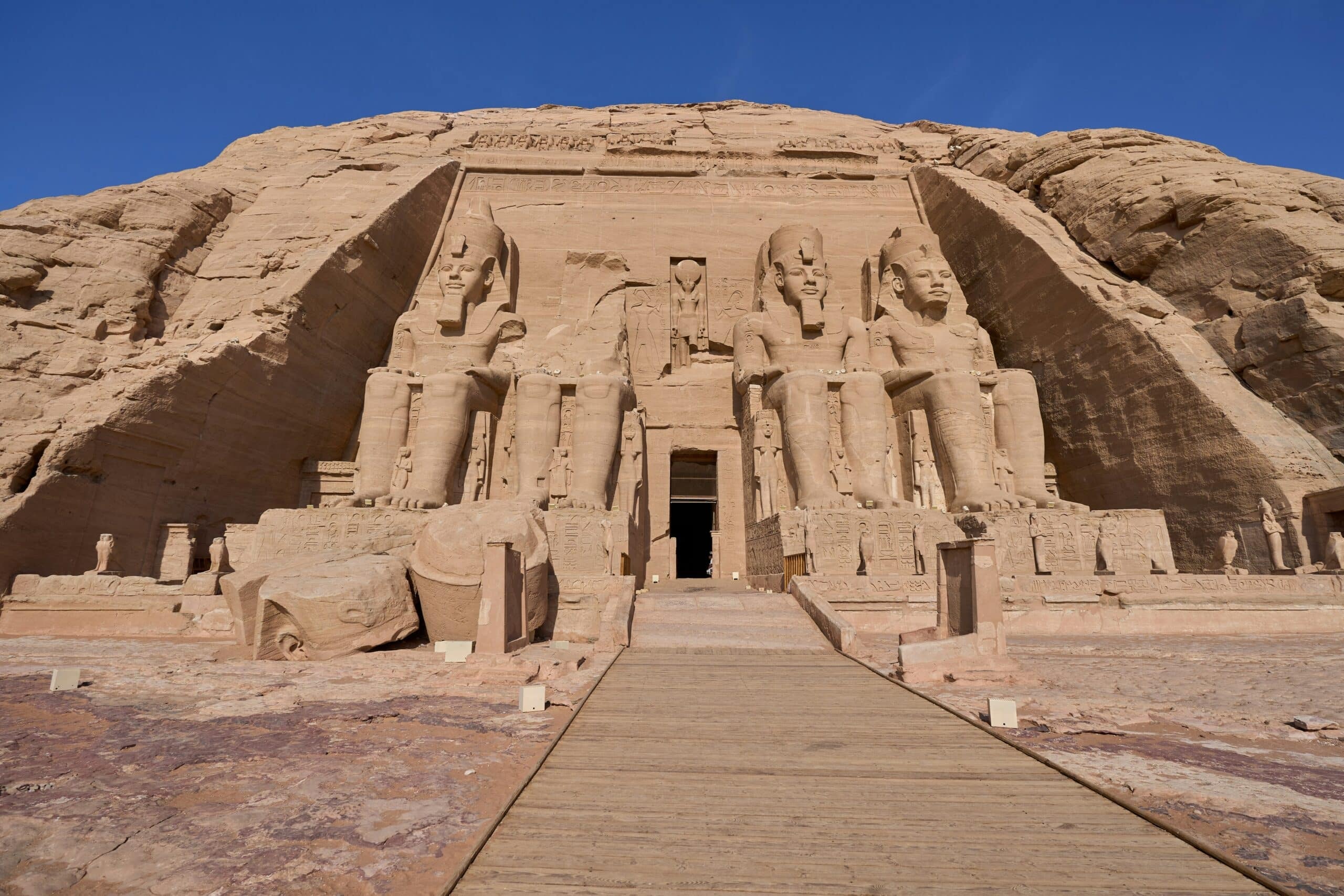
Approaching the entrance of Abu Simbel Temple, travellers are first greeted by four towering seated statues. Each one represents the same ruler—Pharaoh Ramses II. In an era centred on the divine king, he chose to carve his own likeness into the cliff face, proclaiming that “the king is god, and god is the nation.” Unlike other temples expanded over generations by multiple pharaohs, Abu Simbel was commissioned solely by Ramses II at the height of his power. He wanted every traveller entering Egypt from the south to feel the might of the empire at first glance. 💡 Did You Know: One of the four colossal statues collapsed in an ancient earthquake and remains in that state to this day. It serves as a reminder that while power may crumble, faith and memory are forever carved into stone.

The façade of the Great Temple of Abu Simbel: four colossal statues, each 20 metres tall, all depicting Ramses II himself. Carved entirely from solid rock, this temple was built at the height of the pharaoh's power to “proclaim royal authority,” making it one of ancient Egypt's most iconic personal temples.Photo by Dmitrii Zhodzishskii on Unsplash
Not far from the Great Temple, hidden within the cliffside, stands a smaller yet profoundly meaningful temple — the Nefertari Temple. This is the "small temple" built by Ramesses II for his most beloved queen, dedicated also to the goddess Hathor, symbolising feminine compassion and creation. Approaching the temple entrance, six standing statues are arranged side by side — two of the queen, four of the pharaoh. In ancient Egyptian art, a queen's image was rarely depicted at equal height to the pharaoh's, yet here it is the exception. This is not merely an ode to love, but a public affirmation of the queen's status. 💡 Did you know: Nefertari's name means "Beautiful One Has Come". She was not only a queen, but also played an important role in diplomacy and religious ceremonies. The murals inside the temple depict scenes of her interacting with the goddess — soft and solemn, celebrated as among the most exquisite reliefs in Egypt.

Front view of the Nefertari Temple (Small Temple): six standing statues arranged side by side, with the queen and pharaoh standing at equal height. Built by Ramesses II for his beloved queen and dedicated to the goddess Hathor, this temple is a rare architectural symbol in ancient Egypt of a queen's status equalling that of a pharaoh.Photo by Dmitrii Zhodzishskii on Unsplash If the Great Temple of Abu Simbel is a declaration of pharaonic power, then the Temple of Nefertari is the tender chapter he left behind.

The Great Temple of Abu Simbel (left) and the Small Temple of Nefertari (right) stand only about a hundred metres apart, side by side on the same cliff face. Here, Ramesses II built two rock-cut temples—one for himself, one for his queen—symbolising the eternal coexistence of "power and love."
At Abu Simbel, only on two mornings each year does sunlight pierce the darkness deep within the temple. On 22 February and 22 October local time, the first rays of dawn shine directly through the entrance, travel down a passage roughly 60 metres long, and finally illuminate the four statues in the innermost sanctuary. Among those four statues, the one seated at the centre is none other than Ramesses II himself, seated alongside the sun god Ra. In that moment, the light is more than a natural phenomenon—it is a dialogue between pharaoh and deity. Why these two particular days? Scholars have yet to reach a consensus. The most widely held theory suggests these two dates mark Ramesses II's coronation and birthday respectively; some astronomers, however, point out that they actually correspond to the sun's position around the spring and autumn equinoxes. Whatever the truth may be, such precise alignment reveals the astonishing mastery the ancient Egyptians held over astronomy and architecture. 💡 Did You Know: NASA's Astronomical Observations Compared to the Abu Simbel Sun Miracle According to research records from NASA's Goddard Space Flight Center, the original design of the Abu Simbel Temple was indeed precisely aligned to two specific dates: February 21 (the Pharaoh's birthday) and October 22 (his coronation anniversary). Due to the precession of Earth's rotational axis, the dates the sunlight now strikes have shifted slightly to approximately February 22 and October 23. NASA's measurements show that sunlight travels through the 56-metre (about 185-foot) long corridor and the 4-metre wide doorway, illuminating three of the statues in the "Holy of Holies" — Ramesses II, Amun-Ra, and Ra-Horakhty — only on the mornings of these two days. Only Ptah, the god symbolising the underworld, remains forever in shadow. This is no coincidence, but a miracle born from the ancient Egyptians' fusion of faith and astronomical calculation.
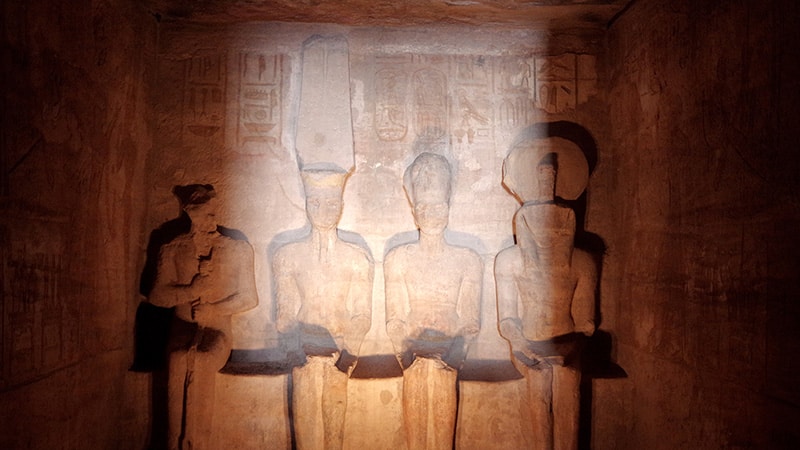
The four statues in the "Holy of Holies" of the Great Temple of Abu Simbel: sunlight travels through the 56-metre-long corridor to illuminate three deities and Pharaoh Ramesses II. This spectacle has occurred only twice a year (around February 22 and October 22) since ancient times. Only Ptah (far left), god of the underworld, remains forever in shadow. This design of light and faith is regarded as one of ancient Egypt's most precise achievements in astronomical architecture. Photo by Diego Delso, CC BY-SA 4.0
In the 1960s, as the construction of the Aswan High Dam caused the Nile's water level to rise, the Abu Simbel Temples faced the fate of being submerged. To save this thousand-year-old monument, the United Nations Educational, Scientific and Cultural Organization (UNESCO) launched an unprecedented "International Campaign to Save the Monuments of Nubia". More than 50 countries and thousands of engineers and archaeologists took part in this cross-national collaboration. Over four years of construction, the entire temple was cut into more than a thousand massive stone blocks, each numbered, transported, and then reassembled on higher ground. Not only did they precisely recreate every carving and orientation, but the temple's axis and the angle of sunlight were also fully preserved.This was not just an engineering feat, but a movement launched by humanity to safeguard cultural memory. The successful relocation of Abu Simbel became a symbol of cultural conservation in the 20th century, and also led to the birth of theUNESCO World Heritage system.

The relocation site of the Abu Simbel Temples in 1967, with workers reassembling the head of the colossal statue of Ramesses II. To save the monument from being submerged by the rising waters of the Aswan High Dam, UNESCO initiated an international collaboration, cutting the entire temple (including the mountain itself) into more than 1,000 stone blocks, then precisely reconstructing it at a new location 60 meters higher than the original site. This effort is hailed as the greatest cultural heritage rescue project of the 20th century. Photo By "Per-Olow" - Per-Olow Anderson (1921-1989) - sv:Forskning & Framsteg 1967 issue 3, page 16, Public Domain, 💬 Fun Fact: As part of this same effort, some smaller Nubian temples were gifted to the countries that assisted, for preservation. The most famous of these is the Temple of Dendur, now housed at the Metropolitan Museum of Art (The Met) in New York. There, the temple stands quietly within a glass hall, reflecting the water and the setting sun, reminding people that civilization does not belong to just one nation, but is a heritage shared by all of humanity."]

Housed in The Metropolitan Museum of Art (The Met) in New York, this was built in 15 BC by a Roman-era governor of Egypt to honour Isis and Osiris. In 1965, it was gifted by the Egyptian government to the United States in gratitude for its assistance in the Nubian Monuments rescue campaign. Photo credit: The MET 👉 Further Reading: Where Are Egypt's National Treasures Housed Around the World?
Want to witness the miracle of sunlight piercing the temple and feel the eternal legend of pharaohs and queens, without setting off at 3am from Aswan? Join DeWonder Travel's "Egypt In-Depth Tour" and travel south at the leisurely pace of the Nile, rediscovering the warmth of human civilisation between history and sunlight. ✨ Tour Highlights:
- Travel comfortably by Nile cruise to Abu Simbel Temple, avoiding the long morning drive for a more relaxed journey.
- Expert guiding and storytelling: gain deep insight into the sun miracle, the UNESCO relocation project, and Nefertari's temple of love.
- Cultural workshop: trace hieroglyphs by hand and learn to read ancient Egyptian symbols of prayer.
- Small group design (8–14 people): enjoy more relaxed interaction and a closer experience of local culture.
👉 View Egypt In-Depth Tour Departure Dates All Year Round 👉 Join Our Free Online Webinar to Get Your Egypt Trip Questions Answered 👉 Click Here to Register DeWonder Egypt In-Depth Tour Information Kit 👉 Click Here to Download 👉 Further Reading: Egypt Pyramids Guide | Grand Egyptian Museum Guide 👉 Further Reading: Guide to Egyptian Mythology 👉 Further Reading: Introduction to the Valley of the Kings