When it comes to polar photography, most people's first instinct is Antarctica's armies of penguins and towering icebergs. Yet at the other end of the earth, the Arctic offers a completely different visual language.
If Antarctica is an active display of being "surrounded by animals," then the Arctic is more like a "hunter's search." Here you'll findSvalbard'ssolitary polar bear monarchs, Greenland'scolorful Inuit settlements, and the astonishing micro-ecosystems of the summer tundra. Not to mention, if you travel toward the end of the season in September, you may even have the chance to enjoy the dance of the aurora over the sea, exclusively from your cruise ship.
This guide combines DeWonder Travel's hands-on experience with professional advice from the polar photography instructors of our partner Quark Expeditions, to help you unlock the mysterious light and shadow of this northern land.
Antarctica vs. the Arctic: Key Differences in Photography Strategy
Search for Antarctic photography photos, and you'll see photographers shooting in a "penguins right at your feet" style. But even though both are polar photography, the Arctic shooting approach is completely different—if you prepare with Antarctic-style gear, you'll find your Arctic lenses "aren't long enough."To help you prepare your equipment precisely, we've compiled the key differences in photography logic between these two polar regions:
| Comparison |
Antarctica |
The Arctic |
| Core Focal Length |
Wide-Angle to Medium Telephoto (16-200mm)
Penguins are abundant and unafraid of people, so wide-angle lenses are often used to capture group shots and environmental scenes. |
Super Telephoto (400mm-600mm)
Polar bears are aggressive and protected by regulations requiring you to keep a great distance, making telephoto lenses essential. |
| Subject Matter |
Penguins, massive tabular icebergs, whales |
Polar bears, walruses, reindeer, Arctic foxes |
| Landscape Colours |
Blue, white, black (pure ice, snow and rock) |
Multi-coloured(summer tundra greenery, red-orange lichen, colourful cabins) |
| Light Characteristics |
Strong reflections off ice and snow, cold light |
Soft midnight sun in summer, chance to see theAurora in autumn (September) |
If you're heading to the other end of the earth, or want to compare gear details between the two regions, please refer to our detailed Antarctic photography guide
👉 Further Reading : Antarctic Photography Guide: Cruise Polar Shooting Techniques and Equipment Recommendations
Arctic Photography Gear Checklist: Preparing for “Distance” and “Colour”
In the Arctic, equipment choices hinge on two key words: “Safe Distance” and “Mobility.”
① The Lens Decider: Why Do You Need 400mm or More?
In Antarctica, penguins are often within arm's reach, and you might easily capture close-up “feather-counting” shots with a 70-200mm lens. But in the Arctic, this logic doesn't apply at all. This isn't just about safety — it's also because of the strict regulations that took effect in 2025.
According to the Norwegian government's latest revision of the Svalbard Environmental Protection Act, in order to protect polar bears that are easily disturbed, all expedition vessels and tourists must strictly comply with the following mandatory distances:
- March 1 to June 30 (spring/breeding sensitive period): a distance of 500 metres or more must be maintained.
- July 1 to February 28 (summer sailing period): a distance of 300 metres or more must be maintained.
What does this mean? At a distance of 300 metres (roughly three football pitches), if you're only carrying a 200mm lens, the polar bear may just be a blurry little white dot in your viewfinder.
Therefore, in order to capture clear and detailed images while strictly adhering to the AECO Wildlife Guidelines "Do Not Disturb" principle, we strongly recommend:
- Essential Focal Length: Bring a super telephoto lens with an equivalent focal length of 400mm, 500mm, or even 600mm.
- High-Resolution Cropping: If you don't have a super telephoto lens, we recommend using a high-resolution camera body (40 megapixels or above) for shooting, leaving room for cropping and enlarging during post-processing.
⚠️ Important Reminder: If a polar bear actively approaches the ship (which occasionally happens in pack ice areas), the captain is obligated by regulations to reverse the vessel to maintain the legally required distance. A telephoto lens ensures you won't miss the perfect moment, no matter the distance.

When photographing polar bears in the Arctic, safety regulations require the ship to maintain a distance of several hundred metres at all times. As seen in this photo, only a telephoto lens can capture their true form as they move across the pack ice, without disturbing the wildlife.
② Standard Zoom Lens (24-70mm): Landscapes & Environmental Portraits
While telephoto lenses are important, don't forget the Arctic's magnificent fjords and glacial terrain. A standard zoom lens is your top choice for a second camera to hang around your neck, perfect for capturing:
- Environmental portraits: Teammates hiking across the tundra in vibrant-coloured parkas.
- Fjord reflections: Greenland's fjords become mirror-still on windless days—the perfect moment for reflection shots.

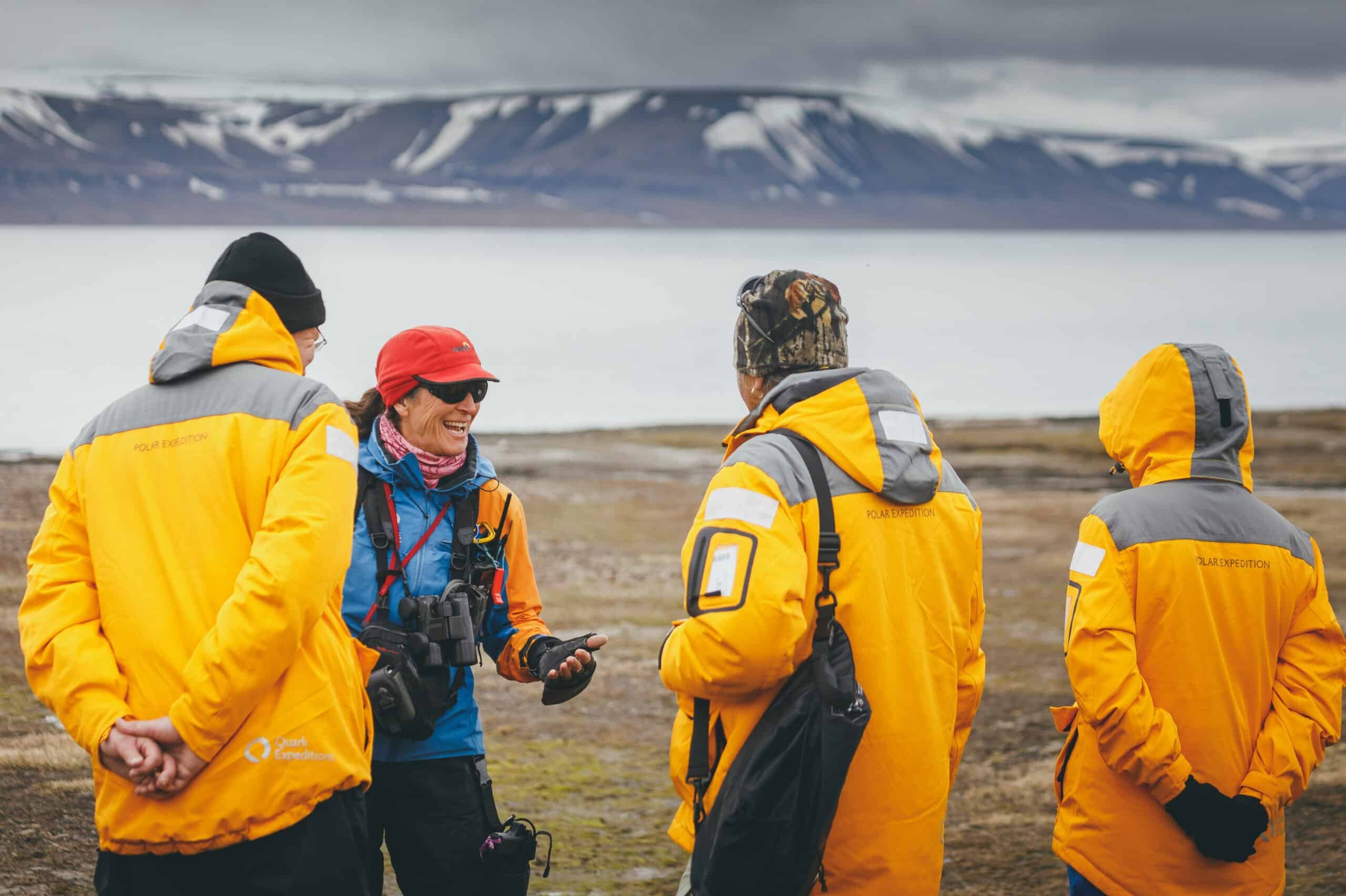
The Arctic isn't just about grand glaciers—delicate tundra flowers and a teammate in a bright yellow parka can also become compositional highlights. Shooting at a low angle with a 24–70mm lens lets you preserve foreground detail while conveying a sense of scale for people within the polar landscape.
③ Lightweight Macro Solution: Skip the Macro Lens!
The ground in the Arctic summer is remarkably rich, filled with miniature wildflowers and lichens. But we don't recommend bringing a heavy dedicated macro lens just for these.
- Lighten your load: The close-up capabilities of modern flagship phones (like the iPhone Pro series) are already remarkably powerful. Alternatively, zoom your 24-70mm lens to its telephoto end and move in close—this reduces your burden while still capturing stunning ecological close-ups.
④ Weighing Up the Tripod
On a rocking Zodiac inflatable boat, a tripod isn't just useless—it can become a dangerous trip hazard.Quark photographer Acacia Johnson advises: "Unless you're shooting the Northern Lights or doing time-lapse photography, leave the heavy tripod at home." In the Arctic, the flexibility of handheld shooting matters far more than stability.
Capturing the King of the Ice: Techniques for Photographing Polar Bears & Wildlife
The Art of Searching and Waiting
Unlike Antarctic penguins that will walk right up to you, photographing polar bears usually requires long hours of searching. This is also part of the joy of Arctic expeditions—scanning the horizon with binoculars alongside expedition staff on deck. When the announcement "Bear on the ice!" comes over the radio, the surge of adrenaline is simply incomparable.

In the Arctic, magic often comes from long waits. This polar bear, seen resting quietly on the shore, took the fleet a long time to spot. Patience and long-distance observation are truly the most captivating part of Arctic photography.
Composition Tip: Make Good Use of "Negative Space"
When you finally capture a polar bear in your shot, don't try to "fill" the frame with it. Quark's photography instructors suggest trying "negative space": position the polar bear at the bottom or corner of the frame, leaving vast areas of ice, ocean, or sky. This composition better highlights the polar bear's smallness and grandeur as the "lonely king" amid the vast polar landscape, and tells a far more moving story.

The smaller the subject, the bigger the story. Using large areas of negative space to highlight the Arctic's grandeur makes the distant polar bear appear even lonelier and more narratively powerful amid the ice and mountains—this is exactly the charm of negative space composition in the polar regions.
Walruses and Bird Cliffs
Walruses, commonly found in Svalbard, usually gather in groups on the beach. Although they move slowly, remember that we're typically shooting from a rocking Zodiac, so be sure to maintain a safe shutter speed of at least 1/1000 second to avoid blurry photos.
👉 Further Reading : Polar Bear Spotting Guide | Arctic Whale, Seal & Muskox Spotting Guide

When photographing bird cliffs and walruses, we're often shooting from a rocking Zodiac. Close-up cliffs, wheeling seabirds and walruses that suddenly surface all demand a fast shutter speed and quick reflexes to capture the most authentic moments of polar ecology.
The Polar Garden Beneath Your Feet: Tundra Photography
When you visit the Arctic, don't just keep your eyes fixed upward searching for bears — look down every now and then, and you'll discover another world bursting with colour. The Arctic summer may be short, but it's incredibly vibrant. Saxifrage, Arctic Poppy and various orange and red lichens bloom in the crevices of the rocks.
📸 Belly Hiking: This is a joke expedition staff often make, meaning you have to lie flat on the ground to get the shot. Try bringing your camera or phone down to the lowest possible angle, and you'll find that these plants, just a few centimetres tall, transform into a vast, colourful forest through the lens. It's one of the most soothing photography experiences when no animals are around.

Wildflowers on the tundra are often just a few centimetres tall, but getting your camera down close to the ground lets them form a magnificent foreground in your shot. Set against distant icebergs and mountains, they create a striking contrast that captures the explosive burst of life in the Arctic summer.
Ship-Based Auroras: How to Capture the Dancing Lights from a Cruise?
If you're joining a September voyage to East Greenland or Svalbard, once night falls you may be treated to the Arctic's ultimate gift — the Aurora Borealis.
The Cruise Advantage in Chasing the Lights: Actively Seeking Clear Skies
Many worry that a rocking ship makes it hard to photograph the aurora, but in fact, cruise ships have a huge advantage that land-based hotels simply don't: mobility. The captain can adjust the course at any time based on weather satellite imagery, leading the whole ship to "escape the clouds" and head towards waters with clear night skies. This greatly increases your chances of witnessing the aurora with your own eyes.
Curious about the difference between chasing the Northern Lights on land versus aboard a cruise? Which one suits you better?
👉 Further Reading : How to Choose Your Arctic Aurora Hunt? Land vs Cruise Comparison

Chasing the aurora from a cruise deck is one of the most unforgettable moments in the Arctic. Even with just a smartphone, mastering high ISO and short shutter speeds lets you capture the aurora dancing across the night sky. A flexible, ship-based journey also greatly increases your chances of encountering clear skies together with the aurora.
Shooting Adjustments Aboard Ship (High ISO Strategy)
When photographing the aurora from a ship, you can't expose for 20-30 seconds as you would on land, since the ship's slight movements will turn stars into streaks. You'll need to adjust your strategy:
- Raise the ISO: Don't be afraid to set ISO to 1600, 3200, or even 6400.
- Shorten the shutter speed: Try shutter speeds between 2 and 5 seconds.
- Use a wide aperture: Use your lens's largest aperture (such as f/2.8 or f/1.8).
This setting actually captures the instantaneous structure of the dancing aurora, producing dynamic images that are strikingly different from the "misty aurora" typical of long-exposure shots taken on land.
Want to learn more about aurora photography techniques? How should you shoot with a phone versus a camera? 👉 Further Reading : Beginner's Guide to Aurora Photography
Arctic Photography Gear Strategy: Prepare for "Getting Wet" and "Hiking"
① A Backpack Camera Bag Is Better Than a Shoulder Bag Unlike Antarctica, where shooting is mostly done at fixed points, Arctic itineraries often include 1-2 hours of tundra hiking. Walking on unpaved terrain covered with moss, rocks, and mud requires you to keep both hands free for balance.
- Recommendation: Choose a backpack camera bag made of waterproof material. It evenly distributes the weight of your telephoto lens, making walking easier, while also preventing your bag from sliding into the sea during wet landings.
② The Golden Rule of Waterproofing on the Zodiac Sea conditions in Svalbard and Greenland are highly unpredictable, and getting your camera splashed by seawater is a common occurrence.
- Dry Bag: This is the cheapest yet most effective form of insurance. While traveling by Zodiac between the main ship and land, be sure to keep your camera in a fully waterproof roll-top dry bag until you reach shore or the captain announces it's safe to shoot.
- Rain Cover/Protective Cover: If you plan to shoot continuously in snowfall or sea spray, fitting your camera with a simple plastic rain cover is essential.
Arctic Photography Gear & Pre-Trip Preparation Checklist
| Category |
Recommended Item |
Practical Tips |
| Camera Bodies |
Two camera bodies (telephoto + standard) |
Polar bears are often far away, and swapping lenses is risky — a dual-body setup is recommended. |
| Key Lens |
100-400mm or 150-600mm |
This is the most important piece of gear in the Arctic. Regulations require keeping a distance of 300m+ when photographing polar bears. |
| Landscape & Macro |
24-70mm or a smartphone (with close-up capability) |
For capturing sweeping fjord views, or for close-ups of lichen and wildflowers during tundra hikes. |
| Tripod: To Bring or Not |
Best to skip it (unless shooting the Northern Lights) |
Zodiacs rock a lot, so handheld shooting is the norm. Only bring a lightweight tripod if you plan to photograph the Northern Lights. |
| Carrying System |
Waterproof backpack |
Tundra hikes are common in the Arctic, and a backpack frees up both hands for balance while staying waterproof and mud-resistant. |
| Protective Gear |
Roll-top dry bag, rain cover |
Sea spray can easily soak your gear during Zodiac cruises, so be sure to stow everything in a dry bag when boarding or disembarking. |
| Filter Accessories |
Polarizing Filter (CPL) |
Eliminates reflections on the water surface of Greenland's fjords, or enhances the colour saturation of tundra plants. |
| Batteries & Storage |
3-4 spare batteries, portable SSD |
Batteries drain quickly in cold temperatures; use an SSD for daily backups to keep your precious images safe. |
| Cold-Weather Clothing |
Touchscreen-compatible thermal gloves, windproof outer layer |
Keeps your hands warm while operating the camera; dress in layers to adapt to body temperature changes during hikes. |
Create Your Own Polar Story with DeWonder
In Arctic photography, equipment is important, but your observation and patience matter even more. Whether it's a polar bear glancing back on an ice floe, a resilient little flower on the tundra, or the reflection of the aurora beside the ship at midnight, these images are not merely a collection of pixels—they are proof of your dialogue with this distant continent.
DeWonder has teamed up with Quark Expeditions to create a professionalArctic In-Depth Tour.Through our small-group arrangements, you can observe wildlife up close during both the cruise and Zodiac excursions, while expert guides help you gain deeper insight into and photograph polar ecosystems and unique natural landscapes. From the Northern Lights and wildlife to Inuit culture, we have accompanied countless travellers to the ends of the earth.
- Departing fromReykjavik, Iceland, crossing the Denmark Strait to venture deep intoGreenland's northeastern fjords
- Daily Zodiac landings to explore glaciers, Arctic villages and wildlife
- September is the prime season for viewing the Northern Lights, offering both aurora and wildlife exploration in one trip
- A once-in-a-decade astronomical wonder: witness atotal solar eclipse over Arctic glaciers
- The itinerary combines fjord exploration, wildlife observation and science lectures
- Perfect for travellers who love photography and astronomy
- Gather in Helsinki, Finland, then take a charter flight to Longyearbyen to board the ship
- The region with the world's highest polar bear density — explore glaciers and wildlife under the midnight sun of summer
- Flexible route design, adjusted in real time according to animal sightings and sea conditions
👉 Check out the full-year Arctic departure schedule
👉 Join our free online seminar and enjoy savings of up to HK$28,000!
👉 Further reading: Arctic Travel Guide