
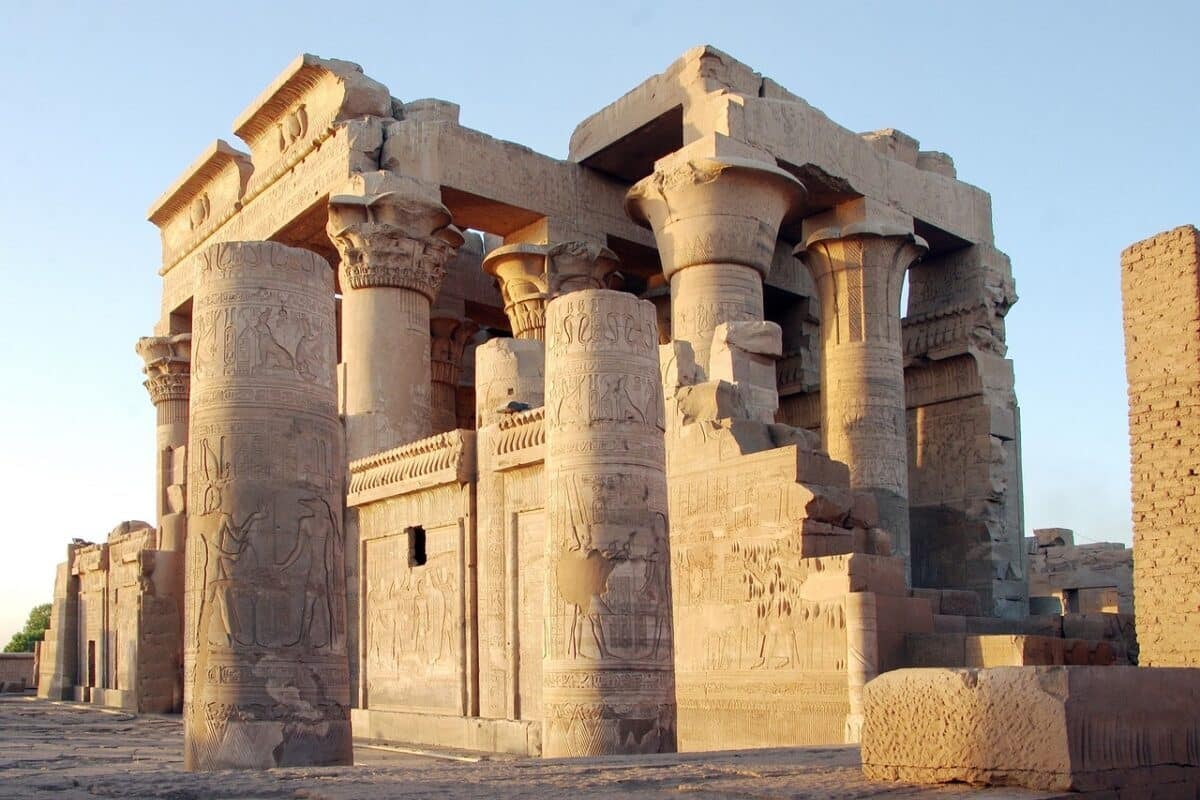
Kom Ombo Temple: Egypt's Only Double Temple! Step into the Nile Legend of the Crocodile God
What's so special about Kom Ombo Temple? It's Egypt's only double temple, dedicated to both the crocodile god Sobek and Horus, making it one of the most distinctive stops on a Nile cruise. Want to know the must-see highlights? This article rounds up the top five must-know points for you!
Kom Ombo Temple sits on the east bank of the Nile and is one of Egypt's most distinctive "double temples." The left half is dedicated to the crocodile god Sobek, while the right half honours the falcon god Horus. The entire temple was built in perfect symmetry, making it unique among all ancient Egyptian temples. Facing directly onto the Nile, it's especially stunning at sunset and is one of the most delightful stops along any Nile cruise itinerary.
The greatest appeal of Kom Ombo lies in the fact that it is Egypt's only temple shared by two gods. Ancient Egyptian temples typically honoured a single main deity, but Kom Ombo brought together two gods of entirely different standing—the crocodile god Sobek and the falcon god Horus—within one shared temple. This arrangement was no coincidence, but carried deep religious and geographical significance:
- Sobek symbolised strength and the dangers of the Nile: Kom Ombo was once home to large numbers of Nile crocodiles, so locals needed his protection.
- Horus symbolised kingship and order: representing light and justice, he was the guardian deity of the pharaohs.
- The pairing of two gods balanced chaos and order: along one of the most unpredictable stretches of the Nile, the ancients chose to have "two powers" watch over the land together.
Because of this rare configuration, the temple displays perfect left-right symmetry: two entrances, two axes, two altars, and two sets of chambers, as though two temples had been merged into one—an architectural form seldom seen anywhere else in Egyptian civilisation.
Kom Ombo Temple may seem mysterious, but its formation is actually closely tied to the political strategies of the Ptolemaic Dynasty, the environment of the Nile, and local religious beliefs in southern Egypt.
- Most of the structure was built by the Ptolemaic Dynasty (around the 2nd century BC).
- The architectural lines carry a Hellenistic style, while still retaining the complete structure of an Egyptian temple.
- The design of the “double temple” can be seen as a Ptolemaic ruling strategy: appeasing both the local worshippers of Sobek and the traditional followers of Horus at the same time.
- Kom Ombo sits on a bend of the Nile, one of the areas where crocodiles were most commonly found in ancient times.
- Crocodiles posed a threat to navigation and agriculture, which made the worship of Sobek especially important in this region.
- The temple’s numerous crocodile reliefs and the crocodile mummies later discovered here both reflect this intense local devotion.
- Roman emperors continued making offerings to Sobek and Horus, and added new spaces and carvings to the temple.
- Some of the medical wall reliefs (such as surgical instruments and childbirth scenes) date from this period and are among Kom Ombo’s most popular highlights.
- The Roman-style decorations on the colonnades and walls give Kom Ombo a blended “Egyptian × Roman” aesthetic.
- Its special location close to the riverbank has left the temple exposed to flooding and erosion over the centuries.
- This is also why today’s Kom Ombo appears more “open” than other temples—many walls have crumbled, yet this only adds to its raw, ancient character.

Front façade of Kom Ombo Temple|A Ptolemaic-era double temple renowned for its symmetrical colonnades and intricate reliefs; Sobek and Horus are each enshrined on either side, making it the only double-temple structure in all of Egypt.Image by DEZALB from Pixabay
In Kom Ombo, one cannot ignore the presence of Sobek, the crocodile god, for along this stretch of the ancient Nile, crocodiles were not merely symbolic but a very real threat. The ancient Egyptians personified the power of water, giving rise to Sobek, this mighty guardian deity. Sobek is typically depicted with a crocodile head atop a human body, symbolizing strength, courage, and vitality, and was believed to balance the dangers of the Nile, allowing its waters to bring stability and abundant harvests. There are three key reasons behind the worship of Sobek in Kom Ombo:
- Kom Ombo sits on a bend of the Nile, which in ancient times was a natural gathering spot for crocodiles.
- Farmland, river navigation, and irrigation could all be affected by crocodiles.
As a result, people believed that honouring Sobek was essential to gaining the power needed to protect their villages.
- Sobek represents the hydraulic power of the Nile and the forces of nature.
- Locals believed he could protect voyagers, bring bountiful harvests, and dispel chaos.
- Paired with the falcon god Horus (order and kingship), he also forms a symbolic balance.
This is what made Kom Ombo world-famous: archaeologists discovered a large number of crocodile mummies nearby, wrapped and preserved by priests according to complete rituals. These mummies are now housed in the Crocodile Museum, offering the most direct and striking evidence for understanding the worship of Sobek. 🐊 Fun Fact: Why Are There More Crocodile Mummies Than You'd Expect? Because in Kom Ombo, crocodiles were not merely seen as "dangerous animals" but as incarnations of Sobek. The birth, death, and preservation of crocodiles were all regarded as acts connecting priests with the divine. This is also why Kom Ombo became a symbol as the "City of Crocodiles."

Relief of the Crocodile God Sobek | Kom Ombo Temple depicts Sobek with a crocodile head and human body, symbolizing strength, healing, and the protective power of the Nile. He is also one of the most representative deities in Kom Ombo Temple's "dual worship of two gods."Image by DEZALB from Pixabay
Though the Temple of Kom Ombo is not large in scale, it is packed with highlights and intricate details, making it a surprisingly rewarding stop on your Nile cruise journey. Here are 5 key highlights you shouldn't miss:
- The most famous feature of the Temple of Kom Ombo: the left hall is dedicated to the crocodile god Sobek, while the right hall is dedicated to Horus.
- Two halls, two axes, two altars — perfectly symmetrical in every way.
- Many scholars (as commonly noted in introductory Egyptology textbooks and museum guidebooks) believe this dual temple may reflect a "religious balancing strategy" adopted by the Ptolemaic Dynasty in response to diverse local beliefs.
- Among the reliefs at Kom Ombo, the most eye-catching are those depicting medical-related imagery.
- Includes: surgical instruments, curved blades, forceps, obstetric-related poses, and more.
- Often cited as evidence when introducing ancient Egyptian medicine and the role of priests : many museums and scholarly works reference this Kom Ombo relief as an example.
- Countless crocodile images can be found throughout the temple: Sobek's crocodile-headed depictions, crocodile hieroglyphs, and riverbank-related motifs.
- These details echo the geographical fact that the area around Kom Ombo was once a gathering place for Nile crocodiles.
This is an absolute must-see highlight of Kom Ombo:
- On display are dozens of ritually preserved crocodile mummies.
- The exhibits show how priests raised, selected, and enshrined crocodiles : most scholarly sources cite this as the best case study for understanding the cult of Sobek.
- Compact in size, comfortably air-conditioned, with clear explanations, this museum is a firm favorite among cruise passengers.
- Kom Ombo stands directly on the banks of the Nile, where the golden-hour light bathes its columns and reliefs in warm golden tones.
- As cruise ships typically dock here in the afternoon or evening, this is the easiest place on the entire voyage to capture that quintessential "Egyptian cinematic" feel.

Kom Ombo Temple|Egypt's Only "Perfectly Symmetrical" Double Temple The front façade clearly shows a fully symmetrical structure on both sides, dedicated respectively to the crocodile god Sobek and the falcon-headed god Horus, symbolizing the coexistence of two forces—the balance of protection, healing, and kingship. By I, Rémih, CC BY-SA 3.0

Kom Ombo Temple|A relief depicting a ritual scene of the falcon-headed god Horus. On the right of the image is Horus, the falcon-headed god of ancient Egyptian kingship and the sky, symbolizing protection and victory, and one of the principal deities of Kom Ombo's double temple.Image by DEZALB from Pixabay

Medical Relief at the Temple of Kom Ombo | The walls are carved with ancient Egyptian surgical instruments, medical supplies, and healing rituals, making it one of the most important sources for studying ancient Egyptian medicine and reflecting the high regard for health and healing during the Ptolemaic period. By Ad Meskens - Own work, CC BY-SA 3.0
Q1: What makes the Temple of Kom Ombo so special? Is it really the only "double temple" in Egypt? A: Yes! Kom Ombo is the only temple in all of Egypt that is symmetrically divided and dedicated to two main deities at once — Sobek and Horus. This "twin-temple" layout is extremely rare in Egyptian architecture, and it's precisely what makes Kom Ombo so worth visiting. Q2: What's so special about the medical reliefs at Kom Ombo? Are they really connected to ancient Egyptian medicine? A: Yes, and they're extremely valuable. The medical reliefs at Kom Ombo are frequently cited by scholars and museums to interpret ancient Egyptian medical rituals, obstetric scenes, and the shapes of surgical instruments — making them one of the most commonly referenced visual sources for understanding ancient Egyptian medicine. Q3: Are the crocodile mummies real? Why are there so many at Kom Ombo? A: Yes, it's true, and there are quite a number of them. Kom Ombo is located near a bend in the Nile, where ancient crocodiles were especially numerous and were regarded as incarnations of Sobek (the crocodile god); hence the crocodile mummies reflect a strong local belief. At the Crocodile Museum, you can view well-preserved specimens up close. Q4: Is Kom Ombo suitable for independent travel? Or is it more convenient by cruise? A: Most travelers choose to arrive at Kom Ombo via a Nile cruise, since the mooring point is right beside the temple, allowing entry on foot. For independent travel, you'd need to arrange a private car, making timing and transportation more complicated. → If you want to save effort and time while getting better photos, a cruise is the most convenient way.
Kom Ombo Temple sits right on the banks of the Nile, and the most captivating way to experience it is by cruise, gently docking at sunset as golden light illuminates the colonnades of the double temple—an unforgettable scene for many travelers throughout their entire journey. If you want the most effortless way to admire Kom Ombo's double temple, learn the story of Sobek × Horus, and not worry about transportation or scheduling, DeWonder's Egypt In-Depth Tour will be the easiest choice. We arrange for you:
- 4-Day 3-Night Nile Cruise Voyage: Kom Ombo, Edfu, and Philae, one stop after another
- Professional Guide Tour: Helping you understand the symmetrical design and medical murals of the double temple
- Exquisite Small Groups of 8–14: A relaxed pace, with more leisurely time for photos and explanations
- Cultural Lecture + Pre-Trip Briefing:Get ahead by understanding the background of Ancient Egyptian religion and the two major deities
- No Need to Worry About Transport:Simply walk to the temple entrance after the cruise docks
If you want to travel slowly along the Nile, letting each temple reveal itself to you at just the right moment, then Kom Ombo will be the most "ritualistic" stop on your journey. 👉 Check out this year's Egypt In-Depth Tour departure dates 👉 Join our free online seminar to have your Egypt itinerary questions answered 👉 Click here to register DeWonder Egypt In-Depth Tour Information Kit 👉 Click here to download 👉 Further Reading: Egypt Temple Series Introduction
👉 Further Reading: Guide to Egyptian Mythology 👉 Further Reading: Egyptian Pyramids Guide | Grand Egyptian Museum Guide