
Luxor and Karnak Temple: The Birthplace of Ancient Egyptian Kingship and Its Religious Heart
Get a quick overview of the must-see highlights of Luxor and Karnak Temple, understand the core of ancient Egyptian kingship and religion, and learn the best visiting order — this article gives you the full picture of Luxor's true charm.
On the east bank of the Nile in Luxor, kingship and religion were never two separate paths. At one end stands Luxor Temple, where pharaohs received the gods' recognition; at the other lies Karnak Temple, the holiest site of Amun worship. The two are connected by the 3-kilometre-long Avenue of Sphinxes, forming the central axis on which ancient Egyptian civilisation operated. If you want to understand where pharaohs' power came from and how the gods were worshipped, the answer often begins in Luxor.
Ancient Thebes was the political and religious centre of Egypt's New Kingdom period, and Luxor sits at this ancient city's most crucial location. Luxor's importance lies in the fact that what is enshrined here is not an ordinary deity, but the "Royal Ka" — the symbol of the pharaoh's life force. In the ancient Egyptian worldview, a pharaoh's power only became legitimate once it was "confirmed" by the gods, which is why Luxor Temple was an indispensable stage in every pharaoh's coronation ceremony. Luxor and Karnak, the two great temples, are connected by the 3-kilometre-long "Avenue of Sphinxes" — a road that once served as the route for the annual Opet Festival's procession of the gods, symbolising how the pharaoh received kingship at Luxor while divine power was renewed at Karnak. To understand Luxor is to understand how ancient Egypt operated a nation through the combined workings of "kingship × divine authority." 💡 Did You Know: The Most Important Religious Festival in Ancient Egypt — The Opet Festival The Opet Festival was the grandest religious celebration in Thebes during the New Kingdom period, held annually around the Nile's harvest season and lasting anywhere from a few days to several weeks. During this time, statues of Amun, Mut, and Khonsu were carried from Karnak Temple along the Avenue of Sphinxes to Luxor Temple. This procession symbolised the gods personally descending upon the city, once again "confirming the pharaoh's legitimacy and divine power."👉 It is precisely because of the Opet Festival that Luxor and Karnak remain so closely connected.

Avenue of Sphinxes A 3-kilometre ceremonial road linking Karnak and Luxor Temple, flanked on both sides by rows of guardian sphinxes. Photo by Francesco Albanese
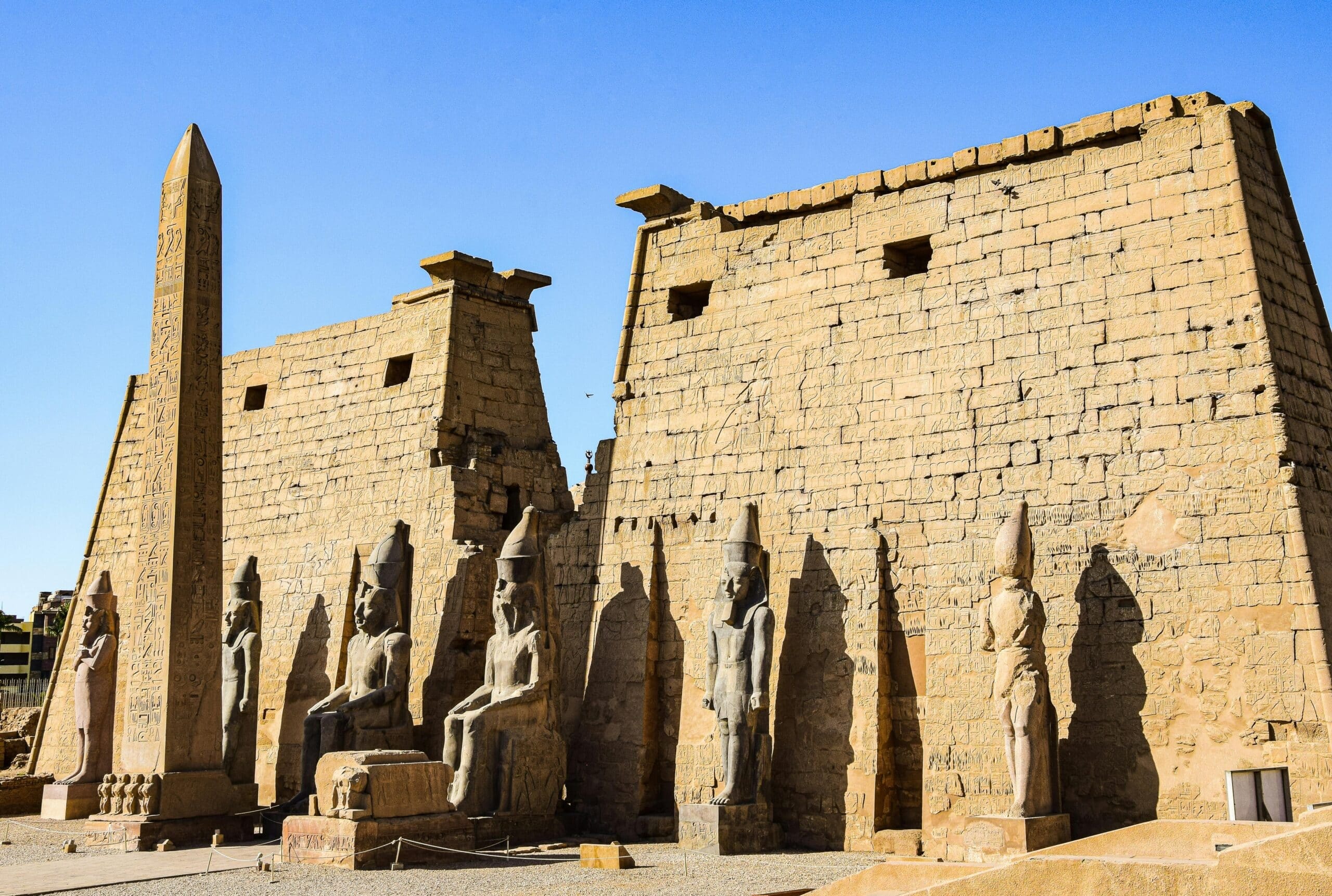
Step into Luxor Temple and you'll be greeted by colossal statues of Ramesses II and an obelisk still standing in its original spot. Many assume this temple was built by a single pharaoh, but its history actually spans multiple eras: first constructed by Amenhotep III, later expanded by Ramesses II, and further marked by inscriptions and construction from Alexander the Great and the Roman Empire — even during the Islamic period, when the Abu Haggag Mosque was built directly atop the temple. This makes Luxor Temple a truly "living temple" — one where ancient Egyptian, Greek, Roman, and Islamic civilisations have all left their mark. Only one obelisk remains at the entrance, as the other was gifted to Paris in the 19th century and now stands in the Place de la Concorde — a delightful bit of trivia for many travellers. By day, Luxor Temple is perfect for examining its colonnades and carvings in detail; but the most captivating time is at night, when lighting brings out the depth of the reliefs, lending the entire temple a more epic atmosphere.

Entrance to Luxor Temple The colossal statues of Ramesses II and the original obelisk form the temple's most iconic entrance scene. Photo by AXP Photography

The Abu Haggag Mosque standing alongside Luxor Temple Perched above the temple, the Abu Haggag Mosque reveals three thousand years of Luxor's layered urban history. By Marc Ryckaert - Own work, CC BY 3.0
Karnak Temple is the largest religious complex in ancient Egypt, covering over 25 hectares and continuously expanded by more than thirty pharaohs over a period of over a thousand years, forming a vast "city of the gods." Its most iconic feature, the Hypostyle Hall, contains 134 massive columns. Few realise these columns once supported a covered roof, and the entire space was once painted in vivid blue, gold, and red. Where traces of pigment still remain today, one can still imagine the magnificent scenes of ancient ceremonies. Karnak's religious power extended far beyond its architecture. In the late New Kingdom, the priests of Amun grew so influential that they could even sway royal politics, making Karnak a symbol of being "not merely a dwelling of the gods, but also a political stage." 💡 Did You Know: Some of Karnak's gates and axes align with the winter solstice sunrise, showing that astronomical symbolism was woven into the temple's design—a rarity among ancient civilisations. The Sacred Lake, once used by priests for purification rituals, still exudes a mysterious, tranquil atmosphere within the temple grounds today.

The Great Hypostyle Hall of Karnak Temple With 134 massive columns and still-visible coloured reliefs, this is Karnak's most awe-inspiring forest of stone pillars. Photo by AXP Photography
Below are the 3 most frequently asked questions—key points to note when visiting both the Luxor and Karnak Temples.
- Colossi of Ramesses II: The most iconic entrance scene.
- Original Obelisk Site: Its twin now stands at Place de la Concorde in Paris.
- Alexander the Great Relief Carvings: A testament to the city's Hellenistic-era history.
- Abu Haggag Mosque: Perched atop the temple, it embodies three thousand years of layered civilisation.
- Temple at Night: The lighting brings the carvings and colonnades to life, making it the most recommended time to visit.

The Luxor Obelisk—the only remaining obelisk at the temple entrance, with its twin now standing in Paris's Place de la Concorde—is one of Luxor's most storied landmarks. Photo by AXP Photography
- Avenue of Ram-Headed Sphinxes: Sacred beasts symbolising the god Amun, marking the starting point into the Karnak temple complex.
- Hypostyle Hall: With 134 massive columns, it is the most awe-inspiring space in the entire temple.
- Core Sanctuary of Amun: The religious heart of ancient Egypt.
- Sacred Lake: The site of the priests' purification rituals, most beautiful in the light of sunset.
- Hatshepsut's Obelisk: A symbol of the queen's political and religious will.

The Avenue of Ram-Headed Sphinxes at Karnak Temple, located before the entrance to the Karnak Temple, guards the sacred domain with ram heads symbolising the god Amun. Photo by AXP Photography

Panoramic view of Karnak Temple and the Sacred Lake At dusk, Karnak Temple's reflection on the Sacred Lake offers the best angle to experience the temple's solemn and mysterious atmosphere. By Taranis-iuppiter - Own work, CC BY-SA 3.0
Suggested route: Karnak → Avenue of Sphinxes → Luxor Temple. This route follows the same path as the ancient Egyptian Opet Festival's procession of deities, offering the best lighting, photo angles, and timing for your visit.
Absolutely! The night lighting brings the colonnades and carvings to life in three dimensions, making it one of the most atmospheric and photogenic times to visit Luxor.

Luxor Temple at NightThe night lighting makes the obelisk and colossal statues of Ramesses II at the temple entrance stand out in even greater relief—the most recommended time to view them. Photo by AXP Photography
Luxor symbolizes the birth of pharaohs and the workings of royal power, while the Valley of the Kings on the west bank holds their path to eternity.The Nile links both banks into the most complete story of ancient Egyptian civilization, forming the most classic travel route.If you want to experience Karnak, Luxor Temple, the Valley of the Kings, and the magnificent temples along the Nile all in one trip—without worrying about transportation, routing, or guiding—DeWonder's Egypt In-Depth Tourwill be the easiest and most well-structured way to do it. ✨ Tour Highlights:
- 4 days, 3 nights on a Nile cruise, traveling slowly along the pharaohs' river
- Expert guided commentary to understand the stories behind the temples, murals, and religious rituals
- Seamlessly connected classic sites: Karnak → Luxor → Valley of the Kings → Kom Ombo → Edfu
- Small groups of 8–14 people, for a more comfortable pace and deeper experience
Let this be more than just a visit—truly step into the heart of ancient Egyptian civilization. 👉 View Egypt In-Depth Tour Departure Dates for the Whole Year 👉 Join Our Free Online Seminar to Get Your Egypt Trip Questions Answered 👉 Click Here to Register DeWonder Egypt In-Depth Tour Information Kit 👉 Click Here to Download 👉 Further Reading: Egypt Pyramids Guide | Grand Egyptian Museum Guide 👉 Further Reading: Egyptian Mythology Guide 👉 Further Reading: Introduction to Abu Simbel Temple | Introduction to the Valley of the Kings