
Philae Temple: Egypt's Most Beautiful Water Temple! Discover the Pearl of the Nile
Get a quick grasp of Philae Temple's charm and must-see highlights! This article covers its history, mythology, and key sights, helping you easily capture the essence of the "Pearl of the Nile."
Philae Temple sits on the banks of the Nile in Aswan, hailed by many travellers as "Egypt's most beautiful water temple." Its beauty comes not only from the temple itself, but from the atmosphere created by myth, relocation, and the play of light on the island. Looking towards Philae from the water, you'll understand why it's called the "Pearl of the Nile"—gentle, serene, and carrying a sense of protection from an ancient goddess.
Philae Temple stands out among Egypt's many temples mainly for the following reasons:
- The temple sits on a small island, encircled on all sides by the Nile.
- Unlike the grandeur of Abu Simbel or Karnak, Philae's beauty is more delicate, gentle, and poetic.
- Travellers' favourite moment is: the instant the temple's reflection appears on the water as the boat slowly draws near.
- The carvings are exquisite and the slender columns carry more of a Hellenistic architectural style than other temples.
- The capitals, reliefs, and walls display the graceful lines of the Ptolemaic period.
- Unlike the Ramesses temples that emphasise power, Philae emphasises beauty × storytelling.
It is not merely a religious structure, but:
- The principal center of worship for the goddess Isis (one of ancient Egypt's most revered deities)
- A symbol of motherhood, magic, protection, and resurrection
- Its mythology imbues the temple with an even richer imagery of romance and the restoration of life
👉 This "emotional resonance" is Philae's most distinctive charm, and the reason travelers form such a deep connection with it.
- Long after other ancient religions had ended, the Temple of Philae continued to operate into the Roman period.
- Its exceptionally long period of use gave rise to a rich accumulation of layered cultures, earning it the title:"The Last Living Temple of Ancient Egypt."

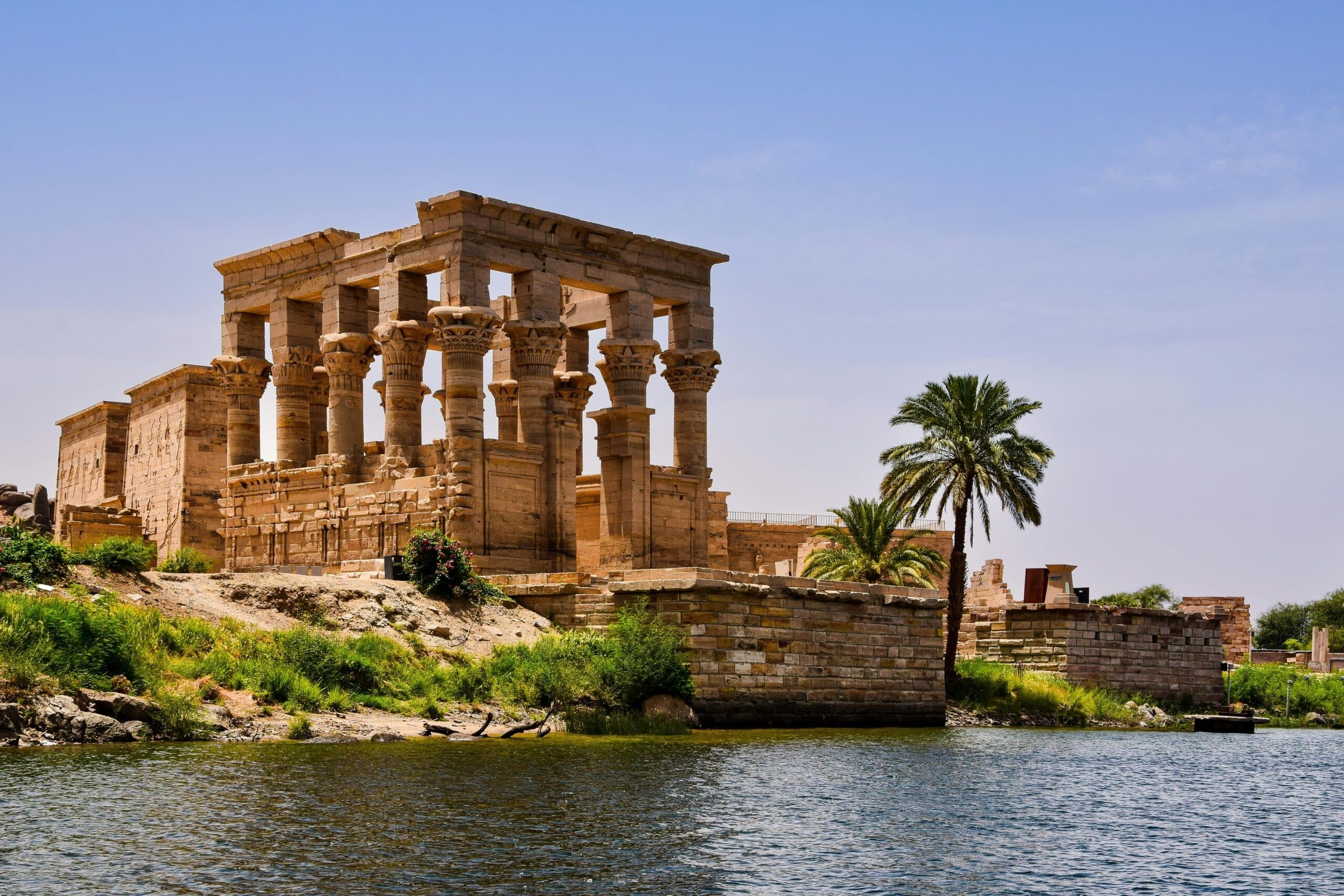
A distant view of the Temple of Philae from the Nile|The First and Second Pylons of the main temple, along with the surrounding colonnades, are clearly visible — one of the most iconic sights greeting travelers as they arrive by boat.Photo by AXP Photography
The Temple of Philae is not only famous for its scenery on the water; it also bears witness to a rare "overlapping of eras" found in the Aswan region. On this single island, you can see traces left behind by different civilisations, making Philae an essential key point for studying the history of southern Egypt.
- The main structures were built by the Ptolemaic dynasty, featuring delicate lines and lighter proportions.
- Among the many ancient Egyptian temples, Philae's carvings and columns lean towards a Hellenistic style, giving it a softer character compared to Karnak and Abu Simbel.
- Roman emperors continued to honour the goddess Isis, adding ceremonial kiosks on the island.
- The most iconic of these, Trajan's Kiosk, has almost become "the signature silhouette of Philae."
- While most Egyptian temples ceased their rites of worship under Roman rule, the cult of Isis at Philae persisted much longer, only officially ending in the 6th century AD.
- This makes Philae the last operating temple centre of ancient Egypt.
- Parts of the temple chambers were converted into Christian worship spaces.
- The crosses carved on the walls were not acts of destruction, but symbols of religious transition.
- These details make Philae a true temple of "multi-civilisation coexistence."
Philae Temple is regarded as the "Sacred Island on the Nile" because of one of ancient Egypt's most moving myths — the journey of Isis in search of her husband Osiris. In legend, Osiris symbolised civilisation and order, embodying the ideal ancient Egyptian king, while Isis represented motherhood, magic, and protection, making her one of the most revered goddesses. Together, they were a couple symbolising the balance of nature and the legitimacy of kingship. The story takes a dramatic turn when Osiris is murdered by his brother Set, who dismembers his body and scatters the pieces across Egypt. Refusing to give up, Isis travels the length of the land, recovering her husband's body parts one by one and using magic to restore him to life. According to legend, one of Osiris's most important remains was found on Philae Island. It was here that Isis performed the resurrection ritual, briefly bringing Osiris back to life, and it was also here that she gave birth to Horus—the protective god symbolising the Pharaohs of Egypt. Thus, Philae is not merely an island where a temple stands, but a place symbolising rebirth, protection, and the continuity of kingship. This is precisely what sets Philae Temple apart in character from all other temples. 💡Quick Facts: Key Comparisons Between Philae Temple and the Myth
- Isis = Motherhood × Magic × Protection
- Osiris = Life × Civilisation × Archetype of Kingship
- Philae Island = The key site where the body was found × Where the resurrection ritual took place
- Birth of Horus = A symbol of the Pharaoh's legitimacy
👉 Further Reading: A Quick Guide to Egypt's Most Important Deities
That Philae Temple stands intact on the Nile today is by no means something to be taken for granted. After the Aswan High Dam was completed in the 1960s, the original Philae Island was gradually submerged by rising water levels. The temple's foundations, colonnades and reliefs remained underwater for years, and the murals began to flake away due to moisture. Had rescue efforts not come in time, this "Pearl of the Nile" could have vanished within just a few decades. This made Philae the second major international heritage rescue operation launched by UNESCO, following Abu Simbel.
According to UNESCO records, the scale of this engineering project was far grander than most visitors imagine: a coffer dam was first built to drain the water surrounding the original island, allowing the engineering team to work on "dry land".
- The temple was dismantled block by block, with each piece numbered, photographed and measured to ensure no stone was lost.
- Tens of thousands of stone blocks were transported to Agilkia Island — higher and safer, with terrain closer to that of the original Philae Island.
- The temple was reassembled in its original orientation and structure, with an overall margin of error so small it rivals the precision of the Abu Simbel relocation.
- This relocation project took many years and mobilised experts from multiple countries, standing as a landmark example of collaboration between engineering technology and heritage preservation.
Through this relocation process, the Temple of Philae has gained even greater value. It is no longer simply a "preserved temple", but rather a cultural heritage site recognised by the world as worth protecting and worth saving.
- A result jointly safeguarded by the ancient and the modern: the temple bears traces from the Ptolemaic, Roman and Christian periods, and now carries an additional layer — its "rebirth through modern engineering".
- A clearer meaning of preservation:Every column and every stone was dismantled and reassembled piece by piece — what you see is not just architecture, but a triumphant example of large-scale cultural rescue.
- More "fragile, fortunate and precious" than other temples:Having narrowly escaped submersion, the temple now standing once again in the sunlight makes you truly appreciate "how remarkable it is that this island has survived to this day."
- The best real-world lesson in UNESCO World Heritage preservation philosophy:Anyone interested in culture, engineering, or history can come here and witness "how the ancient is preserved in the modern age."
Why is the Philae Temple so worth seeing? As travellers pass through the First Pylon and gaze toward Trajan's Kiosk over the water, what they see is not merely a temple preserved by time, but a temple that was "rescued from beneath the water by the world."
- Isis Temple|The Core Structure of Philae The main sanctuary of the entire temple complex, with clear pathways and excellent preservation. The reliefs on the First and Second Pylons depict Isis performing rituals for Osiris and Horus.
- Birth House (Mammisi)|Symbol of Horus's Birthplace Depicts the scene of Isis's pregnancy and the birth of Horus. This is a key space for understanding the concept of "divine right of kings."
- Trajan's Kiosk|Philae's Postcard on the Water The iconic pavilion that visitors first see from the boat. Built during the Roman period, it was used to welcome the sacred barque ceremony.
- First Pylon Reliefs|The Best Introduction to the Myth of the Isis Family The reliefs fully depict the mythological narrative of Isis, Osiris, and Horus.Clean, clear lines make this the spot experts most recommend lingering over.
- Inner Sanctuary & Barque Shrine|The Ritual Core The most sacred area, housing the sacred barque and divine statues. The murals depict the barque procession and royal ceremonies, offering a key scene for understanding ancient Egyptian rites.

Entrance to the Main Temple of Isis|The pylon reliefs depict the classic myth of Isis, Horus, and Osiris, one of the most iconic scenes at the Temple of Philae. Photo by AXP Photography

Birth House (Mammisi)|A typical Ptolemaic-era structure, its column capitals carved with the face of the goddess Hathor, while wall reliefs depict Isis cradling new life—an important space symbolizing the birth of Horus.Image by Nadine Doerlé from Pixabay

Kiosk of Trajan | One of the most photogenic structures at the Temple of Philae, renowned for its open colonnade, elegant proportions, and waterside setting. In ancient times it was used to welcome the "Divine Boat Ceremony," and today it's the first landmark visitors see from the Nile.Photo by AXP Photography
Q1: What's special about the Temple of Philae? Why is it a must-visit? A: It's Egypt's most beautiful "temple on the water," combining the myth of Isis with Ptolemaic and Roman architectural styles, plus the remarkable story of its UNESCO-led relocation and revival — making it one of the most iconic cultural sites along the Nile. Q2: When is the best time to visit? A: Early morning and evening are best recommended: the light is soft, reflections are at their clearest, and it's also the most beautiful time to photograph the Kiosk of Trajan and the First Pylon. Q3: How do you get to the Temple of Philae? Is it easy to reach? A: Philae is located in Aswan — you'll need to head to the dock first, then take a small boat to the island. It's recommended to join a tour group or arrange transfers with a local driver, which will save both time and effort. Q4: Is the Philae Temple night light show worth watching? A: Absolutely! Philae at night is even more magical—the play of light and shadow brings the reliefs vividly to life, making it the "Pearl of the Nile" after dark in the hearts of many travellers.
Philae is a temple on the water that can only be reached by boat, and it's also one of the most atmospheric spots along the Nile to savour slowly. If you want to relax and enjoy Philae's reflections on the water, learn about the myth of Isis, and skip the hassle of arranging transport, docks, and boat transfers in Aswan—DeWonder's Egypt in-depth tour is the most comfortable way to do it. We've prepared for you:
- 4-day, 3-night Nile cruise: Travel slowly along the very waterways the pharaohs once sailed
- Expert guided tour of Philae Temple: Understand the myth of Isis and Osiris, plus the story of the temple's relocation
- Classic Nile-side itinerary: Aswan → Philae → Kom Ombo → Edfu
- Boutique small groups of 8–14: Just the right pace, with more time for photos and explanations
- Pre-Trip Cultural Briefing:Get to know ancient Egyptian mythology and temple structures beforehand, so you'll feel more connected on site
If you want to truly understand the story of the Philae Temple, experience the play of light and shadow on the temple's water surface, and travel along the most classic and comfortable Nile route, then join us on a journey to fully understand the civilization of southern ancient Egypt. 👉 View year-round departure dates for our Egypt In-Depth Tour 👉 Join our free online seminarto get your Egypt itinerary questions answered 👉 Click here to register DeWonder Egypt In-Depth Tour Information Kit 👉 Click here to download 👉 Further Reading: Egyptian Temple Series Introduction
👉 Further Reading: Egyptian Mythology Guide 👉 Further Reading: Egyptian Pyramids Guide | Grand Egyptian Museum Guide