
Who Was Hatshepsut? Understanding the Link Between Her Temple and the Valley of the Kings
Get to know Hatshepsut and understand the connection between her temple and the Valley of the Kings, so your trip to Egypt isn't just about seeing ruins, but about grasping the context behind them.
Hatshepsut was one of the few women in ancient Egypt to truly rule as a "pharaoh." For travellers, understanding her importance isn't about memorising her life story, but rather this: Her temple and the Valley of the Kings happen to correspond to two things
- How she built her image as a pharaoh
- How she was placed within the pharaonic system
If you know this context first, what you see on site won't just be architecture or a tomb — you'll find it easier to understand:
- Why her temple differs from those of other pharaohs in design and narrative
- Why the temple repeatedly emphasises "divinely ordained rule"
- Why her presence in the Valley of the Kings is itself noteworthy
👉 At the Temple of Hatshepsut, see how she built her image; at the Valley of the Kings, see how she was placed within the system.
What to look at first? | What will you notice on site? | What does this mean? |
The Temple's Architectural Form | Three terraced platforms, an axial layout, and integration with the cliff face | Establishing the legitimacy of her rule through order and space |
The Content of the Temple's Murals | Divine sanction by the god Amun, a sacred birth, and expedition scenes | Using religion and political achievements to support her status as pharaoh |
The Nature of the Valley of the Kings | A space for royal burial rites, not an ordinary cemetery | In itself a part of the pharaonic system |
Understanding the Two Sites Together | The temple and the Valley of the Kings echo one another | One builds the image, the other corresponds to the system |
Many people, when they walk into the Temple of Hatshepsut in Egypt, feel that this temple's form is rather different from other temples; and once at the Valley of the Kings, they focus their attention on the tombs of various pharaohs. But without Hatshepsut as the connecting thread, these two places can easily be treated as unrelated attractions. 💡Key takeaway: The temple is where she built her image as pharaoh; the Valley of the Kings is where she was placed within the pharaonic system. Once you understand this, the details you see on-site will begin to take on meaning.

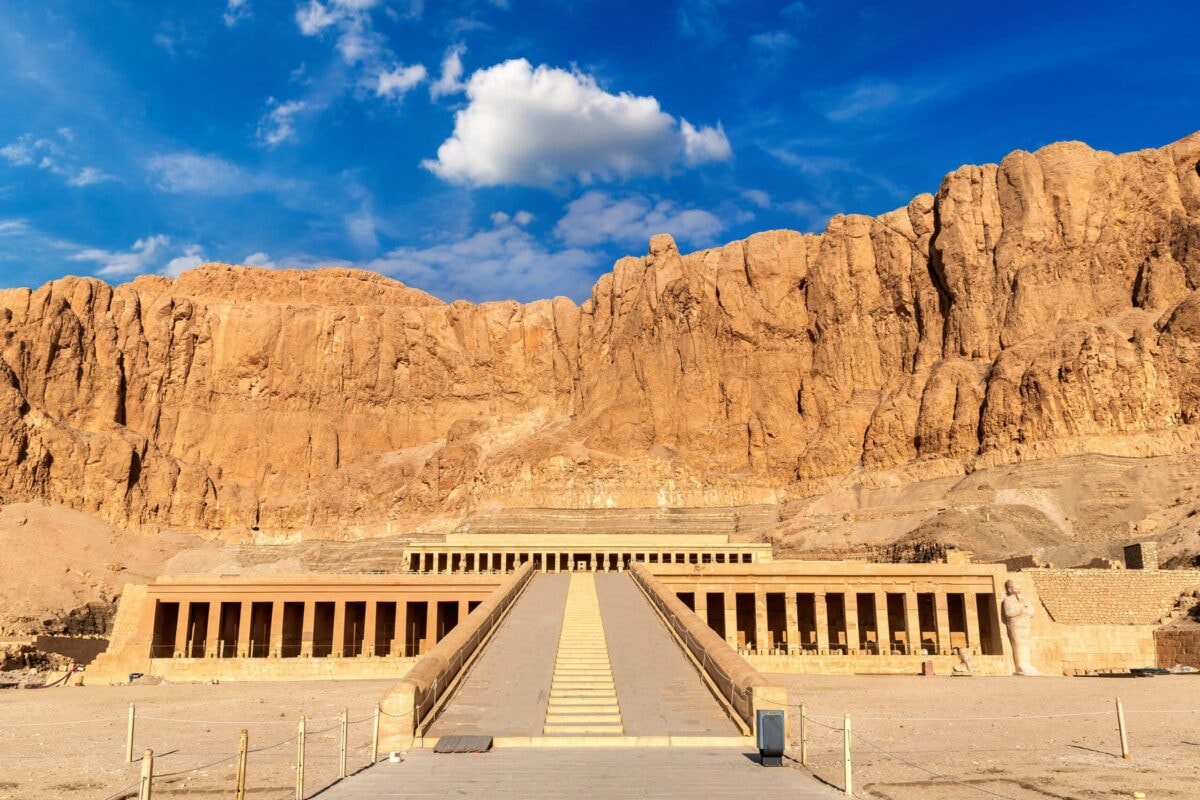
The Temple of Hatshepsut (Deir el-Bahari) is composed of three terraced platforms and a central axis, tightly integrated with the cliff face behind it, demonstrating how ancient Egypt established order and pharaonic authority through architecture.

The Valley of the Kings is not merely the resting place of pharaohs, but a core space where ancient Egyptian kingship and afterlife beliefs converge; once you understand this, you can better appreciate the significance of Hatshepsut's presence here.
The focus of this temple is not just its architectural appearance, but the message that the architecture conveys.
Key Point | What Can You Observe On-Site? | Why Does It Matter? |
Architectural Form | Three-tiered terraces, a central axis, and integration with the cliff face | Establishing authority through structure and order rather than sheer scale |
Mural Content | Divine birth, divinely sanctioned rule, records of expeditions | Legitimising the reign as divine will and accomplishment |
Spatial Flow | A gradual ascent tier by tier, with sightlines focused on the central axis | Guiding visitors, in sequence, into a carefully designed narrative |
The Temple of Hatshepsut lies at Deir el-Bahari, and its principal features include:
- A three-tiered terraced structure
- A clearly defined central axis
- Full integration with the mountainside
- Open spaces with clear proportions
Unlike many temples that emphasise "mass and a sense of overwhelming presence," this one places greater emphasis on structure and order.
Within the temple, pay special attention to:
- The divine birth narrative of the god Amun
- The interactions between pharaoh and god
- Political and economic achievements such as the expedition to Punt
What these all have in common is:placing her reign within myth and cosmic order, rather than treating it as mere historical events. Once you're there, you can look at it this way:
- Whether her position in the scene is prominent
- How the gods "sanction" her
- Which scenes speak of religion, and which are actually about power
This temple doesn't reveal itself all at once, but is entered level by level. You can notice:
- The rhythm between each terrace platform
- How the line of sight is guided toward the central axis
- How the space shifts from open to concentrated
This turns the entire visit into a deliberately arranged process of understanding, rather than aimless sightseeing.
The Valley of the Kings was in itself the royal burial system of the pharaohs, not something built for any single pharaoh.
Key point | What can you observe on site? | Why does it matter? |
The essence of the Valley of the Kings | Concentrated on the tombs of the New Kingdom pharaohs | It is in itself part of the order of kingship and religion |
Hatshepsut's place | She too was placed within this system | She was incorporated into the existing pharaonic structure |
The connection with the temple | The two sites complement each other | One establishes the image, the other corresponds to the system |
The Valley of the Kings was one of the principal burial sites of the New Kingdom pharaohs, carrying clear institutional and religious significance. This means:
- It belonged to the pharaonic system from the outset
- It embodies power and belief in itself
- Not just anyone could be laid to rest here
The point isn't who built the Valley of the Kings, but who was admitted into this system.
It becomes clearer if you first understand the nature of the Valley of the Kings, and then look at her:
- She was not a typical male heir
- Her identity as pharaoh needed to be established and reinforced
- In the end she was still placed within this royal burial system
If you have already seen at the temple how she built her own image, the Valley of the Kings will let you see how she was placed within the existing pharaonic system. This way the two sites connect into a single thread, rather than standing apart from each other. Quick summary: before heading to the Valley of the Kings and the Temple of Hatshepsut, just remember these 3 things
- The temple: how she established her pharaonic image through architecture and narrative
- The Valley of the Kings: how she was placed within the existing pharaonic system
- Viewing the two together: only then can you grasp her complete place in history
👉 This way, what you see on site is not just a sight, but a much clearer context. 👉 Further reading : An introduction to the Valley of the Kings and the Temple of Hatshepsut
Many people, when they visit the Temple of Hatshepsut, only remember that its architectural form is quite special; when they reach the Valley of the Kings, they only remember the tombs and the history. But without the context, it is easy to miss the fact that these two places are actually telling the same story. On DeWonder's in-depth Egypt tour, we don't just take you into these settings—we also help you truly understand how this female pharaoh is placed within, and interpreted through, the entire pharaonic system. If, while travelling in Egypt, you want to focus on understanding the culture, appreciating the sights, and feeling the rhythm of the journey while someone else handles the logistics and itinerary, a small, thoroughly pre-planned in-depth tour will make the whole experience far more relaxing.And DeWonder's in-depth Egypt tour , with its small-group in-depth itinerary, is one option worth considering that meets these expectations: ✨ Itinerary highlights:
- A domestic flight from Cairo links up with an Aswan Nile River cruise—no long road transfers and no backtracking
- A 4-day, 3-night Nile cruise, travelling slowly along the pharaohs' river
- Expert-guided commentary to help you understand the stories behind the temples, murals, and religious rituals
- Small groups of 8–14 people, for a more comfortable pace and a more in-depth experience
So that you don't just pass through, but truly step into the heart of ancient Egyptian civilisation. 👉 View the full-year departure dates for our in-depth Egypt tours 👉 Join a free online seminar to have your questions about the Egypt itinerary answered 👉 Click here to register DeWonder In-Depth Egypt Tour Info Kit 👉 Click here to download 👉 See moreEgypt travel guide 👉 Further reading: A guide to Egypt's temples
👉 Further reading:A Guide to Egyptian Mythology | Decoding Egyptian Symbols 👉 Further reading:Guide to the Pyramids of Egypt | Guide to the Grand Egyptian Museum