
Who Was Ramesses II? Meet the Pharaoh Who Unlocks Abu Simbel, Karnak & Luxor
Get to know Ramesses II and make sense of the three great temples: Abu Simbel, Karnak, and Luxor.
Ramesses II was one of the pharaohs who reigned during ancient Egypt's most powerful era, ruling for as long as 66 years. He built or expanded the temples of Abu Simbel, Karnak, and Luxor, leaving an extraordinarily vivid presence through architecture and statues. For travellers preparing to visit Egypt, understanding Ramesses II is almost like grasping the main thread that makes sense of the temples.
Many people's first impression in Egypt is: the temples really are magnificent, but it seems a little hard to tell them apart. It's not that they're hard to remember, but that a "connecting point" is missing. And Ramesses II happens to be exactly the person who can tie the whole journey together.
- At Abu Simbel, you'll first see his "presence"
- At Karnak, you'll begin to notice his "traces"
- At Luxor, you'll sense his "role"
- At the Grand Egyptian Museum, you'll encounter him once again
As these points slowly connect, you'll realise: this journey has actually been unfolding around the same person all along.
Rather than saying Ramesses II was "the greatest," it's more accurate to say he knew very well how to make himself remembered.
- A 66-year reign: gave him ample time to gradually build up his architecture, image, and power.
- The Battle of Kadesh: through murals and reliefs, he left behind a version of the story that was entirely his own.
- Buildings and statues scattered far and wide: making his name appear again and again across different spaces.
In the end, you'll realise that the "Egypt" you remember is, in large part, the image Ramesses II left behind.
When visiting these temples in Egypt, many people find them magnificent yet a little hard to connect. Ramesses II is the key figure who ties the whole story together. Once you understand his role, revisiting these four places will feel completely different.
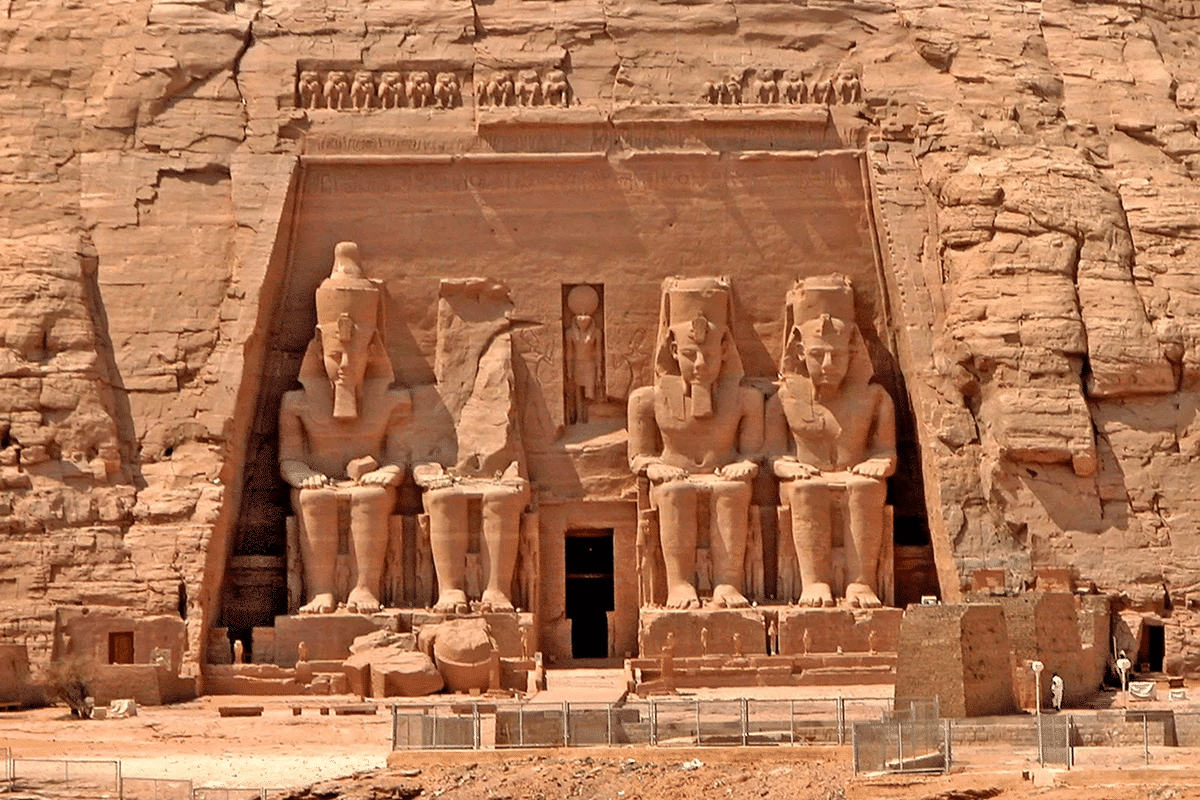
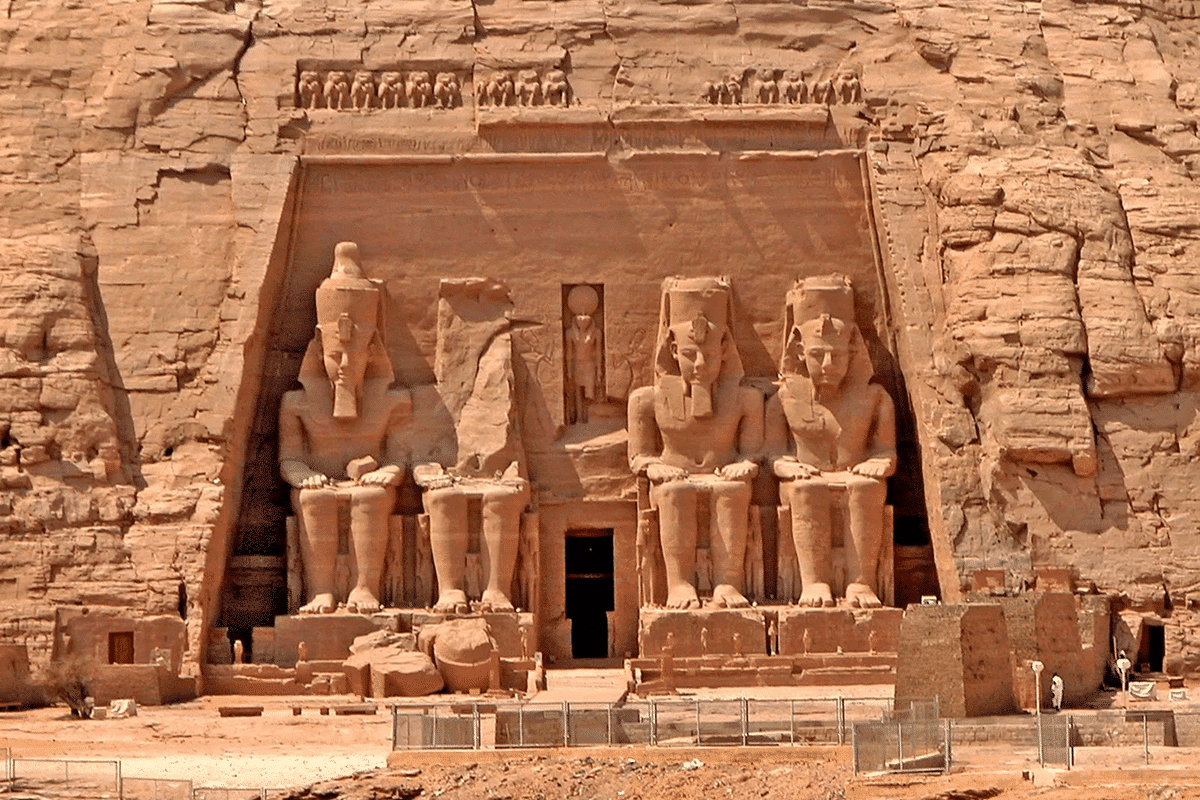
The colossal statues of Ramesses II outside the Abu Simbel Temples. Through four statues standing about 20 metres tall, he placed his own image directly on the frontier, reinforcing the presence and power of the ruler.
This temple was built by the direct order of Ramesses II, located at Egypt's southernmost frontier:
- Facing the Nubian region, carrying clear geographical and political significance
- The four colossal statues on the façade, each about 20 metres tall, all depict him
- The murals inside the temple portray the Battle of Kadesh, emphasising his military image
- Features a "solar alignment phenomenon", where on specific dates sunlight reaches deep into the temple
The entire design centres on one core idea: "reinforcing the image of the pharaoh."
Outside the temple, pay special attention to:
- The arrangement and orientation of the four statues
- Whether they are all presented in the same posture and proportions
- The direction the statues face (outward rather than inward)
Once inside the temple, you can also observe:
- How the battle scenes are depicted
- The pharaoh's proportions and position within the scenes
These details help you understand how the temple reinforces the ruler's image through visual design. 👉 Further reading : Abu Simbel Temple Guide

The columns of the Great Hypostyle Hall at Karnak Temple, inscribed with the name and image of Ramesses II. Through the cartouches that recur throughout the temple's spaces, his presence at this religious centre is reinforced.
Karnak Temple was built by many pharaohs, and Ramesses II carried out significant expansions and decorations there:
- Completed most of the decorative work in the Great Hypostyle Hall
- Inscribed a great many cartouches on the columns and walls
- In some areas, traces can be seen of records of previous pharaohs being overwritten
He was not the sole builder, but he left behind an extremely high density of his presence.
In the hypostyle hall, you can observe:
- The frequency and distribution of the cartouches
- Whether they are concentrated at a particular eye level
- whether the depth of the carvings varies
You can also pay attention to:
- whether there are traces of re-carving or overwriting
- the spatial relationship between the names of different pharaohs
These details can help us understand how spaces were reused across different periods.

The pylon, obelisk and statues of Ramesses II at the entrance of Luxor Temple. Through the arrangement of the entrance space, the gaze is guided toward the pharaoh's image, presenting his central role in religious rituals.
Ramesses II carried out major expansions in front of Luxor Temple:
- building a large pylon
- placing colossal seated statues on either side of the entrance
- Originally featured two obelisks (one of which now stands in Paris)
- Connected to the ceremonial route of the Opet Festival
This was an important venue for religious rituals and the display of royal power.
At the temple entrance, you can observe:
- The relationship between the placement of the colossal statues and the entry pathway
- Whether your line of sight naturally converges on the pharaoh's statue
- How the architectural axis guides the direction of your walk
Within the overall space, you can also pay attention to:
- The direction in which the ceremonial route extends
- The continuity between different areas
These designs reflect the temple's function as a "ritual space." 👉 Further Reading: Luxor & Karnak Temple
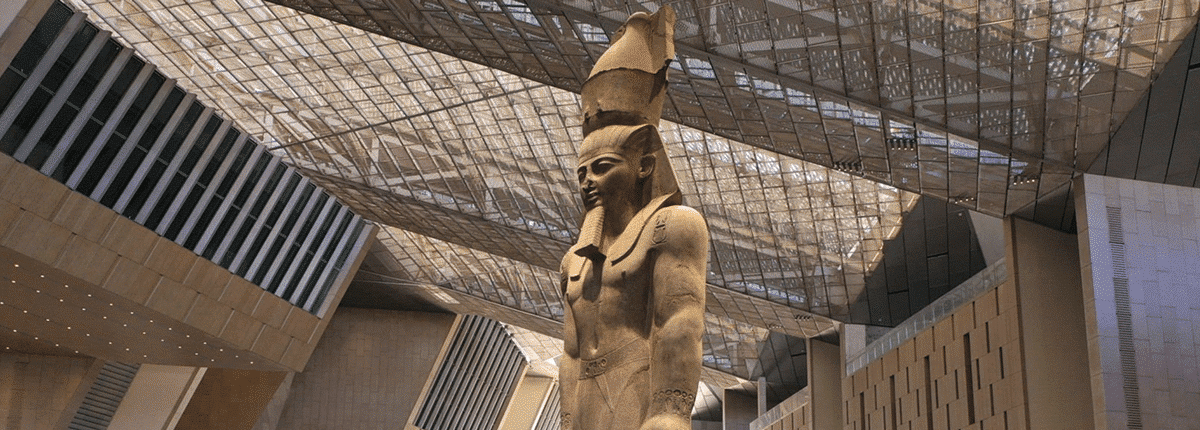
The statue of Ramesses II in the atrium of the Grand Egyptian Museum (GEM). Through the central entrance axis and spatial design, the pharaoh's figure is placed as the first visual focal point upon entering the museum, continuing his role as a symbolic figure in the display.
A colossal statue of Ramesses II is displayed in the atrium of the Grand Egyptian Museum:
- Originally located in Memphis
- Moved to Ramesses Square in Cairo in the 20th century
- Officially relocated to the GEM in 2018, becoming the centrepiece of the entrance
- One of the earliest artefacts to be moved into the museum
Today it serves as a key visual focal point as you enter the museum.
When entering the museum, you can observe:
- The position of the statue within the space (the central axis of the entrance)
- Whether your line of sight is naturally drawn toward the statue
- How the building's openings and light fall upon the statue
At the same time, you can also reflect on:
- Why this artefact was placed at the entrance
- Its relationship to the overall flow of the exhibition
These arrangements reflect the modern museum's strategy for displaying "symbolic artefacts".
Once you have made your way through Egypt's major sites, you will gradually discover how significant Ramesses II is to these places
- At Abu Simbel, he shows you his power
- At Karnak, he makes you remember his name
- At Luxor, he makes you believe in his standing
- At the GEM, you meet him once again
You are not simply viewing different sites—you are stepping into a world shaped by one and the same pharaoh. If you would like to travel through Egypt with someone to help arrange the logistics and itinerary, so you can focus on understanding the culture, appreciating the sites, and savouring the rhythm of the journey, a well-planned, small-group in-depth tour will make the whole experience far more relaxing. And DeWonder's Egypt In-Depth Tour small-group in-depth itinerary is one option worth considering that meets these expectations: ✨ Itinerary Highlights:
- Domestic flights link Cairo with an Aswan Nile cruise itinerary—no long road transfers and no backtracking
- A 4-day, 3-night Nile cruise, travelling slowly along the pharaohs' river
- Expert-guided commentary, so you understand the stories behind the temples, murals and religious rituals
- A small group of 8–14 people, for a more comfortable pace and a deeper experience
So you don't just pass through, but truly step into the heart of ancient Egyptian civilisation. 👉 View the full-year departure dates for our in-depth Egypt tours 👉 Join our free online seminar to get answers to your questions about the Egypt itinerary 👉 Click here to register DeWonder In-Depth Egypt Tour Info Kit 👉 Click here to download 👉 See more Egypt Travel Guide 👉 Further reading: An introduction to Egypt's temples series
👉 Further reading: Guide to Egyptian Mythology | Decoding Egyptian Symbols 👉 Further reading: Guide to the Egyptian Pyramids | Guide to the Grand Egyptian Museum