
Antarctic Penguin Guide: 8 Star Species, Peak Months & Habitat Highlights
Where should you go to see penguins? This article rounds up the features and viewing spots of 8 Antarctic penguin species, helping you nail the best season and plan your itinerary!
30-Second Quick Guide to Antarctic Penguin Watching
-
Common species: Adélie, Gentoo, Chinstrap (the Antarctic Peninsula trio); King, Macaroni (South Georgia); Magellanic, Rockhopper (Falkland Islands).
-
The legendary species: Emperor Penguin. Requires a special icebreaker voyage, with November–December being the golden period for observing chicks.
-
Peak months:
- November: Nest-building and battles over stones.
- December–January: Chick hatching, the peak period for watching parent birds feed their young.
- February: Chicks molt and learn to swim.
-
Clothing tip: Observing penguins means standing in the snow for long periods, so be sure to wear waterproof, windproof trousers and thick wool socks.👉 Further reading: Polar Clothing Guide
Quick Reference: Where and When to See Which Penguins?
If you have specific penguins you want to see, please refer to the table below to plan your route and departure month:| Penguin Species | Main Distribution Area | Best Months to Observe | Behavioural Traits |
| Adélie Penguin | Antarctic Peninsula | November - January | Classic tuxedo look, extremely curious |
| Gentoo Penguin | Antarctic Peninsula / Falkland Islands | December - January | Orange-red bill, hops across the snow |
| Chinstrap Penguin | Antarctic Peninsula | December - January | Black line under the chin, loudest call |
| King Penguin | South Georgia Island | Year-round (peaks Nov-Mar) | Second-largest species, orange-yellow neck plumage |
| Macaroni Penguin | South Georgia Island | November - January | Golden crest feathers, rock-star flair |
| Rockhopper Penguin | Falkland Islands | November - January | Expert jumper, red eyes |
| Magellanic Penguin | Falkland Islands | November - January | Burrows underground to nest, two black chest bands |
| Emperor Penguin | Antarctic interior sea ice | November - December | Largest species, hardest to spot |
Meet Antarctica's 8 Star Penguins: Which Will You Encounter?
When it comes to Antarctic travel, getting up close with penguins is undoubtedly the highlight everyone looks forward to. There are 17 penguin species in the world, 8 of which are found in the Antarctic Peninsula, South Georgia, and the Falkland Islands. Of these, 7 species are the most commonly seen on typical Antarctic voyages, while the remaining 1 — the “legendary” Emperor Penguin — can only be spotted by icebreaker ship and helicopter.The Antarctic Peninsula's “Three Musketeers”: The Stars You're Most Likely to Meet
The Antarctic Peninsula is the first stop on 90% of voyages, and its mild climate makes it home base for these three penguin species:
- Adélie Penguin: Dressed in the most classic black-and-white tuxedo, lively and often eager to approach humans.
- Gentoo Penguin: Recognisable by its orange-red beak. They're master builders, often squabbling over stones to build their nests.
- Chinstrap Penguin: Looks like it's wearing a black helmet strap, and is the noisiest, liveliest group on the Antarctic Peninsula.
- “Pingu” is the beloved claymation series that's part of many people's childhoods — Pingu lives in an igloo and makes the sound “noot noot”. Although the show never specifies the exact species, based on its appearance and Antarctic setting, Pingu was most likely inspired by the Adélie Penguin or the Gentoo Penguin.
 On the Antarctic Peninsula, the "tuxedo penguin" you're most likely to encounter is the Adélie Penguin — lively and curious, they're often seen roaming the snow in groups
 Looking for Gentoo Penguins? Just spot their bright orange-red beaks and the white stripe across their heads! Sociable and agile, they often gather in groups on the snow to build nests and call to one another
 That black line across the face resembling a "chin strap" is the Chinstrap Penguin's most distinctive feature.
South Georgia: A Breathtaking Gathering of King Penguins
Known as the "Galápagos of the Polar Regions," this island boasts an extraordinary density of wildlife:
- King Penguin: The second-largest penguin species after the Emperor Penguin. At St. Andrews Bay, you can witness the awe-inspiring spectacle of hundreds of thousands gathered together.
- Macaroni Penguin: With golden crests atop their heads and an unmistakable swagger, they're the fashion icons of the penguin world.
 On South Georgia, it's common to see tens of thousands of King Penguins gathered together like this, their vivid plumage and upright posture creating a striking sight
 Their golden eyebrow feathers are simply eye-catching—this group of Macaroni Penguins struts along the rocky shore, bobbing their heads like they're on a runway, making them South Georgia's most distinctive penguin personality
Falkland Islands: Little Spirits Among Burrows and Rocks
- Magellanic Penguin: One of the few penguin species that "digs burrows" to nest, often seen popping in and out of holes along grassy slopes.
- Rockhopper Penguin: Small in stature but fierce in spirit, these penguins excel at hopping across cliffside rocks, distinguished by their striking red eyes.
 On the beaches of the Falkland Islands, you'll often spot Magellanic Penguins strolling leisurely like this—they love digging burrows to nest in, and they're experts at keeping a "polite distance" from people
 Rockhopper Penguins are bursting with energy, hopping nimbly across rocky shores with striking yellow brows that give them tons of personality 【Image Source】: Jack Salen on Pexels
Legendary Star: Emperor Penguin
The largest species, living on remote sea ice far from typical routes. They're rarely seen on standard itineraries—only a special "icebreaker + helicopter" trip offers the chance to fulfill your dream at Snow Hill Island. Although Emperor Penguins are one of Antarctica's most iconic species, they live in remote areas and breed on a different schedule from other penguins, incubating eggs on the ice from around May and only beginning to raise chicks by October. Visiting their breeding grounds requires not just a special icebreaker ship but also a helicopter to reach, and it all depends on weather and sea ice conditions, so even with careful planning, there's no guarantee you'll see them.
🔎 Bonus Fact: King Penguin vs. Emperor Penguin—Can You Tell Them Apart?
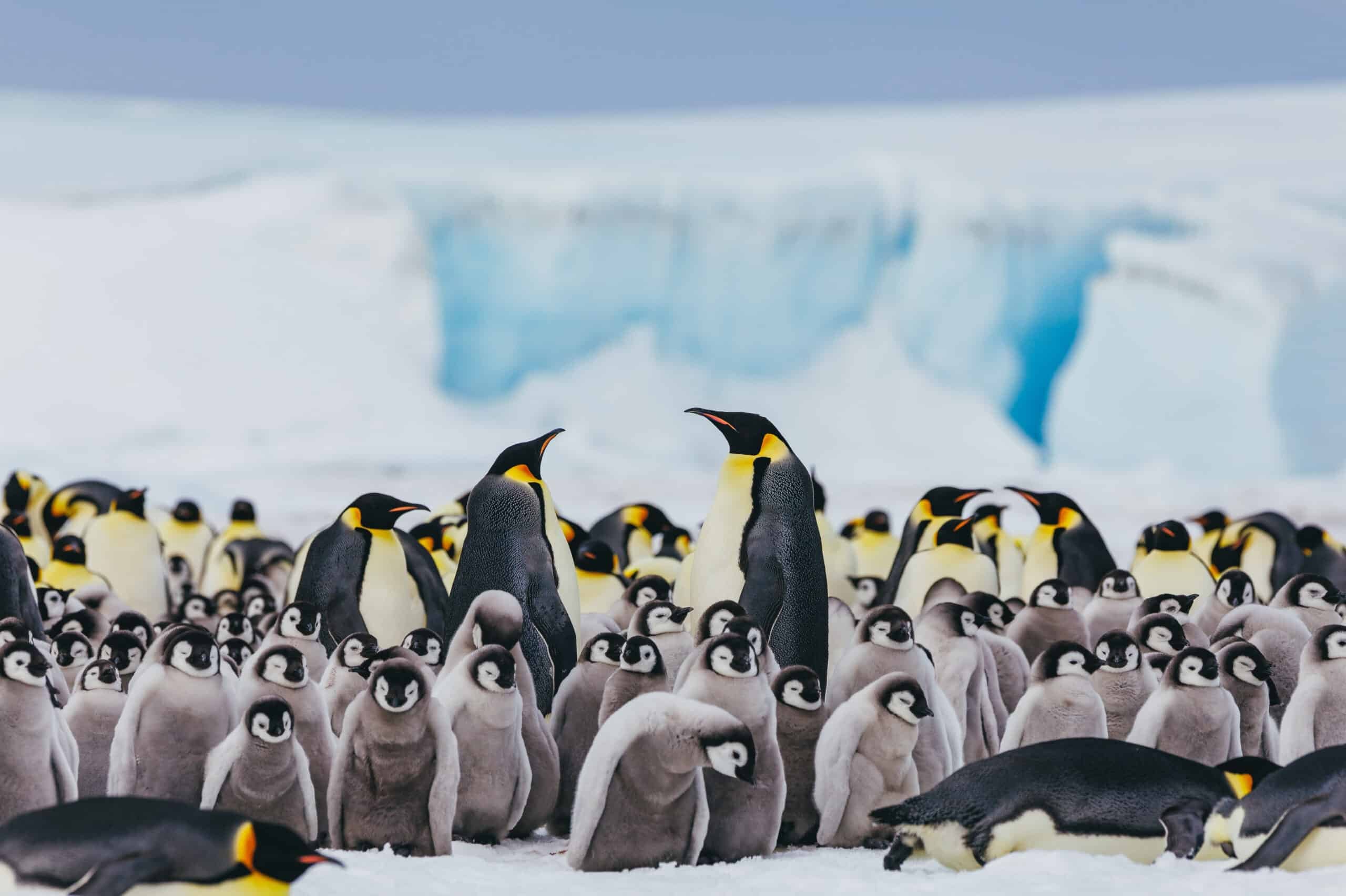
Many people see King Penguins and immediately think of the animated film "Happy Feet", but the star Mumble and his family are actually Emperor Penguins, the largest penguin species in the world, living on the sea ice of the Antarctic continent. Their breeding season begins in the depths of winter, quite different from other penguin species. What you'll see on South Georgia Island, however, is the second-largest species, the King Penguin, which lives on sub-Antarctic islands in huge numbers, making them much easier to spot during your journey. Interestingly, the film also features another character voiced by Robin Williams, "Lovelace", whose eye-catching tuft of long yellow feathers atop his head is modelled on the Rockhopper Penguin! Flamboyant and talkative, just like the real Rockhopper Penguin, he's every bit the drama king. Want to see the real-life prototype of the "Happy Feet" star? The Emperor Penguins and their chicks in this photo are among Antarctica's most iconic penguins, and a coveted sight for every polar traveller.
Penguin Growth Timeline: Choosing the Best Time to Depart
Penguin behaviour changes precisely with the calendar, so you can pick your travel month based on what you want to observe and capture on camera:
- November (Nest-Building): Watch penguins busily carrying stones through the snow and courting mates, against the purest white landscape.
- December (Hatching & Newborns): Around Christmas, chicks begin hatching one after another, and you can watch parent birds tucking their chicks safely beneath their bellies.
- January (Peak Chick-Rearing): Chicks grow at their fastest, as parents dive repeatedly for fish and return to feed them — the busiest scene of the season.
- February (Moulting & Learning): Chicks shed their grey down for waterproof feathers, preparing for their first attempt at swimming.
Overview of Penguin Breeding Behaviour
| Penguin Species | Nesting Period | Incubation Period | Chick-Rearing Period | Highlights to Observe |
| Adélie Penguin | October | November | December – January | Communal nesting, stone-stealing antics, chick-rearing interactions |
| Gentoo Penguin | October | November | December – January | Hopping nest-building, parents feeding chicks |
| Chinstrap Penguin | November | Late November – December | December – Mid-January | Frequent calling interactions, highly active chick-rearing behaviour |
| King Penguin | From November (in batches) | December – January | Continues until March | Abundant fluffy chicks, unusually long breeding season |
| Macaroni Penguin | November | December | December – January | Golden crest plumage + lively chick colonies |
| Magellanic Penguin | October | November | December – January | Burrow nesting, communal living |
| Rockhopper Penguin | November | December | December – January | Hopping behaviour + chick-rearing scenes |
| Emperor Penguin* | May (on the ice) | June – July | October – December | Incubating and rearing chicks on the ice |
Antarctic Penguin Watching Q&A
Q1: Can I touch the penguins?
A: No. Under IAATO guidelines, visitors must keep a distance of at least 5 metres. However, if a penguin approaches you of its own accord, stay still and simply observe.👉 Further Reading: Must-Read IAATO Guidelines Before Heading to Antarctica
Q: Which penguin species is hardest to see?
A: The Emperor Penguin. They are found the furthest south, mostly on sea ice, and require a highly specialised itinerary to reach.
Q: What photography gear should I bring to see the penguins?
A: We recommend bringing a telephoto lens of 200mm or longer.👉 Further Reading: Antarctica Photography Guide
Set Off with DeWonder to Witness the Beauty of Antarctica Firsthand
Antarctica is not only the most remote place on Earth, but also the place that best helps us rediscover "tranquility" and "grandeur." When you stand on the cruise deck and see icebergs shimmering in golden light with your own eyes, penguins waddling along the shore, and whales splashing in the distance—that moment becomes more than just a photo, it becomes a memory. Rather than admiring it only on a screen, why not step onto this white continent yourself? Join DeWonder Travel's In-Depth Antarctica Journey, led by polar experts and photography instructors, and explore the most iconic photo spots on the Antarctic Peninsula, South Georgia Island, and the South Shetland Islands. You'll not only experience the thrill of observing wildlife up close aboard a Zodiac, but also capture your own unforgettable polar moments in the soft midnight light.- Itinerary: Classic Antarctic Peninsula Single-Island Route
- Duration: 11-Day, 10-Night Cruise Itinerary
- Includes: Cruise fare, landing excursions, onboard meals, polar lectures, and professional guiding by the expedition team
- Exclusive Services: Professional pre-departure consultation for Hong Kong & Macau departures, visa advice, flight transfer recommendations, and packing guidance
- Enjoy a Luxury Experience at Hong Kong's Best Value Price