
Antarctic Photography Guide: Cruise Polar Shooting Techniques and Equipment Tips
Preparing for an Antarctic cruise? This guide covers how to choose photography gear, waterproofing and cold-weather techniques, and key tips for shooting from Zodiacs, so you can capture the polar beauty of glaciers, penguins, and whales.
A 30-Second Quick Guide to Antarctic Photography Gear
- Core Setup: We recommend bringing 2 camera bodies (wide-angle + telephoto) to avoid frequent lens changes outdoors, which can lead to moisture or fogging.
- Essential Focal Lengths: 16-35mm (for capturing glacier landscapes) and 200mm or above (for wildlife close-ups).
- Battery Strategy: Prepare 3-4 spare batteries and keep them close to your body for warmth, as low temperatures double battery drain.
- Key Protection Tip: Before entering or leaving the ship's cabin, place your camera in a large sealed bag to let the temperature adjust gradually and prevent condensation.
- Shooting Parameters: On the Zodiac inflatable boat, it's recommended to set the shutter speed to 1/1000 second or faster to counteract the movement.
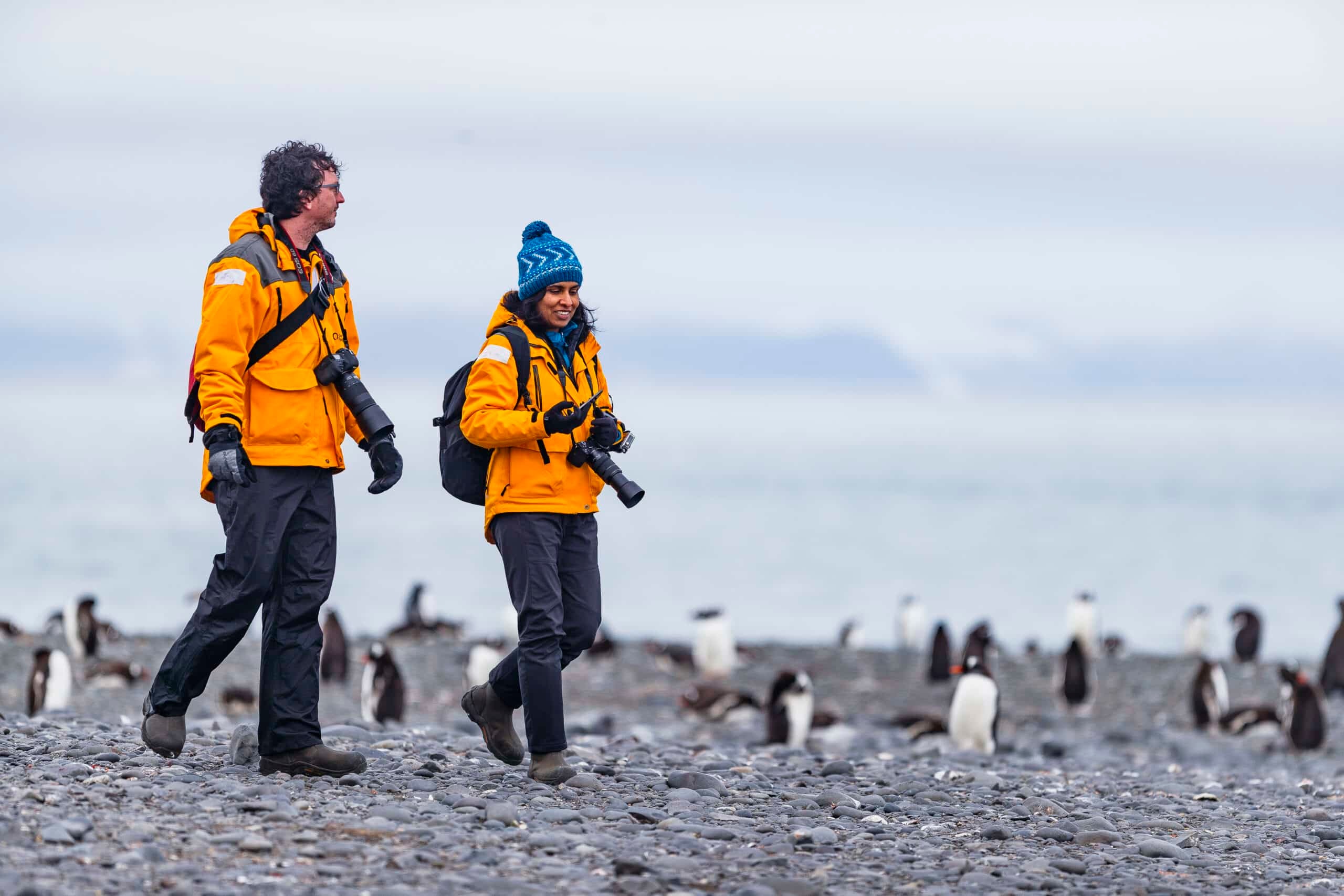
 Accompanied by penguins along the Antarctic coastline, capturing polar scenery handheld. Every step in Antarctica is the beginning of a dialogue between lens and nature.
How to Protect Your Photography Gear in Polar Climates
Shooting in Antarctica, the greatest challenges come from extreme cold and moisture. Without proper protection, even the most expensive camera can fail at the crucial moment. According to Quark Expeditions' polar photography team's shared experience, the most common cause of equipment damage is "moisture condensation caused by temperature transitions". When cold air alternates with the warmth inside the cabin, lenses fog up very easily.Professional Photographer Dave Bouskill recommends placing your camera in a large sealed bag before leaving the deck, allowing the temperature to rise naturally and preventing condensation caused by sudden temperature changes. Here are some practical tips to help keep your gear in top condition in polar environments:- Manage Temperature Differences: Place your camera in a sealed bag before leaving the deck, then let it sit for 1-2 hours after entering a heated cabin to warm up gradually, preventing lens fogging.
- Keep Batteries Warm: Keep spare batteries in an inner pocket close to your body, using your body heat to maintain their battery life.
- Waterproof Protection: When riding on a Zodiac, always use a camera rain cover or dry bag to prevent sea spray from soaking your equipment.
- Cleaning & Maintenance: Wipe your gear with a lens cloth immediately after shooting and store it in a dry bag to prevent residual moisture.
- Data Backup and Secure Storage: Onboard internet speeds are limited, making cloud uploads impractical. We recommend bringing a compact portable SSD (about 1 TB) and backing up your photos daily. Portable SSDs offer fast transfer speeds and high shock resistance, making them the most reliable storage solution for polar journeys
Antarctic Photography Gear Guide: From Lenses to Gloves, Be Fully Prepared
When shooting in Antarctica, the stability and durability of your equipment matter more than the brand. As long as you grasp a few key selection principles, even non-professional photographers can capture stunning images in polar environments. Professional photographer Dave Bouskill suggests key points to note when choosing and preparing your gear:- Camera Body and Lens Combination:
- Wide-angle lens (approx. 16–35mm): For capturing magnificent glaciers and coastlines.
- Mid-range lens (approx. 24–70mm): Ideal for deck activities and interpersonal moments.
- Telephoto lens (200mm and above): The essential focal length for capturing penguins, whales, and birds.
- Essential Accessories:
- Photography Gloves: Choose a cold-weather style that allows touchscreen operation.
- Stability Tools: A lightweight carbon fibre tripod or monopod, for stable compositions on deck.
 A photographer in cold-weather gear and waterproof boots shoots a penguin colony on the Antarctic snow. Antarctica's magnificent scenery and wildlife are right at hand—only with proper gear can you capture every moving moment with ease.
Practical Shooting Techniques: Cruise Deck vs. Zodiac
One of the joys of photographing Antarctica is switching between perspectives: gazing at glaciers from the cruise deck, or getting up close to penguins and whales aboard a Zodiac. Master the following tips for more stable, safer shooting.- Shooting from a Zodiac: In choppy waters the boat rocks easily, so stay seated and raise your shutter speed to 1/1000 sec or faster. A plastic rainsleeve over your camera is recommended, keeping it working reliably even when snow covers the outer layer.
- Exposure Control: Snow glare is intense, so slightly lower your exposure (–0.3 to –1 EV) to preserve ice detail, or use a CPL polarising filter to cut glare and enhance colour depth
 Travelers ride a Zodiac boat through Antarctica's icy waters, capturing close-up shots of glaciers and their reflections on the sea surface. Stable composition, along with waterproof and cold-resistant gear, are the most crucial skills for polar aerial photography.
Antarctic Wildlife Photography: The Art of Respect and Distance
In Antarctica, penguins, seals, and whales are the most sought-after subjects for photographers, but capturing stunning photos requires more than just technical skill—respect and observation matter even more. Antarctica is one of the world's most protected ecological zones, and all photography should be guided by the principle of "non-interference", allowing animals to display their most authentic natural behavior.- Maintain a safe distance:When shooting, always keep at least 5 meters away from animals, avoiding approaching them or making noise to attract attention. If a penguin approaches on its own, you can lower your position slightly and wait for it to enter the frame. Use the appropriate focal length:A telephoto lens (200mm or above) is the best choice for photographing Antarctic wildlife, allowing you to maintain distance while capturing fine details. To photograph whales or seals, set your camera to continuous shooting mode in advance while on the Zodiac, so you don't miss their brief moments of surfacing.
- Master natural light and motion:Animals are most active in the early morning and evening, when the light is soft and shadows have rich layers. Use a faster shutter speed (1/1000 second or above) to freeze motion, or a slower shutter speed to create motion blur for a natural sense of flow.
- Choose subjects based on the season:
- November: Penguin egg-incubation period: Ideal for capturing nesting and courtship behavior.
- December: Newly hatched chicks: Watch parent birds feeding their chicks and their interactions.
- February: Chick growth period : Chicks molt and learn to swim, making this the most lively period.
- Maintain environmental and ethical awareness:Dave Bouskill emphasizes in his polar photography course: "The best wildlife photo is the one taken in the moment when you barely exist."Don't feed, chase, or touchthe animals—this is every Antarctic traveler's responsibility. What you leave behind should be only footprints and images, not disturbance.
 A group of penguins strolling leisurely across the Antarctic snow, with travellers observing and photographing from a safe distance. Respect and restraint are the most important principles for Antarctic wildlife photography.
 A seal rests leisurely on an ice floe, while travellers quietly observe from a Zodiac inflatable boat in the distance. The beauty of Antarctic photography lies not in getting close, but in documenting natural life from a respectful distance.
Composition and Light: Capturing the Soft Glow and Layers of the Antarctic Three Islands
The Antarctic Three Islands route is the main area most travellers visit on their way to Antarctica. The light here differs from the “midnight sun” within the Antarctic Circle, but is equally breathtaking.Due to its geographic location between roughly 54° and 65° south latitude, even during the peak summer months (December to January), the sun stays above the horizon for extended periods, and the night sky remains bathed in a silvery-blue glow—a phenomenon known as "Midnight Twilight". This unique quality of light means there's almost no "true darkness" for photography, allowing you to capture gentle, shifting light and shadow throughout the day:- November – Early Spring Thaw: Daylight hours gradually lengthen, with the sun sitting low on the horizon creating strong contrast—an ideal time to capture the texture of icebergs and the reflective glow of melting ice.
- December to January – Peak Summer Aurora Season: The sun lingers near the horizon for long stretches, casting warm, soft light. Even at midnight, the sky still glows with hues of golden orange and pale blue, perfect for capturing landscapes and wildlife activity.
- February – Late Summer Soft Light Season: Daylight hours are slightly shorter, but the colour palette becomes richer and more layered. The pink-orange light of evening is best for photographing whales, penguin colonies, or reflections on the sea's surface.
- Make Good Use of the "Rule of Thirds": Position icebergs, animals, or boats along the left or right third of the frame, leaving open sea and sky as backdrop for a greater sense of depth.
- Use Foreground Elements: Incorporate drifting ice, footprints, or the edge of a Zodiac boat to add a three-dimensional feel.
- Control Exposure: Snow reflections are intense, so slightly lowering exposure (–0.3 to –1 EV) helps preserve ice details. To highlight blue ice, shoot in the morning or on overcast days. Master Overcast Lighting: Cloudy skies reduce harsh shadows, making them especially natural for wildlife close-ups. Adjust white balance to around 6000K to maintain pure white snow tones.
Pre-Departure Photography Checklist: Make Your Antarctic Journey More Effortless
Antarctic photography is a true test of patience and preparation. With rapidly changing conditions and limited landing times, every detail can affect whether you capture that "perfect moment." Before you set off, review the checklist below to ensure both you and your camera are ready for the polar challenge.Antarctic Photography Gear and Pre-Trip Checklist
| Category | Recommended Items | Practical Tips |
| Camera Bodies and Lenses | Two camera bodies (wide-angle + telephoto) | Reduces the risk of lens changes and helps avoid moisture and fogging. |
| Lens Combination | 16–35mm, 24–70mm, 200mm and above | Covers needs from landscape to wildlife photography. |
| Batteries & Memory Cards | At least 3–4 batteries, multiple medium-capacity memory cards | Battery power drains quickly in cold temperatures; using separate memory cards is safer. |
| Protective Gear | Waterproof cover, dry bag, anti-fog film | Essential especially when boarding Zodiacs, extending the lifespan of your equipment. |
| Data Backup | Portable SSD (approx. 1TB) | The best backup solution when cruise internet is unstable—shock-resistant and fast. |
| Stabilizing Tools | Carbon fiber tripod or monopod | Lightweight and stable, suitable for use on deck and during landings. |
| Cold Protection & Ease of Operation | Waterproof touchscreen gloves, anti-glare sunglasses | Maintain dexterity in cold temperatures while protecting your eyesight. |
| Clothing & Footwear | Windproof outer layer, layered thermal clothing, non-slip boots | Stay warm while shooting and move with ease. |
| Practical Shooting Tips | Get familiar with exposure settings, back up daily, avoid changing lenses frequently | Check your files immediately after shooting to make sure you haven't missed any precious moments. |
Polar Clothing & Photography in Practice: FAQ
Q1: Do I really need to bring two cameras for photography in Antarctica?
A: Strongly recommended. In polar environments (especially aboard Zodiac boats), changing lenses is strictly forbidden, to prevent sea spray or snowmelt from getting into the camera body. Carrying two camera bodies, one fitted with a "wide-angle lens" and the other with a "telephoto lens", lets you capture magnificent glaciers and fast-changing wildlife at the same time.
Q2: Does the cold drain camera batteries quickly? How many spare batteries should I prepare?
A: Yes, batteries drain about 1-2 times faster. It's recommended to prepare at least 3-4 spare batteries per camera. The key trick is to keep spare batteries in an "inner pocket" close to your body, using your body heat to keep them warm, and only taking them out the instant you need to swap them, to maintain the lithium battery's performance.
Q3: How can I prevent my camera from "fogging up" or getting damaged after entering a warm cabin?
A: Use the sealed-bag warming method. This is the single most important step to protect your gear: before moving from the freezing outdoors into the heated cabin, place your camera in a sealed zip-lock bag and squeeze out the air. Let the camera warm up slowly inside the bag for 1-2 hours — this completely prevents condensation from forming inside the lens, which can otherwise cause mould growth or electronic malfunctions.
Q4: Can I use a drone to shoot during an Antarctic or Arctic cruise?
A: Drones are prohibited for general travellers. Under IAATO regulations, recreational drone flights are currently strictly banned in the polar regions to protect the ecological balance and ensure safety. Unauthorised flights will result in equipment confiscation and hefty legal penalties. We recommend using a telephoto lens of 400mm or longer instead, which can achieve equally stunning close-up shots.
Q5: What safety precautions should I take when photographing from a Zodiac?
A: Waterproofing and stability come first. Always remain seated while shooting, and use a camera strap or safety tether to prevent your equipment from falling into the sea. We recommend pairing this with a professional rain cover or dry bag, and raising your shutter speed to 1/1000 sec or faster to counteract blur caused by the boat's movement.
Set Off with DeWonder to Witness the Beauty of Antarctica in Person
Antarctica is not only the most remote place on Earth, but also the place best able to help us rediscover the true meaning of "tranquillity" and "grandeur".When you stand on the cruise deck and watch icebergs glisten in the golden light, penguins waddling along the shore, and whales breaching in the distance in the far distance — in that moment, every scene becomes more than just a photograph; it becomes a memory. Rather than admiring it only on a screen, why not step onto this white continent yourself? Join DeWonder TravelAntarctica In-Depth Journey and be guided by polar experts and photography mentors as you explore the most iconic photo spots across the Antarctic Peninsula, South Georgia, and the South Shetland Islands. Not only will you experience the thrill of observing wildlife up close aboard a Zodiac, but you'll also capture your own unforgettable polar moments under the soft midnight light.- Itinerary: Classic Antarctic Peninsula single-island route
- Cruise Duration: 11 days, 10 nights
- Inclusions: Cruise fare, shore landings, onboard meals, polar lectures, professional guiding by the expedition team
- Exclusive Services: Professional pre-departure consultations for Hong Kong & Macau departures, visa advice, flight connection recommendations, and a packing guide
- Enjoy a luxury experience at the best prices in Hong Kong