
Complete Antarctic Cruise Packing List: Everything You Need to Know About Polar Travel Outfits, Gear & Cold-Weather Preparation
Want to visit Antarctica but not sure what to pack? This packing list guide teaches you what to wear and what to bring, covering everything from windproof and waterproof gear to landing equipment—pack right and set off with ease.
2026 Antarctic Gear Quick Checklist: Pack Smart, Not Heavy
- Provided by the cruise (no need to bring): Professional waterproof, windproof cold-weather jacket (Parka), waterproof landing boots (Muck Boots).
- Must bring yourself: Waterproof trousers (waterproof rating of 10,000mm or above recommended), touchscreen-compatible warm gloves, Merino Wool base layers.
- Hong Kong shopping recommendations: For great value, we recommend the Decathlon sailing series;for professional-grade performance, we recommend The Overlander, Patagonia, or The North Face.
- Dressing logic: The key lies in "wind resistance" and "staying dry," not simply piling on thickness.
Why Does Packing for an Antarctic Trip Require Such Careful Thought?
Although Antarctica's travel season falls between November and February—known as "Antarctic summer"—average temperatures still only range from 0°C to 10°C. In other words, while it won't be so cold that you're shivering and freezing, strong winds are the real reason it feels cold. Around the Antarctic Peninsula and Drake Passage, wind speeds often reach 40–80 km/h. When cold wind blows directly at you, the perceived temperature can often feel 5–10°C lower than the actual reading. Combined with the open terrain and near-total lack of shelter, you're exposed to wind everywhere—from the cruise ship deck to the landing sites. Antarctica has a dry, cold climate with low air humidity but powerful sea winds. This means that even without snow, the wind alone can strip heat from your body. Therefore, rather than bulky down jackets, you should prioritise windproof, waterproof, and cold-resistant outer layer gear. Want to learn more about Antarctica's climate and seasonal differences 👉 Further Reading: Best Time to Visit Antarctica A traveller photographs glaciers from the cruise ship's deck. Summer temperatures hover around 0–10°C, and while it may look sunny, sea winds can make it feel much colder — a windproof jacket and beanie are essential gear.
Common Myth: Do You Need a Mountain of Gear for Antarctica? It's Really About Bringing the "Right" Items
When many people hear "Antarctica," they immediately picture heavy snow suits, snow boots, hiking backpacks... But in reality, most Antarctic trips are cruise expeditions, and the environment is far more comfortable than you'd imagine.Cruise ships have heating, drying rooms, and even dedicated landing gear. Most cruise operators provide down jackets for free or for rent — the bulkiest and hardest item to prepare — so you don't need to bring your own. What really deserves careful thought is clothing that can be flexibly layered, dries quickly, and blocks sea winds. After all, the real challenge in Antarctica isn't "how cold it is," but rather "how fast the weather changes and how strong the winds are." Bring just a few key items and you'll easily handle the temperature swings from deck viewing to shore excursions. ✅ Key Takeaway: Packing right beats packing more. Rather than bulky coats or piles of luggage, what matters most is knowing how to choose the right fabrics and protective layers. Most cruise companies provide polar-specific jackets, helping you prepare the right cold-weather gear, so you don't need to worry about spending a fortune on equipment you'll never use again
Antarctica vs the Arctic: What's the Difference in Packing?
Many people assume "the Arctic and Antarctica are equally cold," but in reality the environments, climates, and travel styles of the two regions differ enormously, and the priorities for packing are completely different too. Antarctica is a continent covered in ice, with strong winds and wide-open terrain, and journeys mostly involve cruise ships plus Zodiac boat landings, so windproofing, waterproofing, and snow-glare protection are especially important. The Arctic, on the other hand, is mainly an ocean surrounded by ice, with a more "damp and cold" climate, and itineraries often include land expeditions or camp stays, so moisture protection and long-lasting warmth are the top priorities. In other words:- In Antarctica, what you need is "a windproof outer layer"
- While in the Arctic, you need more of "a warm, moisture-resistant mid layer"
Antarctica vs Arctic Climate and Cold-Weather Strategy Comparison Table
| Item | Arctic | Antarctic |
| Climate Characteristics | Damp and cold, with large pressure fluctuations | Dry and cold but with strong winds, making it feel even colder |
| Mode of Transport | Overland expeditions | Cruise ship + Zodiac boat landings |
| Wildlife | Polar bears, reindeer | Penguins, seals, whales |
| Key Protection Needs | Warmth, moisture protection | Windproofing, waterproofing, sun protection |
| Sensory Characteristics | Humid air, penetrating cold | Strong winds, pronounced wind-chill effect |
Antarctic Clothing & Packing Principles: Windproof, Waterproof, and the Scientific "Three-Layer System"
On an Antarctic journey, dressing correctly matters even more than packing light.The most effective protection strategy recognised in the polar tourism industry for 2026 is the "three-layer system". Master the following principles and you'll stay comfortable on board while remaining agile on land.① Windproofing: The Key to Retaining Body Heat
Antarctica's biggest challenge is strong wind. Wind speeds often reach 40–80 km/h, which can cause the perceived temperature to plummet instantly.
- Outer layer essential: Your jacket must have a windproof design with an adjustable hood.
- Head and neck protection: Beanie (ear-covering): Reduces heat loss from the head by over 50%.
- Multifunctional neck gaiter (Buff): Protects your nose and mouth from cold wind.
- Expert combo: Jacket hood plus beanie together form the best defence against strong winds.
② Waterproofing: Coping with Waves and Snow Splash
Landings require boarding a Zodiac. Even on clear days, getting splashed by waves or sitting on a damp gunwale is common. Most cruises providea polar-grade waterproof jacket, but you'll still need to prepare your own inner layers and lower-body wear:
-
Key gear: Waterproof trousers. We recommend choosing trousers with a waterproof rating of 10,000mm or above, or those rated Gore-Tex.
-
Where to buy in Hong Kong: For value, consider Decathlon's sailing range waterproof trousers; for a more professional option, The Overlander offers technical snow trousers.
💡 Quick tip: Once your lower body gets soaked, the cold sets in fast — waterproof trousers are the single most important piece of personal gear for the whole trip.
③ Insulation: The Scientific "Three-Layer System", Not Bulk
Antarctica has a dry cold climate, so as long as you choose the right materials, three layers can handle temperature swings from -5°C to 10°C.| Layer | Recommended Clothing | Key Materials | 2026 Expert Tips |
| Base Layer | Moisture-wicking shirts, thermal wear | 100% Merino Wool | No cotton, ever! Wool retains warmth even when sweaty and resists odour. |
| Mid Layer | Fleece jackets, down vests | Lightweight synthetic fibres | Add or remove flexibly to maintain core body temperature. |
| Shell | Waterproof jacket, waterproof trousers | Gore-Tex or equivalent | Most cruises provide the jacket, so you only need to bring waterproof trousers. |
Onboard vs. Ashore: What to Wear for the Best Fit
- Onboard:Cabins are heated, so a long-sleeved top or sweater is enough; add a light windbreaker when heading out to view the scenery.
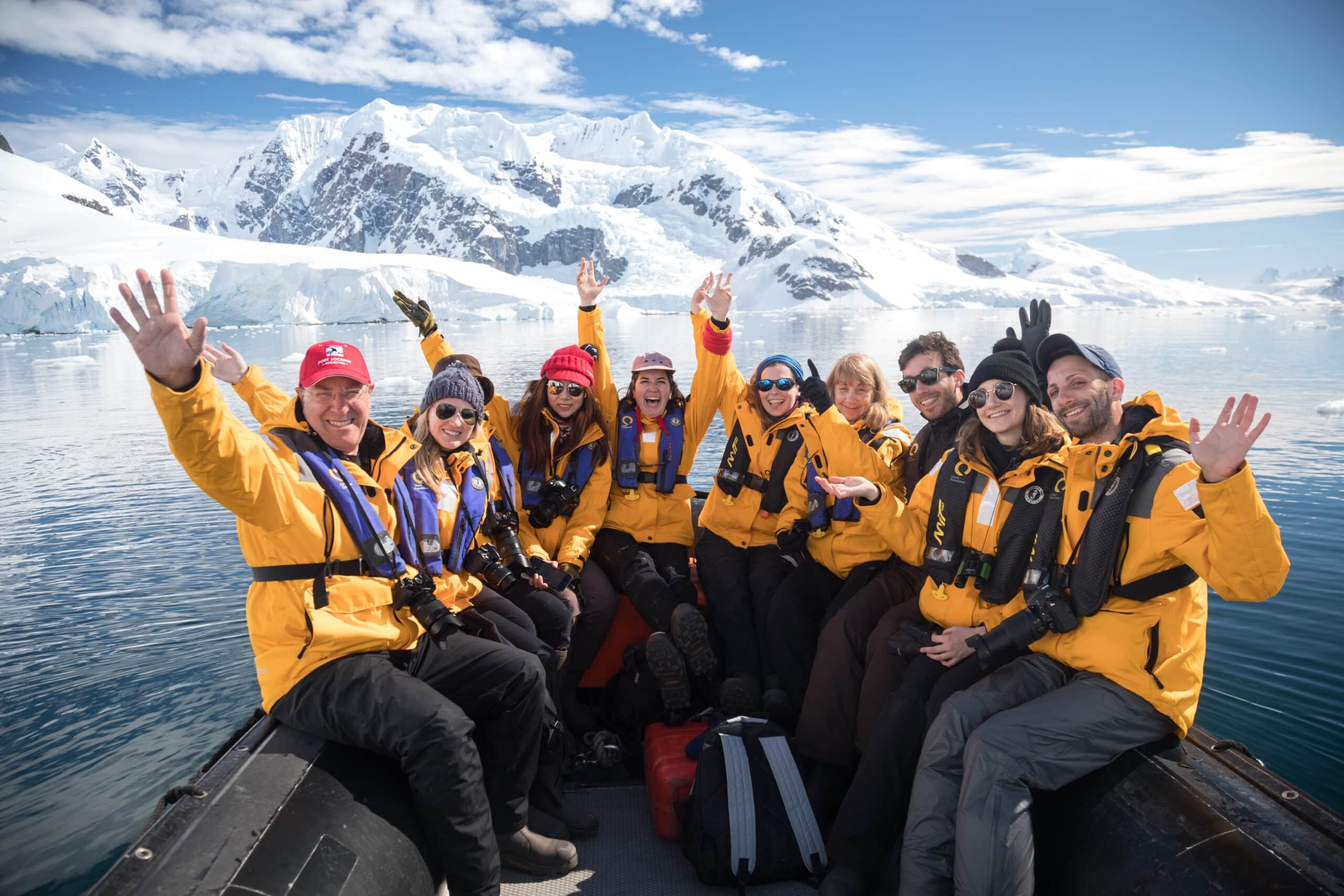
- Landing activities:Wear the waterproof jacket provided by the cruise line on top, with warm mid layers and waterproof trousers underneath.
 During a landing activity, travellers in waterproof jackets board a Zodiac boat, ready to head ashore in Antarctica to observe wildlife. Windproof and waterproof gear is key to fending off the cold.
Where to Buy in Hong Kong? Tips for Choosing Antarctic Gear
For travellers with different needs, we've put together a guide to shopping locally in Hong Kong (DeWonder has no commercial ties with the brands below — this is for equipment reference only):
- Best Value: Decathlon We recommend their waterproof trousers from the "Sailing" range and merino wool base layers from the "Mountain" range. For travellers heading to polar regions just once a year, this is the most cost-effective solution.
- Professional Performance: The Overlander / Patagonia / Arc'teryx If you plan to head to snowy or high-altitude regions again in the future, it's well worth investing in a pair of high-quality Gore-Tex professional waterproof trousers or lightweight Montbell down jacket.
- Sun Protection & Essentials: Mannings and Watsons carry high-performance SPF50+ sunscreen and lip balm.
Antarctica Packing List Overview
When preparing for an Antarctic trip, the biggest worries are packing too much or missing essential items. Below is a practical packing list table designed specifically for Antarctic cruise travellers, covering everything from cold-weather clothing to electronics, all sorted out for you in one place.🧥 Cold-Weather Clothing & Gear
| Item | Purpose | Recommendation |
| Down Jacket (Personal) | Keeps you warm onboard the cruise or during brief outdoor activities | A lightweight down jacket is recommended; switch to the waterproof jacket provided by the cruise company during landing activities |
| Windproof/Waterproof Jacket & Pants | Blocks sea wind and splashing snow | This is the main gear worn during landing activities; most cruises provide a waterproof jacket, but waterproof pants must be brought yourself |
| Fleece Jacket/Down Vest | Mid-layer warmth | Allows flexible layering and easy movement |
| Thermal Wear/Moisture-Wicking Base Layer | Quick-drying inner layer | Avoid cotton; choose moisture-wicking materials |
| Wool Hat (Ear-Covering) | Windproof head protection | Recommended to pair with a jacket hood for double-layer protection |
| Multi-Function Neck Gaiter (Buff) | Windproof and sun protection | Can be pulled up to cover your nose and mouth, preventing cold wind from getting in |
| Thick Socks (2–3 pairs) | Warmth and moisture absorption | Quick-drying wool-blend material is recommended |
| Windproof Gloves | Prevents frostbite | Separate inner and outer layers are most practical, making it easy to operate your phone while taking photos |
🧴 Personal Items
| Item | Purpose | Recommendation |
| Sunscreen SPF50+ | Prevents sunburn from snow glare | A small travel-size bottle is recommended |
| Lip Balm (with SPF) | Prevents chapping | Essential in low temperatures and strong wind |
| Moisturising Lotion | Prevents dryness and cracking | One bottle can be used for both face and hands |
| Seasickness Medication | For use when crossing the Drake Passage | Test beforehand to check for drowsiness |
| Hand Warmers | For warmth | Works best when placed in pockets or shoes |
| Wet Wipes / Tissue Paper | Personal hygiene | Convenient to carry during landing excursions |
📸 Photography & Electronics
| Item | Purpose | Recommendation |
| Camera/GoPro/Phone | For photos and video | Bring a waterproof case for peace of mind |
| Spare batteries | Battery drains quickly in cold temperatures | Keep them in a pocket to stay warm and last longer |
| Power bank | For recharging devices | High capacity and high output are best |
| SD cards/cables | For storing and backing up photos | Bring an extra set as backup |
| Waterproof/dry bag | Protects electronic equipment | Especially useful during landing activities |
🧳 Documents and Other Items
| Item | Purpose | Recommendation |
| Passport | Required for entry and exit | Valid for at least 6 months; a photocopy backup is recommended |
| Travel Insurance Documents | Emergency medical or luggage coverage | Confirm whether Antarctic regions are covered |
| Credit Cards and US Dollar Cash | On-board spending and tipping | US dollars are widely accepted; a small amount is sufficient |
| Boarding Confirmation / Itinerary | Required for entry and boarding | A printed copy plus a digital backup is recommended |
| Emergency Contact Card | Emergency response information | Can be kept in a waterproof pouch and carried with you |
Essential Preparations Before Departure
Once you've finished packing, don't forget these small tasks that will make your Antarctic journey go more smoothly: ✅ Confirm Your Travel Insurance Coverage — Check whether it covers Antarctica or polar regions. ✅ Verify Your Visa and Entry Documents — Most flights depart via Argentina or Chile. ✅ Attend a pre-departure briefing or online orientation — Learn about landing regulations and environmental guidelines. ✅ Prepare an emergency contact card and medical information — Keep them in a waterproof bag and carry them with you at all times. ✅ Test seasickness medication or motion sickness patches — The waves of the Drake Passage may cause seasickness among passengers. ✅ Check your electronic devices and batteries — Charge fully in advance and bring extra spare batteries, as battery life drains especially fast in low temperatures.Embark on a Dream Antarctic Adventure with DeWonder
Watch penguins waddle across the snow with your own eyes, ride a Zodiac between icebergs to admire polar scenery — Antarctica is more than just a journey, it's an experience of "returning to the purest place on Earth." DeWonder has partnered with Quark Expeditions to create a professional Antarctica in-depth tour. With small-group arrangements, you can observe wildlife up close during cruise and Zodiac excursions, and explore the Antarctic Peninsula, South Georgia Island, and the South Shetland Islands under the guidance of expert leaders, gaining deep insight into polar ecology and unique natural landscapes. We have already accompanied numerous travelers to the ends of the Earth.- Itinerary: Classic Antarctic Peninsula single-island route
- Voyage duration: 11-day, 10-night cruise itinerary
- Cost includes: Ship fare, landing excursions, onboard meals, polar lectures, professional guidance from the expedition team
- Exclusive Service: Professional pre-departure consultation, visa advice, flight transfer suggestions, and packing guides for travelers departing from Hong Kong/Macau
- Enjoy a luxury experience at the best prices in Hong Kong