
Complete Guide to Antarctic Weather: Will It Be Unbearably Cold? Real Temperatures, Snow Conditions, and Drake Passage Waves
How cold does Antarctica actually feel? This article breaks down the temperatures, daylight hours, sea ice, and wave conditions during the Antarctic travel season, helping you prepare your outfits and gear with confidence.
Antarctic Travel Climate: 30-Second Overview
Here is the real climate data for the Antarctic Peninsula in summer (November–March):
- Average Temperature: Mostly falls between -5°C and +5°C, similar in feel to winter in Hokkaido or Northern Europe.
- Biggest Challenge: Not the low temperature itself, but the "wind chill effect." Under strong winds, the perceived temperature can drop to -10°C to -15°C.
- Drake Passage: Modern cruise ships are all equipped with automatic stabilizers, which can offset over 80% of the rocking motion.
- Core Layering Principle: "Windproof and Waterproof" Matters More Than Thickness, and layering like an onion is the only real defense against wind chill.
Antarctica Travel Season Climate Overview
Below is a breakdown of the key weather elements during the Antarctica travel season (November–March): temperature, snow conditions, sea ice, daylight changes, and sea conditions, so you can quickly understand the real face of the Antarctic environment.Antarctica Climate Overview Table
| Climate Factor | Antarctica Travel Season (Nov–Mar) Overview | Key Notes |
| Average Temperature | –5°C to +5°C | Mostly within the "dry cold" range, far milder than the –30°C many imagine. |
| Wind Chill Effect | Can feel as cold as –10°C to –15°C | The higher the wind speed, the faster heat is lost → a windproof layer matters more than thickness. |
| Daylight Hours | Ranges from 12–20 hours | Daylight is longest in Dec–Jan, with strong light and greater flexibility for activities. |
| Snow Condition Changes | Most intact in November → melts the most by February | Affects landing terrain: snow depth, mud levels, and ice surface glare. |
| Sea Ice Conditions | Most in early summer → least in February | Less sea ice means ships can travel further south (extending the route). |
| Precipitation Type | Mainly snow, with occasional rain in Jan–Feb | This is why "waterproofing" matters more than "warmth" for your outer layer. |
| Drake Passage Sea Conditions | Anything from mirror-calm to noticeable swells is possible | There's no fixed pattern, but modern cruise ships are all equipped with stabilizers. |
Why is the Antarctic Peninsula so much warmer than the South Pole?
Most travellers assume Antarctica is an extreme -30°C world, but that's actually the temperature at the "South Pole". The Antarctic Peninsula coast you'll visit on your journey, being closer to South America, at a lower latitude, and moderated by the ocean, typically sees summer temperatures of -5°C to +5°C.
- The Ocean's Warm Water Bottle Effect: The ocean absorbs and releases heat slowly, keeping coastal temperatures more stable.
- Elevation Difference: The South Pole sits inland at an altitude of about 2,800 metres, far from the ocean, making it much colder than the Peninsula.
Perceived Temperature: What Really Makes You Feel Cold is "Wind Speed"
What truly affects how your body feels is the Wind Chill effect.At 0°C, if wind speed reaches 30-40 km/h (very common when riding Zodiac boats), the perceived temperature can plunge instantly to -10°C to -15°C. This is why, when dressing for Antarctica, a windproof and waterproof layer is more important than simply adding thickness. 👉 Further Reading: The Complete Guide to Polar Region Dressing Travellers photographing Antarctic glaciers from the cruise deck. Summer temperatures range from about 0 to 10°C — it may look sunny, but sea breezes can make it feel much colder, so a windproof jacket and beanie are essential gear.
The Truth About Drake Passage Weather and Waves
Crossing the Drake Passage is the part most travellers heading to Antarctica are most concerned about. Its waves can be as calm as a lake at times, or noticeably rough at others — which is why it's known by two names:- Drake Lake: unusually calm
- Drake Shake: noticeably choppy
What Are the "Drake Shake" and the "Drake Lake"?
The Drake Passage lies between South America and Antarctica, and its notorious waves mainly come from three natural conditions:- Strong Westerlies: This belt experiences strong winds year-round, which easily generate long swells.
- Antarctic Circumpolar Current (ACC): The world's largest ocean current passes through here, and with no land to block it, the sea surface is more prone to swell.
- Highly variable seabed terrain: When water flow is compressed, it creates irregular waves.
Which month is the calmest for crossing the Drake Passage?
Sea conditions in the Drake Passage change rapidly, and currently no month can guarantee "definitely calmer" seas. However, based on years of sailing experience, there are a few general trends worth noting:- Longer daylight hours in summer (December–February): With smaller temperature differences, calmer seas are more likely to occur, though this isn't an absolute rule.
- Modern cruise ships are all equipped with stabilizers: These reduce side-to-side rocking, making the actual experience much gentler than passengers imagine.
- Captains adjust the route based on weather: If sea conditions are poor, rougher areas will be avoided, ensuring both safety and stability.
- Seasickness pills and patches work well:Most travelers can comfortably cross the Drake Passage as long as they take medication in advance.
 Modern Antarctic cruise ships are typically equipped with "stabilizers," which greatly reduce side-to-side rolling. The actual stability during the voyage is usually much better than expected, and most travelers can comfortably cross the Drake Passage.
Antarctic Travel Season Climate Comparison Chart: Differences from November to February
Climate changes during the Antarctic travel season can actually be understood through different "scenes": from early summer to the end of the season, snow conditions, sea ice, daylight hours, and light quality all present different characteristics. Below, centered on November to February, we've organized the most important "pure climate factors" to help you quickly grasp the real changes in the Antarctic environment, making it easier for you to choose your travel time according to your preferences.| Month | Temperature Range | Snow Conditions | Sea Ice Status | Daylight Hours | Light Style | Precipitation (Rain/Snow) |
| November | –5°C to 0°C | Highest snow coverage, closest to a "pure white Antarctica" | Most sea ice | Approx. 14–18 hours | Cool tones, more blue light | Almost entirely snow |
| December | –2°C to 3°C | Melting begins, ground becomes more even | Sea ice decreasing | 18–20 hours | Strong light, high contrast | Mostly snow, with occasional light rain |
| January | –1°C to 5°C | Noticeable snowmelt, some exposed terrain | Moderate sea ice | 18–20 hours | Brighter, more saturated colours | Snow and rain coexist |
| February | –5°C to 2°C | Most snowmelt, greatest terrain variation | Least sea ice | Daylight hours begin to shorten | Golden sunsets, noticeably soft light | Snowfall probability rises again |
How to Choose the Best Month for Your Antarctic Trip Based on Your Climate Preferences?
After reviewing the climate table, you'll likely notice that the "Antarctic scenery" actually differs greatly between months. If you want the simplest way to choose your month, here's the most intuitive reference organized by "climate preference":- Want to see the purest white Antarctica? → November
- Want the longest daylight and most stable flexibility for activities? → December, January
- Want to photograph sunsets, golden light, and soft color tones? → February
- Want the ship to sail further south and deeper in? → February, when sea ice is least, offers the best chance
How to Combat Antarctic Climate? Key Lessons on Layered Dressing
Although Antarctic temperatures aren't extreme (around -5°C to +5°C), the powerful "wind chill effect" causes rapid heat loss. Therefore, the key to dressing well isn't about thickness, but about the correct structure.
- Core Logic: Adopt the "three-layer onion method"—base layer for moisture-wicking, middle layer for insulation, and outer layer for wind and waterproofing to lock in body heat.
- Fabric Taboo: Absolutely avoid cotton clothing. Cotton is extremely difficult to dry once it absorbs sweat, and it accelerates heat loss in low temperatures, increasing the risk of hypothermia.
- Outer Layer Key: Must have high-level windproof and waterproof functions to withstand sea spray during Zodiac cruises.
Want to learn more about brand choices and clothing details for each layer? 👉 Further reading: The Complete Guide to Polar Clothing
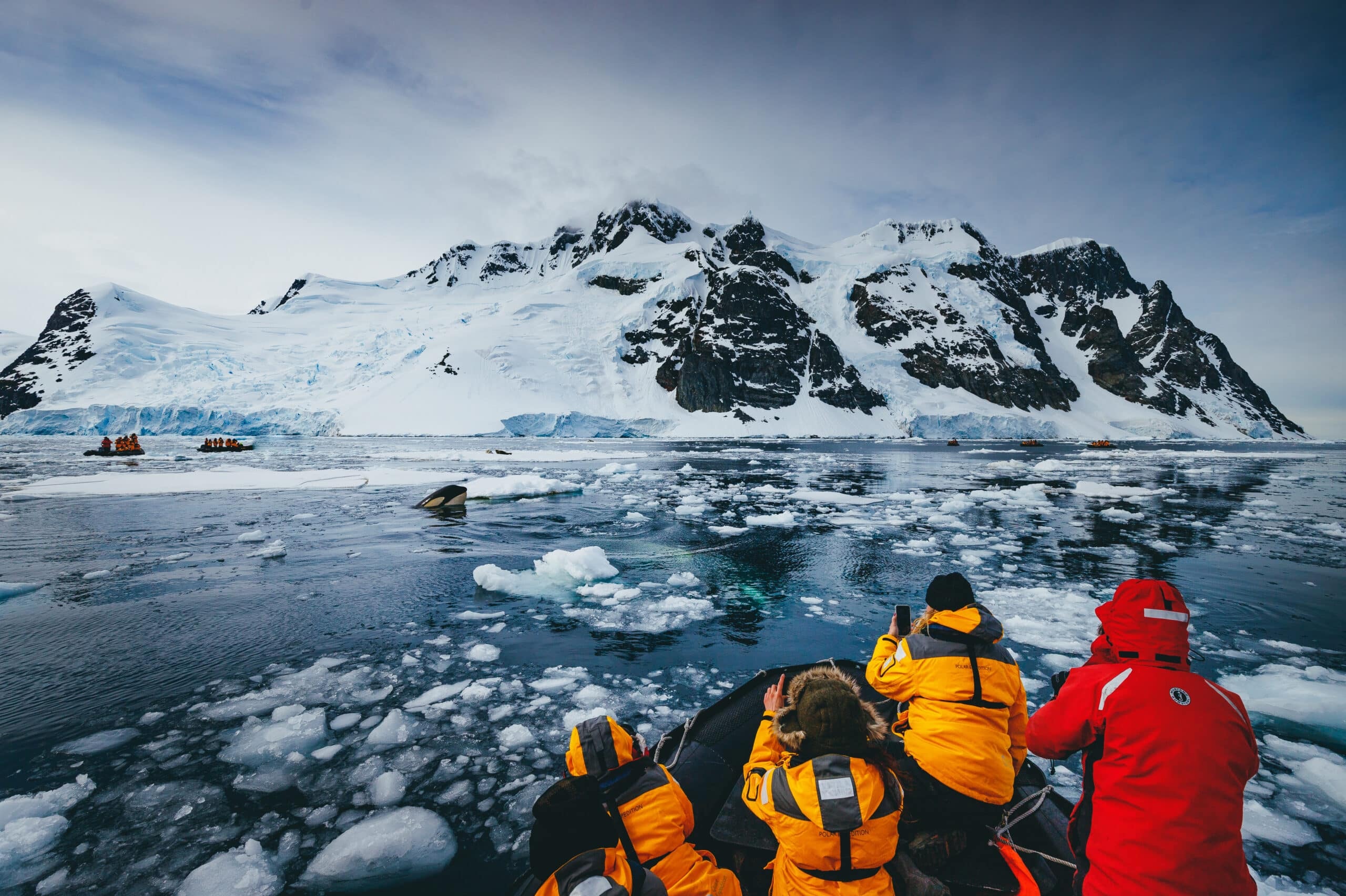
 Wearing polar-specific jackets aboard a Zodiac boat to take in the polar scenery
💡Need a complete "Packing List"?
Once you understand layered dressing, the next step is to confirm your gear is truly complete. We've compiled the most comprehensive Antarctica Packing List, including:- Windproof outer layer
- Two-piece thermal layer
- Waterproof trousers
- Thermal gloves
- Seasickness pills, hand warmers, sunglasses, sunscreen
- Electronics and waterproof storage
Frequently Asked Questions About Antarctica's Climate
Q1. Does it rain in Antarctica?
A: Yes, but mainly during the warmer months of January–February. Most of the time, Antarctica sees "snowfall" rather than rain, though brief light rain can occur during warmer periods. For this reason, it's essential to choose a waterproof outer layer to stay dry during landings or Zodiac rides.Q2: Is it cold inside the cabins on an Antarctic cruise ship?
A: No. Cabins are typically kept at a comfortable room temperature of around 20–22°C. Indoors, you'll only need light long sleeves; it's the outdoor deck, landings, and Zodiac excursions that require proper warm layers.Q3: Can sudden blizzards occur in Antarctica? Would they cancel the itinerary?
A: It's possible to encounter wind and snow, but the captain will make "minor itinerary adjustments" based on weather conditions rather than exposing passengers to dangerous situations.The fundamental principle of Antarctic travel is "safety first". If conditions are too severe, the ship will adjust landing sites or delay the schedule. Cases where landings are impossible for an entire day are quite rare.Q4: Will rough seas in the Drake Passage affect the itinerary?
A: There may be some rocking, but the itinerary itself generally proceeds as planned. The route across the Drake Passage is adjusted based on weather conditions; even in rougher seas, this usually only affects comfort rather than canceling activities altogether. Modern cruise ships' stabilizers effectively reduce the rocking motion.Q5: Does global warming affect Antarctica's travel climate?
A: Yes, the effects are mainly seen in "temperature fluctuations" and "changes in sea ice distribution." In recent years, weather during the travel season has become less predictable—for example, some months may be warmer than before, with earlier snowmelt. However, the travel season (November–March) remains the most suitable and stable period for visiting Antarctica.Embark on Your Dream Antarctic Adventure with DeWonder
Watch penguins waddle across the snow with your own eyes, and cruise among icebergs aboard a Zodiac to take in the polar scenery — Antarctica is not just a journey, but an experience of "returning to the purest place on Earth." DeWonder has partnered with Quark Expeditions to create a professional Antarctica In-Depth Tour. With small-group arrangements, you can not only observe wildlife up close through cruise ship and Zodiac exploration, but also explore the Antarctic Peninsula, South Georgia Island, and the South Shetland Islands with expert guide commentary, gaining deep insight into polar ecology and unique natural landscapes. We have already accompanied numerous travelers to the ends of the earth.- Itinerary: Classic Antarctic Peninsula single-island route
- Voyage Duration: 11 days, 10 nights cruise itinerary
- Fees Include: Cruise ticket, landing activities, onboard meals, polar lectures, professional expedition team guidance
- Exclusive Services: Professional pre-departure consultation for Hong Kong/Macau departures, visa advice, flight transfer recommendations, and packing guides
- Enjoy a Luxury Experience at Hong Kong's Best Value Prices