
Understanding the Physical Demands of Touring the Five Central Asian Countries: Itinerary Pace, Small-Group Flexibility and the Real Experience
Is a five-country Central Asia trip exhausting? We analyse the physical demands from the perspective of duration and number of countries, and explain that the intensity of a trip really depends on how the pace is arranged, not simply the number of countries.
Is travelling through the five Central Asian countries physically demanding? Does the itinerary involve moving every single day? Are older travellers, or those with limited stamina, suited to a Central Asia trip? In fact, the physical demands of travelling in Central Asia depend mainly on the pace and the way the itinerary is arranged, rather than on the intensity of the activities or the destinations themselves. Because Central Asia trips tend to run for more days and involve a lot of cross-border travel, travellers often have questions about the physical burden when planning. In reality, most Central Asia itineraries are cultural-exploration in nature, and as long as the itinerary is well designed and each day leaves room for adjustment, the overall physical demands are both predictable and manageable.
Before assessing whether travelling in Central Asia is "tough," it helps to first clarify where the physical strain actually comes from. The physical exertion of travelling in Central Asia usually comes from the following aspects:
- Longer distances between cities, with travel time adding up
- Cross-border legs that must fit around flights, transits or scheduling
- Fatigue that accumulates from daily routines over a multi-day trip
It is worth noting that this kind of physical strain is not the same as high-intensity physical activity. Central Asia trips are mostly not mountaineering, hiking or sports-oriented travel, and the level of exertion at most attractions is that of ordinary sightseeing. Further reading 👉 A Guide to Cross-Border Travel in Central Asia
Compared with the number of attractions, the pace of an itinerary often has a more direct impact on how physically demanding travellers find a trip. Key factors affecting how physically demanding a trip feels include:
- Whether consecutive days of high-intensity activities are avoided
- Whether there is a reasonable balance between travelling and sightseeing
- Whether each day allows for rest and buffer time
How physically demanding a trip is relates closely to how the pace is arranged, rather than simply depending on the number of days or countries. As such, even an itinerary spanning multiple countries need not feel more tiring than a shorter one, as long as its pace is well designed.
In Central Asia travel, group size and itinerary flexibility have a real impact on whether adjustments can be made along the way. Compared with large groups, small-group tours are usually structured with the following characteristics:
- Fewer participants, making gathering and travel times more manageable
- Lower communication and decision-making costs when adjusting the itinerary
- A measure of flexibility retained within the set framework
In practice, small-group itineraries usually build in flexible free time as part of the itinerary design, marking it on the daily schedule before departure so that travellers can choose to rest or take part in activities according to how they feel that day, without affecting the overall pace. Compared with large groups, small-group itineraries are more flexible in both group size and pace, making it easier to adjust according to your actual energy levels. Further reading 👉 Central Asia Independent Travel vs Small Group vs Large Group: A Comparison

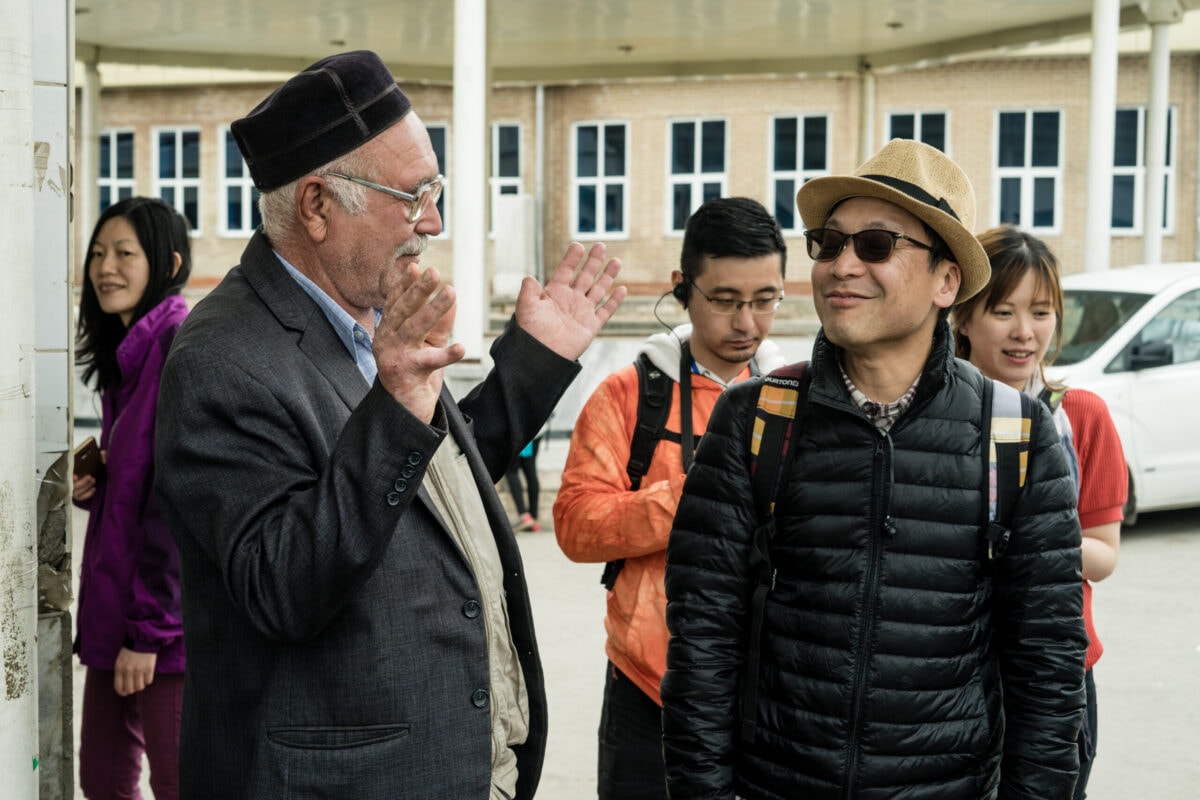
The small group size makes exchanges more natural—there's no need to rush past things just to keep up with the schedule. Through conversation and interaction, the journey gains an added layer of understanding and warmth.
Many travellers worry about whether age or fitness might be a limitation for travelling in Central Asia. From actual experience, age itself is not the only measure of the physical demands of travelling in Central Asia. More crucial factors include:
- Whether the itinerary avoids consecutive high-intensity arrangements
- Whether daily rest and room for adjustment are retained
- Whether you can choose your level of participation based on your personal condition
With a well-paced itinerary and room for flexible adjustments, most senior travellers can still comfortably complete a Central Asia tour.
The number of days and the number of countries covered do affect how you manage your energy, but this does not mean that \”the more days, the harder it must be.\” Generally speaking:
- Fewer days means a simpler pace, but also less buffer room
- More days means more transfers, but fatigue can be reduced through pacing
- More countries means a more complex travel structure, not a higher activity intensity
The key still lies in how each day's itinerary is arranged, rather than simply comparing the number of countries. Further reading 👉How to choose a five-country Central Asia itinerary?

The intensity of a trip is not determined solely by the number of countries. With expert guiding and thoughtful pacing, even a multi-country itinerary can be made steadier and less exhausting through sensible arrangement.
For travellers with limited stamina or special needs, pre-trip preparation and communication are very important. In practical terms, note the following:
- Proactively inform us of any special needs before the trip
- Read through the daily itinerary and pace indicators carefully before departure
- Flexibly adjust your level of participation during the trip according to how you feel each day
Most stamina-related issues can be properly managed through advance communication and itinerary design.
Q1: On a Central Asia itinerary, will I need to carry large amounts of luggage myself? A: This depends on the transport arrangements. In most cases, luggage is transported by vehicle, and you only need to carry it short distances yourself during certain border crossings or transfers between modes of transport. Q2: Will long hours in the vehicle be a major physical burden? A: Some sections do indeed require long travel times, but these are usually paired with rest stops along the way and segmented arrangements to reduce the discomfort of sitting for long, continuous stretches. Q3: If I'm not feeling well one day, will it affect the whole group's itinerary? A: With a small-group structure, the itinerary usually retains flexibility for adjustment. Individual travellers can adjust their level of participation according to their condition without affecting the group's overall progress.
Overall, travel across the five Central Asian countries is not a physically demanding itinerary. The actual physical demands mostly come from travel time and itinerary pace, rather than from the intensity of the activities themselves. Key Takeaways:
- The physical demands come from travel and pacing, not from high-intensity activities
- Itinerary design matters more than the density of attractions
- A small-group structure helps preserve the flexibility to make adjustments
Provided the itinerary is well planned and flexibly arranged, the physical demands of travelling through the five Central Asian countries can be comfortably managed by most travellers, allowing them to fully experience the culture and scenery of this heartland of the Silk Road while still getting enough rest.
If, when travelling in Central Asia, you'd like someone to handle most of the things you would otherwise have to worry about in advance—with a clear itinerary pace, transport and accommodation already arranged, and tour leaders and guides on hand to advise on practical details such as hygiene and safety—then DeWonder's In-Depth Central Asia Tours—this kind of thoroughly pre-planned, small-group in-depth trip that makes the whole experience more relaxed—will be one of the options worth considering that meets your expectations.
Ready to embark on a Silk Road journey? Whether it's the 9-day introductory two-country tour or the 19-day grand tour of all five countries, we've designed a comfortable itinerary full of surprises just for you.
- Two-Country Tour|9 Days 8 Nights👉View Two-Country Tour Itinerary An introductory itinerary taking you through Turkmenistan and Uzbekistan, the best choice for a first taste of Central Asia.
- Three-Country Tour|12 Days 11 Nights 👉 View Three-Country Tour Itinerary Focused on Turkmenistan, Uzbekistan and Tajikistan, ideal for travellers with limited time who still want an in-depth experience.
- Four-Country Tour|15 Days 14 Nights👉 View Four-Country Tour Itinerary A curated selection of Turkmenistan, Uzbekistan, Tajikistan and Kazakhstan, balancing ancient cities with nature at a brisker pace.
- Five-Country Tour|19 Days 18 Nights 👉 View Five-Country Tour Itinerary A complete journey through Turkmenistan, Uzbekistan, Tajikistan, Kyrgyzstan and Kazakhstan.
👉 View All Central Asia In-Depth Tour Departure Dates for the Year 👉 Join a Free Online Seminarto get your Central Asia itinerary questions answered 👉 Click Here to Register DeWonder Central Asia In-Depth Tour Info Pack 👉 Click Here to Download 👉 Read MoreFive Central Asian Countries Travel Guide