
What Is the Gate to Hell? Is It Closing Soon? A Complete Guide to Turkmenistan's Desert Wonder
The legendary Gate to Hell is still burning, but it could vanish at any moment. Want to know how to get to this Turkmen desert wonder? Here's the essential guide before you go.
Deep within the vast Karakum Desert in Central Asia, a fire has been burning for more than half a century. As night falls, roaring flames erupt from a giant crater in the sand, appearing from afar like a gateway to the underworld—hence its name, the "Darvaza Gas Crater" (also known as the "Gate to Hell"). This mysterious natural wonder is located in Turkmenistan, and is one of the world's most spectacular and puzzling burning craters. In recent years, it has sparked renewed debate as the government plans to seal the crater and the flames gradually weaken. Many travelers say: "If you want to witness this half-century-old miracle with your own eyes, you'd better go soon." This article will give you a complete look at how the Gate to Hell was formed, how to get there, the latest closure news, and practical travel tips, so you can fully understand this "burning desert legend" in one go.
The Gate to Hell is located in the Darvaza region in the northern part of Turkmenistan's Karakum Desert, about 260 kilometers from the capital, Ashgabat. It is the country's most famous and mysterious natural landmark. In Turkmen, it is called "Jähennem derwezesi," meaning "the door to hell." Because the flickering light can be seen glowing across the desert at night—as if the earth had cracked open with fire blazing straight down into the depths below—the name quickly spread. Foreign media and travelers usually refer to it by its English name, the Darvaza Gas Crater.

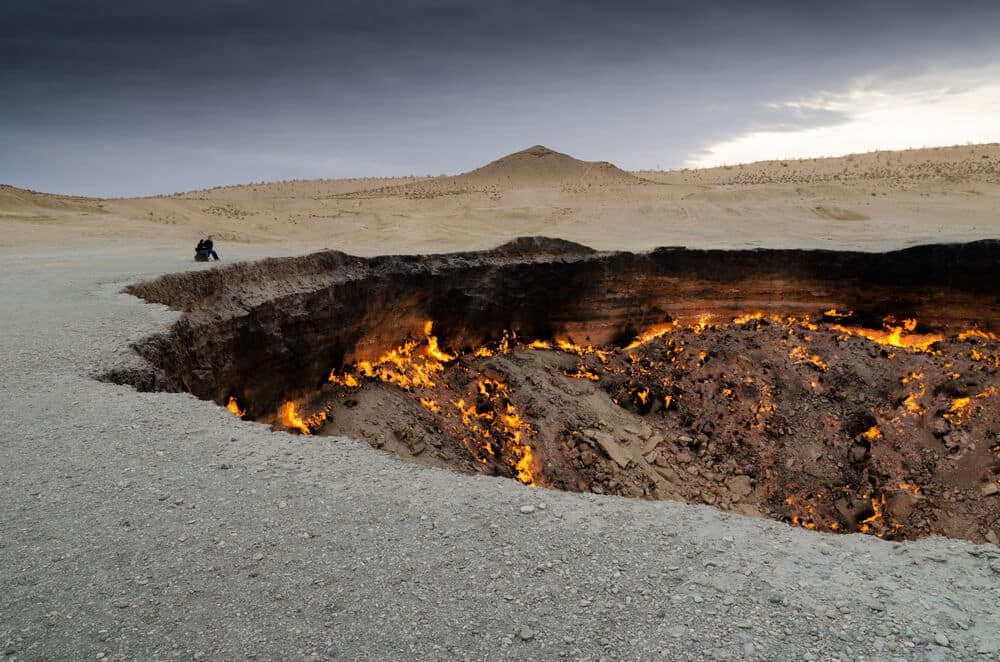
The Darvaza Gas Crater (Gate to Hell), located in Turkmenistan's Karakum Desert, formed in 1971 after a natural gas drilling accident and has been burning ever since.
The Door to Hell is not a natural volcano or geothermal phenomenon, but the result of a drilling accident in 1971. Soviet geologists were exploring for natural gas in this desert at the time, but the underground gas layer unexpectedly collapsed, forming a massive crater on the surface. The engineering team, worried that leaking methane gas would endanger nearby residents and animals, decided to set it alight—expecting the fire to burn out within a few weeks. Instead, it has continued burning for over 50 years and counting.
Today, the crater of the Door to Hell measures roughly 60–70 metres in diameter and about 30 metres deep, with surrounding temperatures reaching over 40–50°C. Flames continue to burst out from dozens of fissures within the pit. By day it resembles nothing more than a giant sandy hollow, but at night the intertwining flames and heat create a breathtaking spectacle, making it a dream destination for photographers and adventurers.However, recent observations suggest that the brightness and intensity of the flames have gradually diminished. Some describe it this way: "The Door to Hell today is no longer as ferocious, but it remains magnificent."
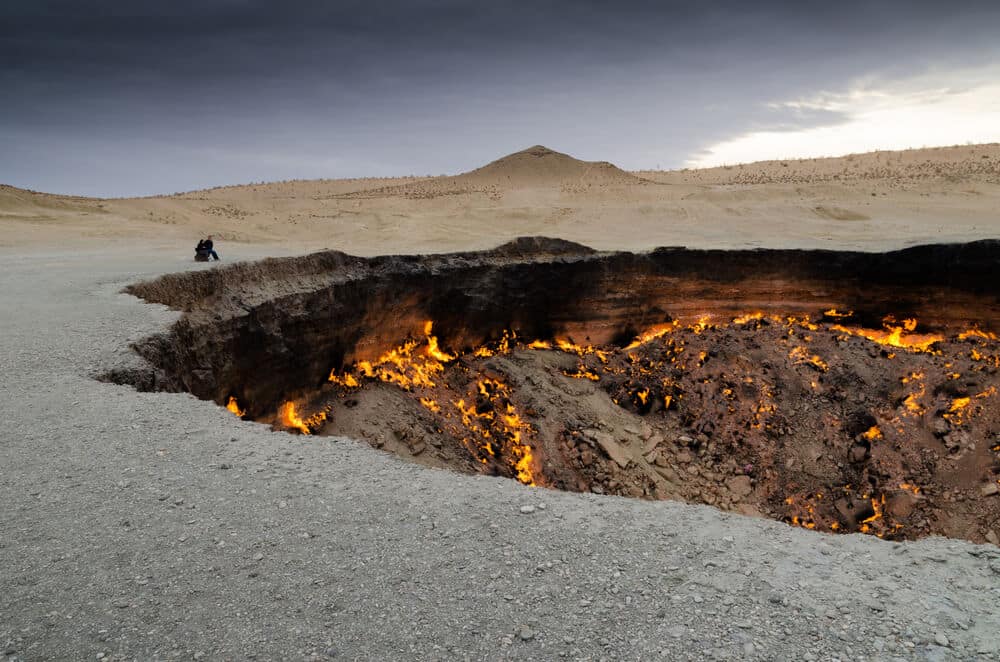
By daylight, the Door to Hell loses the mysterious glow of night, but reveals a clear view of the crater's structure and burning fissures.
In the deserts of Central Asia, where the horizon stretches endlessly and the wind hums low, a flame that never goes out blazes fiercely amid this silent golden wilderness. The Door to Hell is celebrated as one of the world's great wonders not only for its spectacular appearance, but for the awe-inspiring experience of "conversing with nature in an extreme environment."
This fire pit has been burning for more than 50 years since it was first ignited in 1971. At night, its glow can be seen for kilometres, with flames surging from the depths of the crater to form endless waves of orange-red fire, while the air carries a faint scent of gas. Many photographers call it "the loneliest flame in the world," for it has burned quietly, without pause, in this uninhabited desert for half a century.

The Door to Hell under the night sky, like a sea of fire floating in the darkness, with distant human figures appearing small yet striking. Photo by Ybrayym Esenov on Unsplash
If you choose to camp near the crater, you'll find the nights here extraordinarily silent. Looking up, a sky full of stars is clearly visible, with the flames and the Milky Way intertwined — as if standing at the crossroads of hell and the cosmos. The temperature swings are extreme — the night air is cold and dry, yet waves of heat continuously rise from the crater. As the cold wind and hot air collide, the entire dune seems to hum with a faint tremor — a surreal sensation that evokes both fear and awe at once.
The Door to Hell has also become a subject of study for scientists and adventurers. In 2013, Canadian explorer George Kourounis descended into the crater to collect soil and gas samples, researching microbial life in extreme environments. He described the experience as "like stepping into the Earth's breathing vent." This expedition not only revealed the scientific value of the fire pit but also turned the Door to Hell into "a symbol of the tension between humanity and nature's coexistence" — an accident born from the attempt to control nature that ultimately became one of the most magnificent sights on Earth.
The Gates of Hell have been burning since 1971 — more than half a century now. Yet in recent years, more and more reports suggest that this flame may not burn forever: the Turkmen government is actively studying how to seal off this so-called "pit that leads to hell." The government has already ordered research into closure plans In 2022, then-President Gurbanguly Berdimuhamedow stated at a national energy conference that authorities would "find a way to safely extinguish the flames of the Gates of Hell," citing the crater's waste of natural gas and methane leakage, which pose potential risks to both the environment and public welfare.According toThe Guardian's report, this directive was handed to Turkmenistan's energy authorities, who have since launched a feasibility study. Flame intensity noticeably reduced in 2025 According tothe latest 2025 report from Discover Wildlife (a UK nature magazine), the brightness and extent of the on-site flames have visibly diminished. Some tour operators note that the glow "no longer looks as dazzling from a distance as it did a decade ago." The report notes that Turkmen energy companies have drilled gas recovery wells around the crater, aiming to intercept some of the escaping methane and reduce the fuel supply — this is also considered one of the reasons behind the flame's gradual weakening. Will the Gates of Hell really be closed?Still Undetermined Although officials have repeatedly stated their intention to "put out the fire," as of now (the second half of 2025), no official closure date or engineering announcement has been made. According to《National Geographic》's analysis, the Turkmen government has proposed similar plans several times in the past, but none have ultimately been implemented, mainly because the gas layer structure at the site is highly complex, making it extremely difficult to seal.Guides and photographers still observe flames burning at the crater mouth throughout the night, though the scale is now about one-third of what it was a decade ago—presenting a state of "still burning, but gradually fading." Traveler Tip — If You Want to See It, Go Now As the intensity of the flames declines year by year, and with officials repeatedly hinting at possible closure, many travelers have listed the Gate of Hell as a "must-see before it's too late" destination. Some tour operators have even used "Before It's Gone" as their promotional theme, reminding travelers that now is truly the last chance to witness this historic flame with their own eyes.
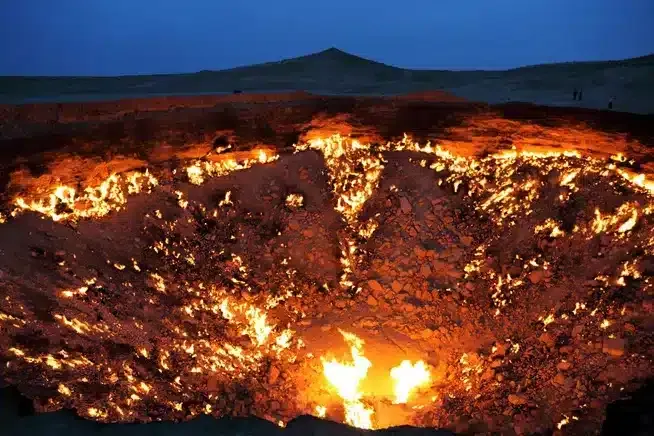
No one knows how much longer it will keep burning—witness this most spectacular desert wonder on Earth while the flames still last. Photo Credit : Discover Wild Life by Daniel Graham
Compared to other Central Asia attractions, getting to the Door to Hell isn't exactly easy, but standing beside the fiery pit and feeling that wave of heat firsthand is absolutely worth the long journey.
Most travellers set off from Ashgabat, the capital of Turkmenistan, with the Door to Hell located roughly 260 kilometres away, a drive of around 4 to 5 hours.The route runs along a straight desert highway, with the final 7–10 kilometres being soft sand impassable to regular cars, requiring a switch to a 4-wheel drive (4WD) vehicle to reach the site. Choosing Your Transport to the Door to Hell
Method | Features | Best For |
🚙 Private Charter/4WD Vehicle | Highly flexible with free stops for photos; drivers are familiar with desert conditions | Small groups/photography enthusiasts |
🚌 Local Tour/Guided Trip | Includes transport, meals and camping gear, saving time and effort | First-time visitors/independent travel beginners |
🚗 Self-Drive (Not Recommended) | Requires a Turkmenistan driving licence and travel permits;Difficult road conditions | Only recommended for drivers experienced with Central Asia self-drive |
💡 Quick Tip:Mobile signal is extremely weak in the desert area, so please arrange transfers and fuel supply in advance.
Some itineraries arrange an overnight camp near the crater, where you can choose to stay in aYurt or tent. Falling asleep by the firelight at night and watching the dunes turn golden at dawn is one of the trip's most popular highlights.For more comfort, you can also stay in a nearby town (Darvaza or Erbent) and head to the crater the next morning to see it glowing in the early light.
- Best Season: March–May, September–Novemberannually (cool climate, moderate sunshine)
- Summer (June–August): Daytime temperatures reach up to 40°C, so it's best to avoid this period
- Winter (December–February): Nights are extremely cold but visibility is excellent, ideal for photography
To capture the most spectacular scene of flames intertwined with the dunes, it's recommended toarrive at the crater in the early evening, as the flames become even more striking against the darkening sky as night falls. 👉 Further Reading:Central Asia Climate & Recommended Attire
There is currently no formal ticketing system for the Gates of Hell, but some areas fall under government control, so it's recommended to join a tour through a licensed travel agency. Travelers holding Hong Kong, Macau, or Taiwan passports all require a visa to enter Turkmenistan. Travel agencies can arrange e-visas or invitation letters on your behalf, with the process taking approximately 2–4 weeks. 💡 Quick Tip: Turkmenistan's entry procedures are fairly strict, so it's advisable to plan ahead and confirm flight connections in advance. 👉 Further Reading:Complete Guide to Central Asia Visas & Entry
Before setting off to witness this half-century-long burning flame in person, you may have some of these questions Q1: What is the Gates of Hell? The Gates of Hell (Darvaza Gas Crater) is a natural gas crater located in the Karakum Desert of Turkmenistan. Ignited in 1971 following a drilling accident, it has continued burning to this day, making it one of the world's rare man-made accidents turned natural wonders. Q2: Is the flame of the Gates of Hell still burning? Yes, it's still burning, but noticeably dimmer than a decade ago. According toDiscover Wildlife (2025), the flames have shrunk by about a third, and while still clearly visible at night, they now cover a smaller area. Q3: Is it safe near the Gates of Hell? There's no official ban on approaching the crater to view it, but it's not advisable to get too close to the edge. The ground around the rim is loose and gas concentrations are high, so visitors should stay within the designated safe viewing area. It's recommended to be accompanied by a driver or guide familiar with the terrain. Q4: Can you camp beside the crater? Yes. There are legal yurts and camping areas around the crater, the most popular accommodation choice for travellers, allowing you to watch the flames and stargaze at night. Q5: How do you get to the Gates of Hell from Ashgabat? It's about 260 km from the capital, Ashgabat, roughly a 4–5 hour drive. You can arrange a private car or join a group tour, with the final stretch across sand requiring a 4x4. There are no petrol stations or mobile signal along the way, so it's best to let a travel agency arrange the trip. Q6: Do you need a ticket or visa? There is currently no admission fee for the Gates of Hell, but a visa is required to enter Turkmenistan. Hong Kong, Macau, and Taiwan passport holders must apply in advance, usually through a travel agency for an e-visa (which typically takes about 2–4 weeks). 👉 Further Reading:The Complete Guide to Central Asia Visas & Entry Q7: What's the best month to visit? The best travel seasons are March–May and September–November, when spring and autumn bring cool weather and the clearest desert views. Summers are scorching and winter nights are freezing, so it's best to avoid these extreme seasons. 👉 Further Reading:Central Asia Climate & Best Time to Visit Q8: How many days should I plan for? We recommend 2 days and 1 night as the basic itinerary, including departure from Ashgabat, desert off-roading, camping, and the return journey. If you'd like to extend your trip to other Central Asia highlights, this can be paired with a 4–5 day themed itinerary. 👉 Further Reading:Must-Visit Attractions in Turkmenistan
If you want to witness with your own eyes this flame that has been burning in the desert for half a century, while also exploring the magnificent landscapes and cultural heritage of the five Central Asian countries in depth, DeWonder Travel's Central Asia In-Depth Tour is your safest and most complete choice. Itinerary Highlights: Live Experience of the Door to Hell
- Private Transfers:Depart from the capital Ashgabat and travel by 4x4 vehicles into the Karakum Desert.
- Professional Guiding & Safety Escort:Expert tour leaders advise on the best photography times and safe viewing areas.
- Desert Culture Exploration:Experience nomadic life and learn about natural gas heritage and geological stories.
DeWonder Travel focuses on small-group, in-depth tours, letting you explore this mysterious land in the most comfortable way:
- Years of Central Asia Experience: Our team has traveled across all five countries, from deserts to lakes, designing itineraries that best suit travelers' needs.
- Flexible Itinerary Design: Choose three, four, or five countries, freely combined according to your time and preferences.
- Must-Visit Classics: Take you to lesser-known wonders like the "Door to Hell," for breathtaking sights.
- In-Depth Exchange: Beyond sightseeing, enjoy family visits, pottery workshops, and local cultural interactions.
- Small Group Departures: Each group has 8–14 people (no more than 18), for a more relaxed atmosphere and deeper experience.
- Travel Community: Travel together like a group of friends exploring the world, creating unique memories.
Book Your Central Asia In-Depth Tour Now Ready to explore the Door to Hell and embark on a Silk Road journey? We offer Central Asia itineraries of various durations,all including the classic Turkmenistan and Door to Hell experience, designed to give you a comfortable and surprise-filled journey.
- Two-Country Tour|9 Days 8 Nights👉View Two-Country Tour Detailed Itinerary An entry-level itinerary taking you toTurkmenistan and Uzbekistan, the best choice for a first taste of Central Asia.
- Three-Country Tour|12 Days 11 Nights 👉 View Three-Country Tour Detailed Itinerary Focused onTurkmenistan, Uzbekistan and Tajikistan, ideal for travelers with limited time who still want an in-depth experience.
- Four-Country Tour|15 Days 14 Nights👉 View Four-Country Tour Detailed Itinerary FeaturingTurkmenistan, Uzbekistan, Tajikistan and Kazakhstan, balancing ancient cities and nature at a more relaxed pace.
- Five-Country Tour|19 Days 18 Nights 👉 View Five-Country Tour Detailed Itinerary A complete journey throughTurkmenistan, Uzbekistan, Tajikistan, Kyrgyzstan and Kazakhstan.
👉 View Central Asia In-Depth Tour Departure Dates for the Whole Year 👉 Join Our Free Online Seminarto answer your questions about Central Asia itineraries 👉 Click Here to Register DeWonder Central Asia In-Depth Tour Information Pack 👉 Click Here to Download